![MaritimeJournal[Seawork]](https://www.maritimejournal.com/wp-content/uploads/2026/09/MaritimeJournalSeawork.svg)

Upping the ante in subsea cable protection
Jan De Nul is building a brand new state-of-the-art rock installation vessel designed to safeguard vital subsea and offshore energy infrastructure.
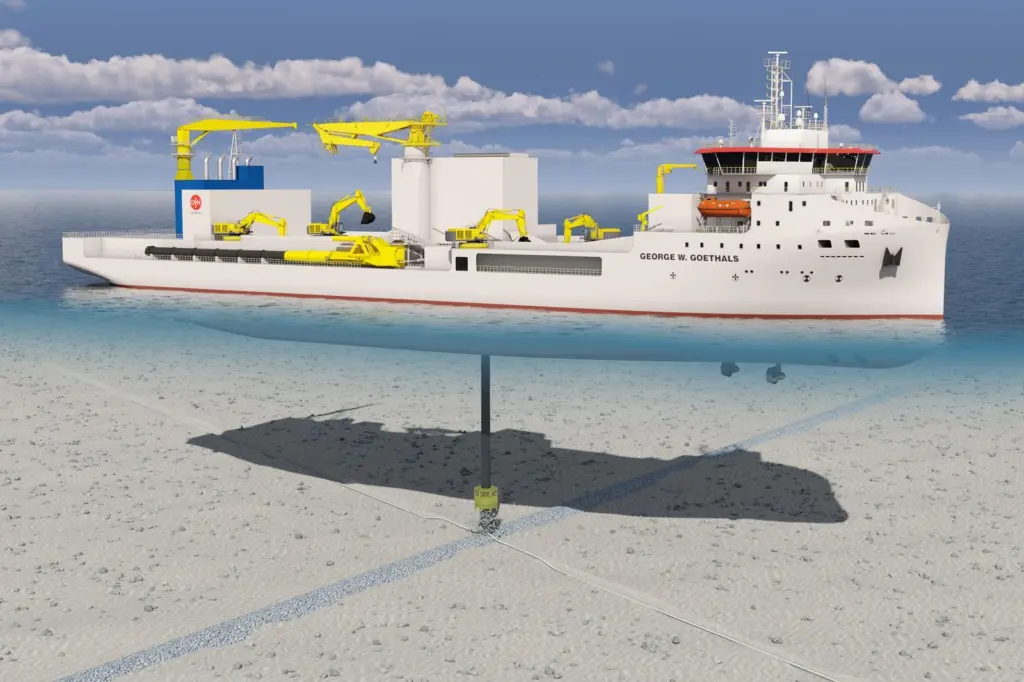
When completed, George W. Goethals will carry out a vital role ensuring that thousands of kilometres of subsea cables transporting electricity, linking offshore windfarms and carrying global data traffic are protected against damage and sabotage.
“A cutting-edge vessel like this represents a major investment and a carefully considered decision. As world builders, we are fully committed to create a reliable energy system worldwide,” said Philippe Hutse, director offshore energy at Jan De Nul.
“Protecting the infrastructure that supports offshore energy production and transmission is essential to achieve this goal. With this new vessel, we are shifting into a higher gear to meet that challenge head-on.”
Critical protection
The George W. Goethals will focus on projects in the North Sea and Southeast Asia, with a capacity of 37,000 tonnes and technology to install large rocks at depths of up to 400 metres.
Designed entirely inhouse as an Ultra-Low Emission vessel (ULEv), its highly advanced dual exhaust filter system removes up to 99% of nanoparticles from emissions using a diesel particulate filter and a reduction system for nitrogen oxides (NOx).
With this technology, the vessel complies with the strict European Stage V emission standards for inland waterway vessels. It also meets the stricter EURO VI emission limits for NOx.
Its engines can run on biofuel and green methanol and the hybrid power plant on board combines the generators with a battery and drive technology, designed for peak shaving, load smoothening, spinning reserve and optimised engine loading.
In addition, the vessel will be equipped with four electric excavators. Among other applications, they will be used for loading large rocks, enabling efficient operations without the need for a dedicated conveyor belt or crane on shore.
George W. Goethals will be the third rock installation vessel above 30,000 tonnes in the fleet of Jan De Nul, which is also developing two cable-laying vessels to interconnect global energy grids to improve energy reliability.
The Fleeming Jenkin and the William Thomson will each have a cable-carrying capacity of 28,000 tonnes. They are designed to install cables over longer distances with fewer subsea connections, making them ideal for interconnector cables that link energy grids across the globe.
Related Articles
 INDUSTRY NEWS
 MARINE CIVILS
 MARINE CIVILS