![MaritimeJournal[Seawork]](https://www.maritimejournal.com/wp-content/uploads/2026/09/MaritimeJournalSeawork.svg)





Almarin’s latest launch
Spanish navaids specialist, Almarin, is launching its latest model of buoy, the GUIA W at the XVIII IALA Conference. It will offer improved daytime visibility, increased safety for the technician working on board, and will provide both a longer service life and lower maintenance.
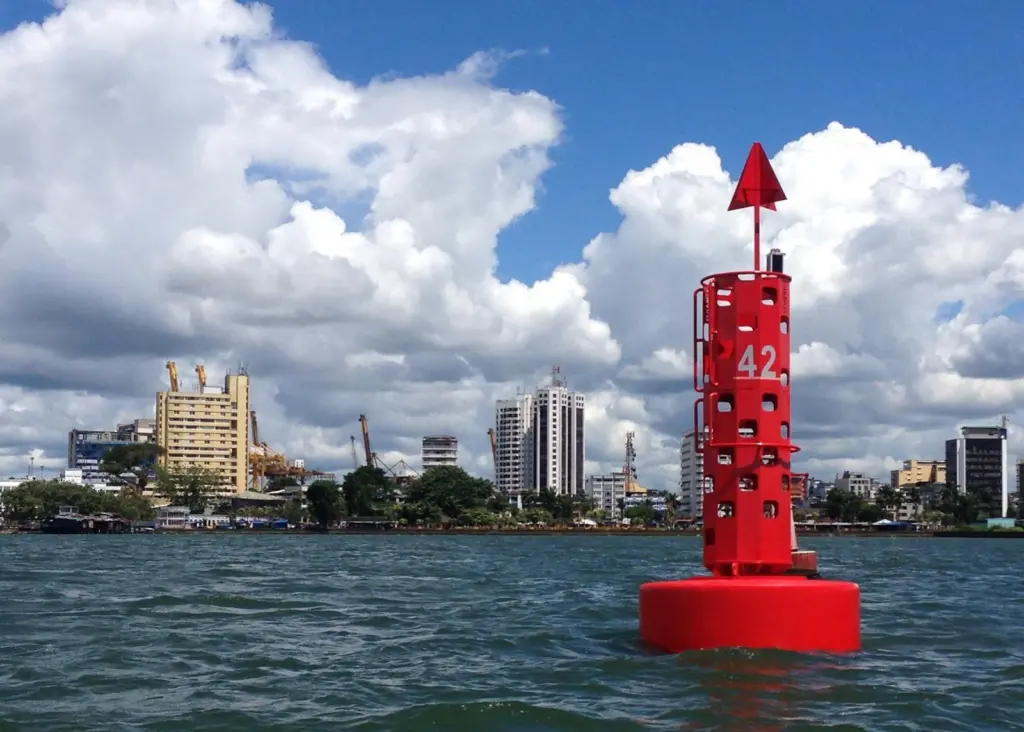
The IALA conference is held every four years and this year will take place from 25 to 31 May in La Coruña, Spain following on from the previous event in Cape Town. Alongside the conference, an exhibition is held allowing IALA industrial members to showcase their latest product lines. La Coruña represents an inspired choice to host this buoyage based bonanza, as the Gallician city’s most famous landmark is often considered to be its Tower of Hercules. This Roman built aid to navigation dominates the harbour and remains one of the oldest lighthouses still in operation.
Almarin will also participate in parallel events such as the first meeting for Aids to Navigation (AtoN) Technicians from Spanish speaking countries, an initiative promoted by Puertos del
Estado. In this first year, the event focuses on ‘Innovation in technology and managerialsystems for the twenty-first century’, specifically in the AtoN segment.
We also hear that Almarin has carried out the design, manufacture and supply of two beacons for the access channel to Manzanillo Bay in the province of Colon (Panamá). Spanish contractor Delta 9 awarded this project to Almarin, which involved the design and supply of 16m focal plane ALT7 model towers, with corresponding lights, AIS systems and photovoltaic energy systems.
These towers have been built to mark the entrance to the port of Manzanillo under the request of the Panamá Maritime Authority (APM). Delta 9 removed the old towers with the subsequent conditioning of concrete bases and installed the new towers provided by Almarin. Delta 9 is a company specialized in concrete infrastructures with strong presence in Panamá.
Almarin assisted in the testing and starting up the equipment, which is currently operating. Due to the size of the product and the difficult access to the outer moles, the towers were manufactured in modules of 600kg for easy transport and installation. Designed according to Eurocode 1 & 3 and to meet IALA recommendations, the towers were manufactured from hot dip galvanised S275JR structural steel. An internal ladder with lifeline provides access to the upper 2x2m rectangular platform, equipped with GRP grating floor, where all the equipment is installed.
By Jake Frith
Related Articles
 VESSELS
 MARINE CONSTRUCTION
 VESSELS