![MaritimeJournal[Seawork]](https://www.maritimejournal.com/wp-content/uploads/2026/09/MaritimeJournalSeawork.svg)






Over 100 species found living on small part of 2,200-year-old shipwreck
Italian researchers have found a community of 114 species of invertebrates on a priceless underwater archeological artifact.
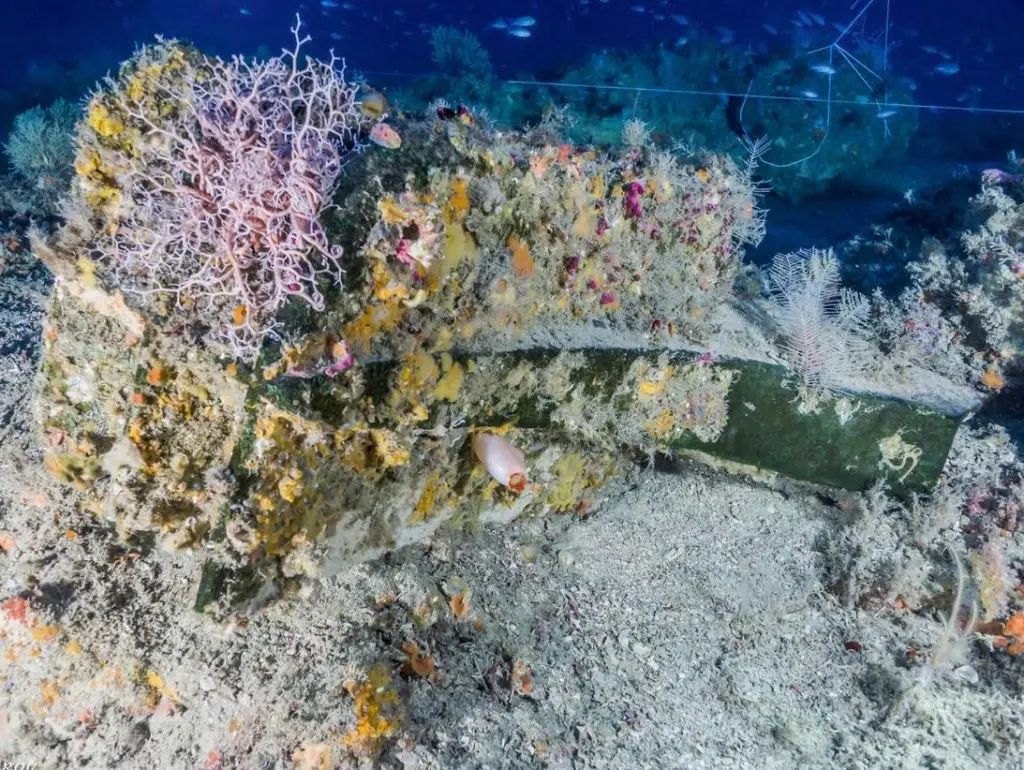
On March 10, 241 BCE, a sea battle took place near the Aegadian Islands off northwestern Sicily. A fleet equipped by the Roman Republic destroyed a fleet from Carthage, ending the First Punic War in Rome’s favour. But scientists have now shown that this destruction and carnage utimately made a rich flowering of marine life possible.
In a recent study in Frontiers in Marine Science, they reported finding no fewer than 114 species of animals, coexisting in a complex community, on a ship’s ram from a Carthaginian ship sunk in the battle.
FIRST STUDY
This is the first study of marine life on a very ancient wreck. The ram is not only a priceless archeological find, but also a unique window into the processes by which marine animals colonize empty sites and gradually form mature, stable, diverse communities.
“Shipwrecks are often studied to follow colonization by marine organisms, but few studies have focused on ships that sank more than a century ago”, said Dr Sandra Ricci, a senior researcher at Rome’s Istituto Centrale per il Restauro (ICR).
Here we have studied for the first time colonization of a wreck over a period of more than 2,000 years. We show that the ram has ended up hosting a community very similar to the surrounding habitat, due to ‘ecological connectivity’ – free movement by species – between it and the surroundings.”
The ram, nicknamed ‘Egadi 13’, was recovered in 2017 from the seabed around 90 metres deep by marine archeologists from the Soprintendenza del Mare della Regione Sicilia, directed by Dr Sebastiano Tusa, in collaboration with divers from the organization Global Underwater Explorers.
It consists of a single, hollow piece of bronze, engraved with an undeciphered Punic inscription, and is around 90cm long, 5cm thick at the front edge, and has a weight of 170kg. Because the ram is hollow, it has accumulated organisms and sediments inside as well as outside.
The scientists’ aimed to compare species associated with the ram with those found in natural Mediterranean habitats, and so reconstruct how it had been colonized – mostly by dispersing larvae – from these habitats. Another focus was to understand the mechanisms by which species already established at the ram can allow other species to thrive.
SPECIES RICH
Ricci and colleagues found a species-rich community, structurally and spatially complex, with 114 living invertebrate species. These included 33 species of gastropods, 25 species of bivalves, 33 species of polychaete worms, and 23 species of bryozoans. This species assemblage was statistically most similar to those found in shallow-water detritus beds and seagrass meadows, and on well-lit rocky seabeds and ‘coralligenous’ reefs, which are built on hard substrates in dim light by algae with calcareous skeletons.
“We deduce that the primary ‘constructors’ in this community are organisms such as polychaetes, bryozoans, and a few species of bivalves. Their tubes, valves, and colonies attach themselves directly to the wreck’s surface,” said coauthor Dr Edoardo Casoli from Rome’s Sapienza University.
“Other species, especially bryozoans, act as ‘binders’: their colonies form bridges between the calcareous structures produced by the constructors. Then there are ‘dwellers’, which aren’t attached but move freely between cavities in the superstructure. What we don’t yet know exactly is the order in which these organisms colonize wrecks.”
Read “First report on the benthic invertebrate community associated with a bronze naval ram from the First Punic War: a proxy of marine biodiversity” in Frontiers Marine Science: https://www.frontiersin.org/articles/10.3389/fmars.2021.772499/full
Related Articles
 INSURANCE, LEGAL & FINANCE
 SUBSEA SERVICES
 ENVIRONMENT