![MaritimeJournal[Seawork]](https://www.maritimejournal.com/wp-content/uploads/2026/09/MaritimeJournalSeawork.svg)


Activity gathers pace at London Array
To mark Global Wind Day, London Array recently gave an update on progress at their windfarm in the Thames estuary.
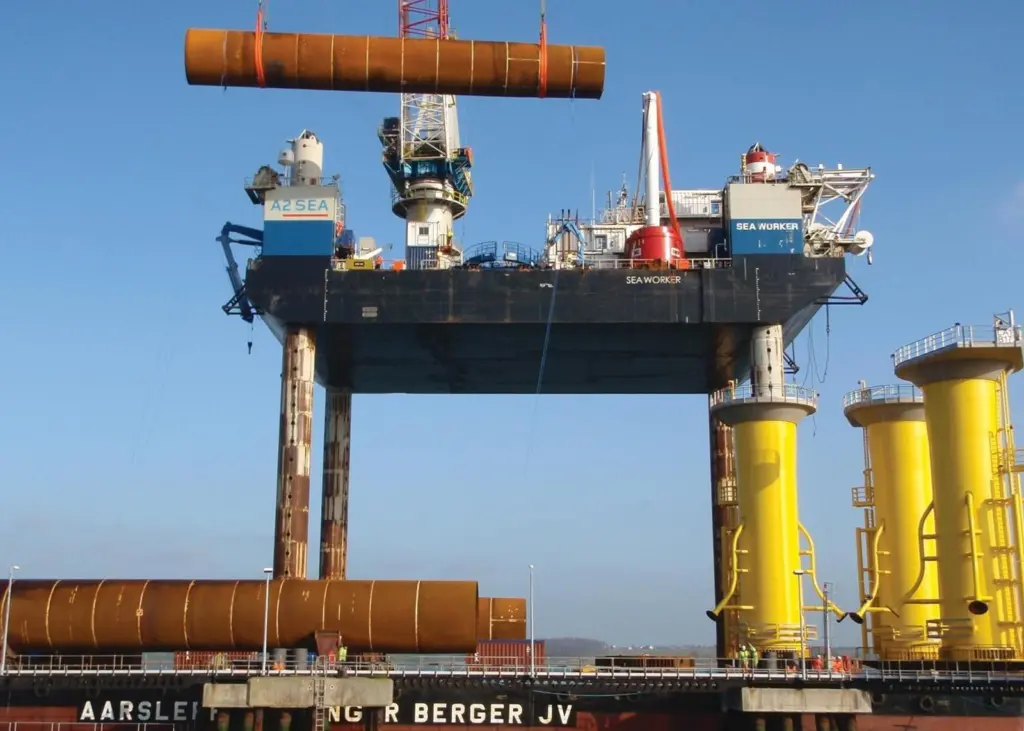
This providided the opportunity to look beyond just the figures, and review the project in more detail, particularly the increasing number of vessels gathering to support construction of what will eventually become the latest holder of the title, world’s largest offshore wind farm.
Phase one of London Array, a joint venture between DONG Energy (50%), E.ON (30%) and Abu Dhabi based Masdar (20%), comprises 175 3.6MW Siemens turbines, three substations, two offshore and one onshore and associated subsea cabling. The project experienced delays early on due to changes with the various partners, and an indication of the timescale of such ventures is that while environmental studies date back to 2001, work on the onshore substation did not commence until July 2009, construction offshore starting in March 2011. The target of 2012 for completion demonstrates the intensity and coordination of activity necessary for projects of this scale to reach fruition.
Contracts totalling over €2bn were awarded in 2009 for core components to: Siemens Wind Power – turbine construction, Per Aarsleff A/S and Bilfinger Berger GmbH (ABJV) – foundation and turbine construction and installation, Future Energy (Fabricom, Lemants and GeoSea) – offshore substation construction, Siemens Transmission and Distribution Ltd – onshore and offshore substation electrical system installation, Nexans Norway AS – export cable production, JDR Cable Systems Ltd – inter-array cable production, Visser & Smit Contracting and Global Marine Systems (VSGM) – cable installation, MPI Offshore and A2SEA – installation vessels.
The development of London Array involves concurrent work on foundation, transition piece (TP) and turbine installation, inter-array and export cable installation together with onshore and offshore substation construction, all involving intensive activities within the supply chain and vessel mobilisation and coordination.
The principle components are manufactured in mainland Europe and three UK ports are now the main players in the construction and operation phases of London Array. Harwich is well established in the offshore wind farm industry, recently hosting vessels for Thanet and Greater Gabbard wind farms, and is now the main load-out port for London Array. Sheerness recently made the news, with Vestas selecting the Kent port as proposed manufacturing site for their 7MW next generation offshore wind turbines and is to be the base for the cable-laying vessels. Ramsgate previously hosted A2SEA’s Sea Jack for foundation installation at Thanet offshore wind farm, and is active as a base for the multitude of smaller support craft involved in the industry. The port has been selected as the long term operations and maintenance base for both Thanet and London Array, with a purpose built building for London Array due to open later this year, along with additional pontoon facilities.
Two companies selected by ABJV for turbine installation are A2SEA and MPI Offshore. A significant variation of water depth at London Array, with some areas 20cm above sea level at LW increasing to almost 30m depth, has resulted in deployment of different types of vessels.
Advantage is being taken of the shallow draft of A2SEA’s jack-up Sea Worker to install 54 of the 175 foundations in water depths of 5m or less (the monopile foundations are up to 60m long and weigh around 600 tons each). Detailed analysis of the substrata at the location was undertaken to assess the effects, including scour, on the legs of the jack-up. Where required, water is injected into the seabed below Sea Worker’s legs, liquefying the sand allowing for penetration to a safe depth of over five metres.
MPI’s installation vessel MPI Adventure has now made its debut at London Array. Described as ‘future proofed’ for next generation larger turbines, MPI Adventure is bringing a new dimension to turbine installation with its large carrying capacity and, being self-propelled, delivering reduced sailing times between load-out port and site together with increased independence berthing and sailing. MPI Adventure has commenced installing around 120 of the heavier foundations at deepwater locations. Both vessels are expected to install the actual turbines at their respective foundation/TP sites.
It is also reported that Ballast Nedam’s heavy lift vessel heavy lift vessel Svanen will be used for installation work. At the time of writing, 31 monopiles and TPs have been installed by Sea Worker.
Towage and anchor handing services for the Sea Worker are provided by two Damen Shoalbusters, the ‘3009’ Sea Alfa, along with the ‘2308’ Sea Echo, both from Seacontractors BV. Additional assistance in Harwich is provided by the local tugs Gray Vixen, Gray Test and Gray Salvor from Felixarc Marine, along with vessels from Svitzer Marine, including their tug Svitzer Trimley.
The monopile foundations for the two offshore substations were installed by the Sea Worker late in May. The substation TPs, transferred from Harwich, were installed by the seagoing sheerlegs Matador 3 assisted by the tug Jan Leenheer, both from Rotterdam based Bonn & Mees BV.
In July, the barge H-331, towed by the tug En Avant 1 (Muller- Dordrecht) transported the two substation topsides, each weighing 1,260 tons to the site. They were installed by the heavylift vessel Rambiz (Scaldis Salvage & Marine), an operation also involving the tugs Fairplay-31 and Holyhead Towing’s Afon Caradog. The support vessel Towyn Bay (Turbine Transfers Ltd) provided additional support for the substation installation element of London Array.
In line with the coordinated progress of individual elements of London Array, VSGM are due to commence the extensive programme of inter-array and export cable-laying work imminently. Preparation work, including cable pre-lay grapnel runs are being conducted close to the export cable shore landing site at Cleve Hill near Graveney on the north Kent coast by the MCS Elly, a Dredgehelper 2510 from Maritime Craft Services (Clyde) Ltd, operating out of Whitstable. MCS’s contribution also includes the multicat MCS Ailsa operating from Sheerness. Further offshore, grapnel runs are underway with Marine Projects Rotterdam’s Eurocarrier 2209 workboat MPR 4, operating from Ramsgate. Sister vessel MPR 2 is providing anchor handling duties for the Stemat Spirit (see below)
Vessels due to carry out cable-laying work for VSGM include CS Sovereign and Cable Innovator (Global Marine) for deepwater array cables, AMT Explorer (Global Marine) and Jan Steen (Van Oord) for shallow water inter-array cables and Stemat Spirit (Stemat Marine Services) for the export cable.
Williams Shipping Marine Ltd are working at the export cable shore landing in the Swale estuary with Wiltango, Wilcarry 300 and Wilcarry 432. Various other small craft have previously carried out work at Cleve Hill, including vessels from GPS Marine, Red7Marine, AJ & A Pratt, Predator Charters, Mike’s Boatyard, Challis & Sons and Canterbury City Council.
An increasing number of small support craft are now operating for various contractors, mainly out of Harwich and Ramsgate. From the Gardline Group, working for London Array, Meriel D, a regular visitor to Ramsgate, has recently been joined by Marianarray, one of Gardline’s new Alicat wind farm support vessels (showcased at Seawork 2011). A competition is being held locally to name the second Gardline Alicat, scheduled to join the Marianarray at Ramsgate later this year. Also contracted to London Array, operating from Ramsgate, is the 19m South Boats built, Conwy Bay from Turbine Transfers, which also has a second vessel due later in 2011. Noise monitoring duties are being provided by the 10.9m launch Neptune, while the 25m multi-task vessel Ocean Dragon (Ocean Marine Services) has provided various services including guard duties along with the Mary Ann 1 (RSS Marine). Safety Boat Services is currently providing marine mammal observation duties from its 10.8m support boat Kirkspray. Another South Boats vessel, MPI Offshore’s MPI Rucio is working for ABJV out of Harwich.
Preparations are underway for the cable-laying work. Support vessels expected to be involved for VSGM include Rhoscolyn Head (Turbine Transfers), Svend T (Dansk Offshore Transport ApS), Atlantic Surveyor (ex VOS Baltic), OMS Pollux (Hughes Sub Surface Engineering/Offshore Marine Services), MCS Maestro (Maritime Craft Services) and Santa Ana (P&O Maritime Services).
Southampton based Emu Ltd has been involved with London Array from an early stage, having carried out a number of pre-construction and subsequent surveys. Currently its 11m survey vessel Nab Cat 2 is operating at the site out of Ramsgate. As actual turbine installation progresses, leading to the commissioning phase, so the number of technicians involved increases proportionally and the use of floating hotels is now a regular feature as accommodation solutions. The Netherlands based C-bed BV’s hotel ship Wind Ambition is currently listed for operations at London Array.
The above list is not exhaustive and inevitably not set in stone, but a snapshot of the situation at one moment in time, the actual vessel allocation situation being a fluid one. To date over 70 craft of various type and size have been noted as being involved in the various stages of London Array’s development. Given that construction is still at a relatively early stage, it does however provide a picture of the broad range of requirements and consequent opportunities that offshore wind farms bring to the marine industry in general, it is not only about constructing turbines.
By Peter Barker
Related Articles
 OTHER NEWS
 FEATURES & VIDEOS
 MARINE CIVILS