![MaritimeJournal[Seawork]](https://www.maritimejournal.com/wp-content/uploads/2026/09/MaritimeJournalSeawork.svg)




Challenging times for windfarm support
“You have to decide what’s the right course of action, the right boats to be built with an eye to the future and stick with it, says Leslie Robertson, general manager of MPI Workboats.
“Even if it gets tough, you can’t spend too much time second guessing yourself.”
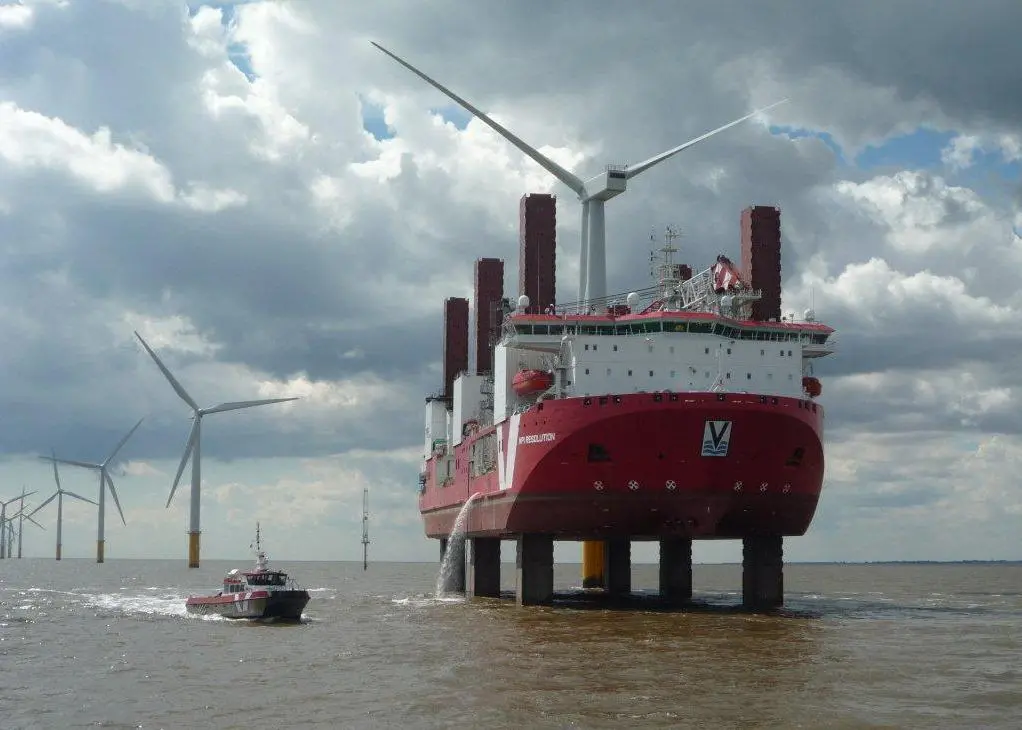
She is talking from the heart, as MPI has four new boats coming into service at the end of the year. Despite the immediate overcapacity in the market, she has faith in the designs.
It has been a careful, evolutionary process, as she explains: “For a long time we only put two new boats in the water every year. Last year, it was the MPI Cervantes and MPI Cardenio, both 17.5m alloy catamarans with a 6.4m beam but a very tight, 1m draft allowing them to maximise their capacity for shallow water work while being fairly independent of tide.”
Looking at ongoing success, MPI decided to get ahead of the curve, and ordered four more vessels to bring the fleet up to 12. These are first of class, identical 19m alloy catamarans that would have a fast sprint performance and breadth to allow for the new, deeper water windfarm’s pull toward greater cargo capacity while still being efficient with fuel. Twin 1,200 hp MAN V12 main engines coupled to Rolls-Royce FF600 water jets were decided upon, as this layout gave a reasonable manoeuvring efficiency at lower speeds but still allows the craft to reach 25 knots if required.
Despite the caution, it hasn’t been an easy delivery. First the boats were entangled in the former South Boat’s financial woes, and then the reality of a tightening market caught everybody by surprise as the new round of deeper water windfarms didn’t come onstream quite when expected.
This, says Raymond Siliakus of Rotterdam based Europort is partly about finances. There is a step change as windfarms and components grow in size, plus the UK’s newer sites are now pushing further out into deeper water with a concomitant rise in expenditure.
Costs are a recognisable issue across Europe says Per Erik Dalen of Norway’s NCE. He points out that there’s a need to “bring down the budget while the sector is still being sheltered by governmental support”, adding that, for example, the EcoWinds project is looking at how to slice 50% off the bill.
However, Mr Dalen and Mr Siliakus agree that there is a lot to be said for being in a tightly knit ‘technology cluster’ and both point out that established relationships can help reduce windfarm related construction and maintenance costs as well as investment in new technologies.
“There are around 12,000 companies working closely together within 200km of Rotterdam, says Mr Siliakus, “which gives a huge advantage.” In turn, the UK has a very interesting core of advanced workboat technology know how, and is playing its part in the EcoWinds group along with south Denmark, northwest Germany and Norway’s Møre offshore cluster.
Mr Siliakus continues: “There are big challenges facing the European workboat industry as a whole; the vessels need to be faster, safer, cleaner and, last but not least, cheaper to run.”
These requirements have been at least partially pushed by the rising tide of EU legislation, but equally the reality of rising fuel prices has also had an impact on workboat design, with many owners, for example, starting to choose engines that don’t just have a good turn of speed, but can also keep operating economically at low loads.
Mr Siliakus adds that despite its huge effect on the workboat market, the wind energy sector is relatively new. “It’s in the nature of an evolving industry that people tend to look for the bright spots in the market, and this drives the technology forward, raising the competition.” This of course does mean initial purchase costs inevitably rise. “Maintaining market share is crucial, so workboats keep on pushing the boundaries.”
Despite the present climate, Ms Robertson at MPI says: “Though a little later than originally expected, these wind farm installations are definitely on the way”, adding that there will be a number of benefits to the current state of play. “Even though this is proving to be a white-knuckle year for some, it’s going to be good for the market, as it will weed out the cowboys.”
She adds that some smaller operators make it a little harder for the rest because “as they don’t have the commitments of the office staff or the backups, they can always come in with a lower price”. This can put a downward pressure on rates, even though she concludes that by and large you get what you pay for.
It is about both commitment and professionalism. Ms Robertson explains: “I believe that to get the best out of any new boat you have to get to know it, its strengths and its quirks. It helps that I have been there from the design of the boat on the drawing board right the way through to seeing it on the quay.”
She adds that there is also a need to match the new boat and crew carefully, and be willing to nurse the operation along in order to get the best out of it. “That means being prepared to get up at 3.00 in the morning to answer the telephone, or going down to a rainy quay to oversee a new gearbox being fitted. It’s simply not a nine-to-five job.”
She is hopeful about the future, and proud too, not just of MPI’s boats but of what the industry is doing: “Seeing the windfarms I get a real thrill. I feel like I am involved in a major project that will eventually grow, and change the environment we live in.”
By Stevie Knight
Related Articles
 OTHER NEWS
 FEATURES & VIDEOS
 MARINE CIVILS