![MaritimeJournal[Seawork]](https://www.maritimejournal.com/wp-content/uploads/2026/09/MaritimeJournalSeawork.svg)





Cost-cutting floating wind platform
A new floating wind platform aims to reduce the Levelized Cost Of Electricity (LCOE) for floating wind.
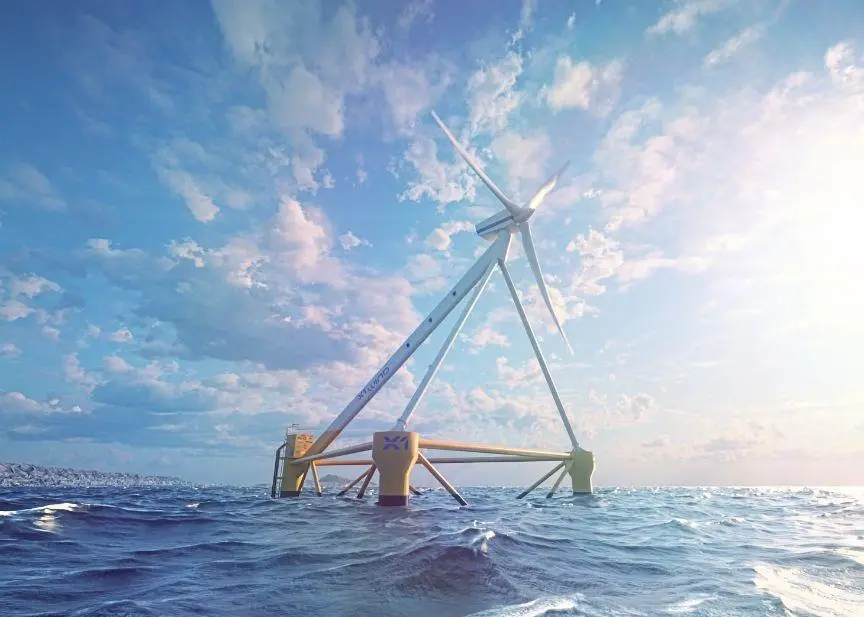
X1 Wind’s PivotBuoy floating wind platform X30 prototype is being prepared for deployment in the Canary Islands following the successful assembly and load-out of a fully functional prototype.
It has been developed through the €4m PivotBuoy Project awarded by the European Commission H2020 Programme. It will be installed at the PLOCAN test site in a bid to demonstrate the efficiency of the innovative structural design and mooring system.
X1 Wind CTO and co-founder, Carlos Casanovas, said: “Portside testing of all subsystems will be performed over the coming weeks, before PivotBuoy is installed in the PLOCAN test site and connected via a dynamic 20kV cable, later progressing to the commissioning phase – the timing of which will be determined by environmental conditions.”
Reducing the cost of electricity
The Pivotbuoy Project aims to substantially reduce the current LCOE of floating wind by demonstrating the advantages of the PivotBuoy system, namely a reduced floater weight, a faster and cheaper installation process and a more reliable operation.
Fitted with a Vestas V29 turbine, the 1:3 scale X30 will be stationed at a 50m water depth through a single point mooring system in a downwind configuration – creating a ‘weathervaning’ solution which maximises use of passive systems.
Mr Casanovas added: “Importantly, our floating wind technology offers a lighter design requiring less steel – which also reduces carbon emissions during fabrication – and requires a significantly smaller footprint on the ocean floor when compared to catenary systems. The scalability of our technology further enables us to transition easily up to 15MW mega-turbines operating at depths of 500m plus.”
The pan-European Pivotbuoy consortium includes EDP NEW, DNV, INTECSEA, ESM and DEGIMA and world-class research centres WavEC, PLOCAN and DTU.
By Rebecca Jeffrey

Related Articles
 OFFSHORE RENEWABLES
 OFFSHORE RENEWABLES
 ENVIRONMENT