![MaritimeJournal[Seawork]](https://www.maritimejournal.com/wp-content/uploads/2026/09/MaritimeJournalSeawork.svg)


First Spanish offshore turbine commissioned
The installation and connection of the first offshore wind turbine in Spanish waters has been completed with the prototype now being operational writes Dag Pike.
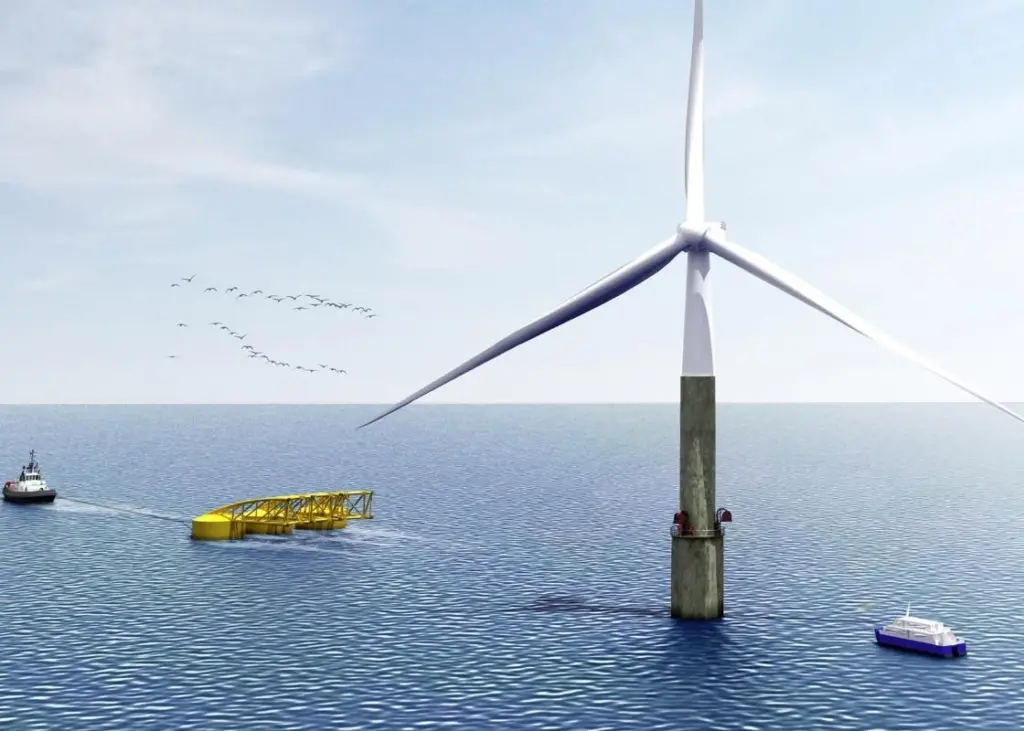
Situated in the waters offshore at the Plocan site on Gran Canaria, this turbine is a prototype of a unique self-elevating turbine pylon that has been developed with the hope of reducing the costs of offshore wind farm installations because it allows most of the assembly of the turbine’s structure to be completed onshore. This can considerably reduce the need to employ specialist installation vessels as the complete unit can be towed to site rather than erected on site.
The 5MW Elisa self-installing telescopic offshore wind turbine was developed under the EU-funded Elican project and it was first installed close to the shore on the east side of Gran Canaria located off the port of Taliarte. To increase the stability of the structure during the transportation and installation of the turbine, an auxiliary flotation system was attached to the unit after the prototype’s nacelle and blades were mounted on the telescopic tower.
The base of the tower is in the form of a ballast tank and this provides the floatation during the float out. The tower is a three section telescopic unit that once the unit is on location and ballasted down to the sea bed, can be erected to its operating height with the turbine blades and generator already in place.
Called the Elican project, it is being carried out by a consortium led by Esteyco, which also includes Siemens Gamesa, ALE Heavylift, DEWI GmbH, and Plocan. ALE Heavylift has been in charge of the engineering and performing the lifting operations for the telescopic tower and the auxiliary transport and installation platform, as well as the final offshore installation and ballasting operations.
The project has reached its goal of assembling the entire system, including the foundation, tower and wind turbine – and carrying out its pre-commissioning under controlled conditions at the Arinaga port, and then towing it to the site using conventional tugs. According to Esteyco, this reduces the risks associated with assembly work at sea and can cut installation costs by 30% to 40% compared to existing conventional solutions.

Related Articles
 OFFSHORE RENEWABLES
 OFFSHORE RENEWABLES
 ENVIRONMENT