![MaritimeJournal[Seawork]](https://www.maritimejournal.com/wp-content/uploads/2026/09/MaritimeJournalSeawork.svg)


Floating offshore wind success
Selecting the optimum floating foundation technology that will deliver the best levelised cost of energy (LCOE) for floating offshore wind projects depends on many factors, says the boss of an offshore marine engineering company.

Mark Goalen, director of offshore engineering at Houlder, says the difficulty is not in proving floating wind technology as commercially viable, rather the challenge is now in how to scale projects to deliver maximum return of energy for minimal production cost.
“The assets delivering the best LCOE outcome are not necessarily the cheapest to build or the quickest to install,” he said, adding that the equation is strongly influenced by how structures are designed, built, managed, maintained, decommissioned and recycled.
“To minimise risk and optimise project costs, developers must choose a floating structure that is a compromise between practical to build with the available port infrastructure, possible to install, and most suitable for operating in the conditions at their site,” he continued. “Additionally, and arguably the most influential cost factor, is the operations and maintenance [O&M] strategy.”
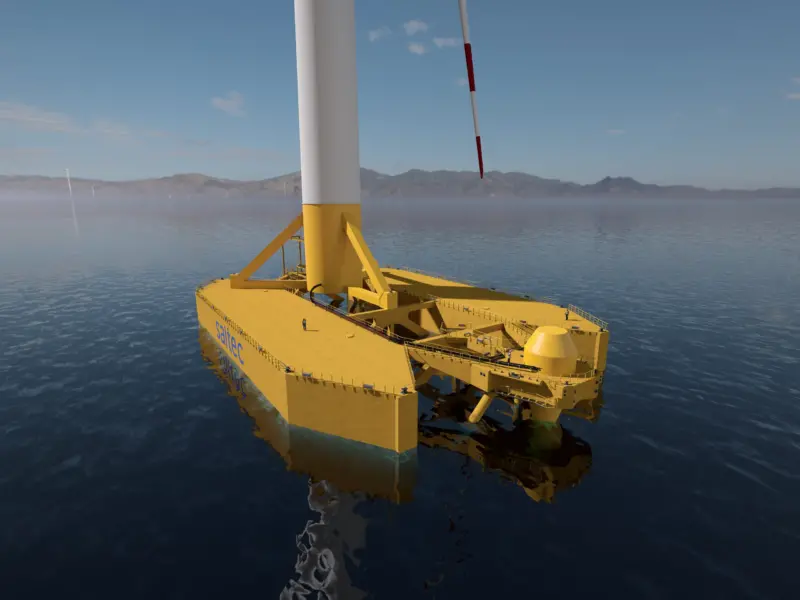
There are four main types of floating foundation to choose from – spar, semisubmersible, barge or tension leg platform – with multiple options for each type and still several more concepts under development. No matter which is chosen, the O&M logistics involved are complex and a significant cost over the project lifetime.
Studies by the UK Offshore Renewable Energy Catapult suggest that it is cheaper to tow a floating wind turbine to shore for maintenance but many are located far from good port facilities and there is risk in disconnecting and reconnecting the units.
Taking into account these findings, Houlder is developing a tool to determine the best option for a specific location in terms of operability, reliability, practicality, cost and potential longevity.
Related Articles
 OFFSHORE RENEWABLES
 OFFSHORE RENEWABLES
 ENVIRONMENT