![MaritimeJournal[Seawork]](https://www.maritimejournal.com/wp-content/uploads/2026/09/MaritimeJournalSeawork.svg)





Floating wind innovation ramps up
Eight floating wind technology projects have the potential to reduce the cost of building and operating floating offshore wind farms.
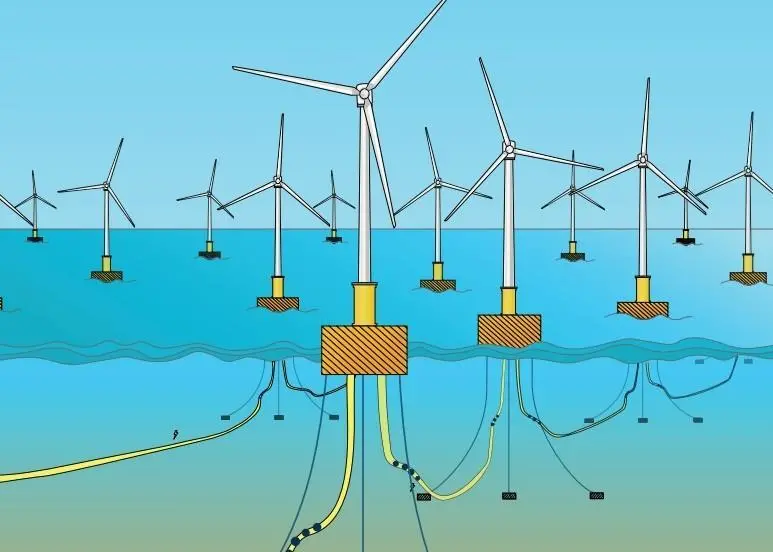
The Floating Wind Technology Acceleration Competition (FLW TAC) has enabled these projects to further develop designs and, in some cases, manufacture and test prototype products.
The FLW TAC received GB£1m funding from the Scottish Government and was managed through the Carbon Trust’s Floating Wind Joint Industry Project (FLW JIP). The competition was launched in September 2019. The eight projects selected started in early 2020 and ran until March 2021.
Jan Matthiesen, director, offshore wind, the Carbon Trust said: “Floating wind has the potential to make a significant contribution to decarbonisation efforts around the world. The acceleration of technologies to overcome identified challenges is crucial to scaling up capacity cost effectively.”
Winning projects
The winning projects include novel methods of monitoring and reducing mooring line loads and a new modular lifting solution for offshore component exchange.
At the end of FLW TAC, one technology is now a commercial product (Vryhof’s Stevadjuster), whilst others have secured additional funding for larger scale demonstration (Intelligent Moorings and University of Exeter’s Mooring Line Dampener) or are actively pursuing opportunities for commercial scale demonstration.
Scotland, which is home to Hywind Scotland – the world’s first floating wind farm, is preparing to host COP26 later this year. It aims to become a net-zero economy by 2045 and generate up to 11 GW through offshore wind by 2030.
By Rebecca Jeffrey

Related Articles
 OFFSHORE RENEWABLES
 OFFSHORE RENEWABLES
 ENVIRONMENT