![MaritimeJournal[Seawork]](https://www.maritimejournal.com/wp-content/uploads/2026/09/MaritimeJournalSeawork.svg)




Floating wind’s eye-watering costs laid bare at Oceanology
The eye-watering cost of floating offshore wind was laid bare at Oceanology International last week, with scientists admitting it was at least six times more expensive than conventional fixed-bottom turbines.
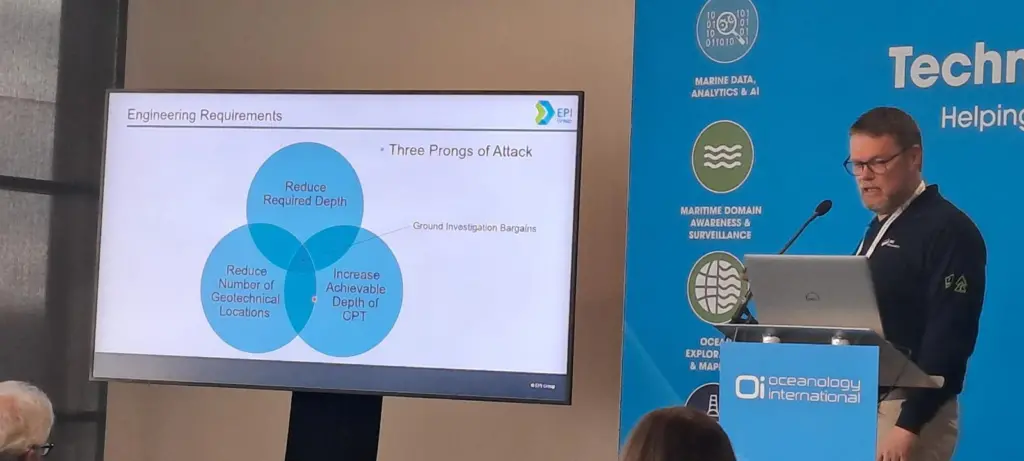
Jenni Nicholls is senior geophysicist & project manager at EPI Group, which was founded in 1987 and provides geophysical data processing and geoscience consultancy for offshore energy projects.
In a session called Challenges and Solutions for Floating Offshore Wind from a Developer Perspective, she told delegates that while floating turbines can unlock new areas because they can operate in much deeper waters where fixed foundations are impractical, that advantage comes with major survey costs.
“We can unlock vast regions where seabed conditions have stopped it before,” Nicholls told delegates. “But with 250 turbines needing eight geotechnical samples each, there are major costs and these developers have to consider this.”
Speaking at the same session, Roger Birchall, Technical Authority for Geophysics at SSE Renewables, put numbers to the challenge. He said core penetration testing (CPT) alone for a floating wind farm with 240 turbines could cost around £29 million (€33.5 million), compared with about £4 million (€4.5 million) for a fixed-bottom project of the same size.
“There’s no way we will get the funding for that,” he said.
Why floating wind needs so many samples
The cost difference largely comes down to how the turbines interact with the seabed.
Fixed-bottom turbines use foundations such as monopiles or jackets installed directly into the seabed at a single point. Engineers need deep soil data, often 50–70 metres below the seabed, but typically only at the turbine location.
Floating turbines work differently. The turbine sits on a floating platform that is secured by multiple mooring lines connected to seabed anchors. Each turbine can require several anchors spread hundreds of metres apart.
Because every anchor location must be assessed, each point generally needs its own geotechnical test, such as a CPT or borehole. The result is far more sampling locations across a site, even if the investigations themselves are shallower.
Anchor design is also highly sensitive to soil strength and seabed layering, meaning developers need detailed data to confirm the anchor type and its holding capacity.
Cutting costs without increasing risk
Birchall said the industry is now searching for ways to reduce survey costs without undermining engineering certainty.
“The budget for ground investigations would need to be six times higher than it used to be,” he said. “The more you spend on your survey, the more you reduce the risk.”
Possible options include reducing the depth required for CPT tests, improving the achievable depth of equipment, and cutting the number of geotechnical investigation locations.
However, he warned that reducing sampling could backfire.
“A large part of the GI cost isn’t just the quantity, but related processes – for example each touch point needs a sample location,” he said.
“Reducing the samples would result in more conservative designs, which would mean bigger ships, bigger hammers and so on. It may be a false economy.”
Current floating wind in Europe
Europe’s floating offshore wind sector is still emerging, with just five farms operating in its waters with a combined capacity of 220MW, according to floating offshore wind developer Flotation Energy.
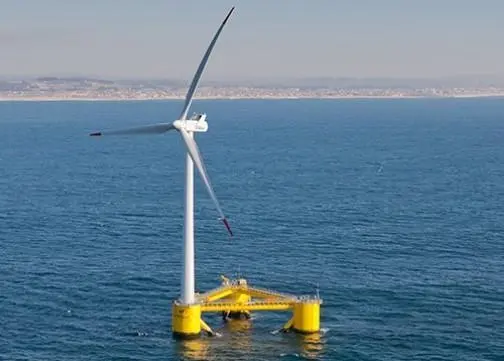
These include Hywind Scotland and Kincardine Offshore Wind Farm in the UK, WindFloat Atlantic in Portugal, Hywind Tampen in Norway, and Provence Grand Large in France. Together they comprise only 27 turbines, highlighting how early the sector still is compared with conventional offshore wind farms that can contain hundreds.
The projects are largely pilot or pre-commercial developments designed to prove technology rather than deliver large-scale electricity generation. Europe has nevertheless emerged as the global leader in floating wind deployment, hosting the majority of installed capacity worldwide.
The largest project so far is Hywind Tampen in Norway, an 88MW floating wind farm owned by Equinor, which began producing power in 2022–23 and supplies electricity to nearby offshore oil and gas platforms.
Despite the modest installed capacity, the pipeline is expanding rapidly. Governments across the UK, France, Spain, Portugal, Norway and Greece are planning auctions and leasing rounds, with industry forecasts suggesting more than 10GW of floating wind could be operating in Europe by 2030 if current plans proceed. The cost may well determine at what pace they do so.
Related Articles
 OTHER NEWS
 FEATURES & VIDEOS
 MARINE CIVILS