![MaritimeJournal[Seawork]](https://www.maritimejournal.com/wp-content/uploads/2026/09/MaritimeJournalSeawork.svg)





GL provides classification for WFSVs
Germanischer Lloyd is moving into the offshore windfarm support vessel market by providing classification services for the first newbuildings to an innovative design from Norwegain shipyard Fjellstarnd AS.
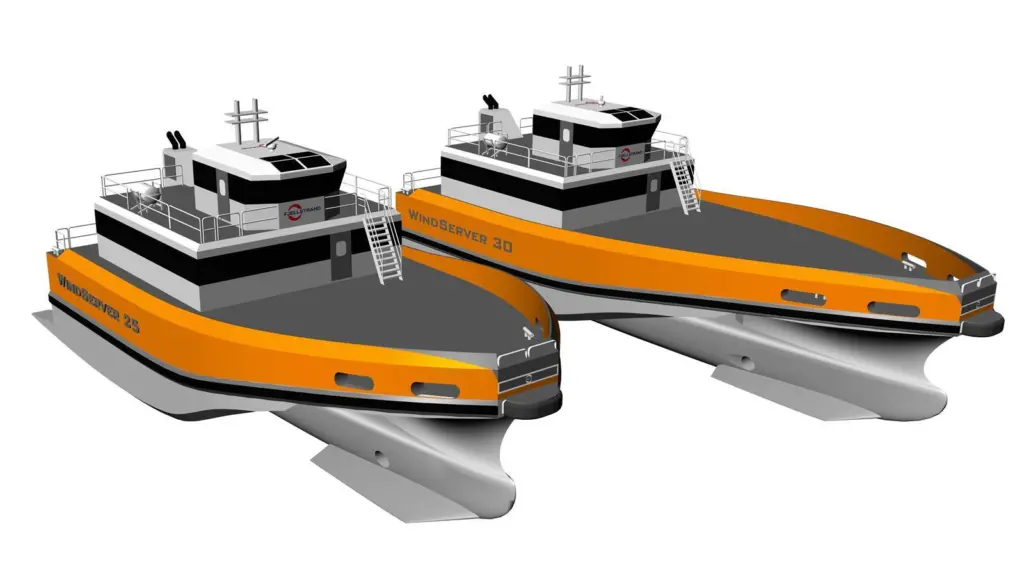
GL will class an order of six of the new Fjellstrand WindServers, two 30m vessels and four 25m, for Danish shipping company World Marine Offshore A/S. The vessels will have a service speed of 25 knots and the capacity to carry 25 and 12 service personnel, respectively. They are scheduled to enter service in March 2013.
The Fjellstrand WindServer includes a number of innovative features which have been designed to improve access to offshore installations in rough weather, improve fuel efficiency, ensure the safety of the personnel on board and reduce running costs. The vessels will be equipped with four engines that power two controllable pitch propellers, giving improved operational flexibility while ensuring redundant capacity.
The vessels will be equipped with ballasting systems allowing them to shift between a rough weather SWATH mode and a lightweight transit mode. A fixed stabilisation foil adds to the design’s stability, one of a set of permanently integrated motion damping devices that are part of the hull concept and designed to reduce construction and maintenance costs by avoiding complex active motion control systems.
“The offshore service sector is currently one of the innovation highpoints within the maritime sector, said Ronnie Westerman, GL’s business development manager for North Europe. “GL has been intensively involved in this area over the past several years, assessing new designs, materials and components and we are extremely happy to be once again working with Fjellstrand to help to bring this exciting new design to life.”
The WindServer was one of 13 shortlisted concepts in the Carbon Trust’s Offshore Wind Accelerator access competition. The Carbon Trust is a UK non-profit organisation funded mainly by the British Government which endeavours to accelerate the commercialisation of innovative concepts that reduce carbon emissions and save energy. The competition was designed to enhance the safety of workers transferred to offshore wind turbines and increase turbine availability by identifying and developing new access systems. The programme allowed Fjellstrand to undertake extensive tank testing on the new hull form, demonstrating its stability and seakeeping ability in high seas states at both high speeds and when stopped.
GL has previously provided classification services for a number of Fjellstrand designed and built passenger catamarans, including the Halunder Jet, a 36 knot, 52m long catamaran which carries some 580 passengers on the nearly four hour journey between Hamburg/Cuxhaven and Helgoland.
In May GL released the first comprehensive set of classification rules for Crew Boats and Offshore Wind Farm Service Craft. The rules were developed by bringing together all of the relevant GL rules, international codes and recommendations which can be used for the classification of Crew Boats. The rules will allow designers to develop vessels built to the individual needs of their clients according to the rules, with full confidence in the fact that their vessel can meet with classification approval. The Rules have been developed in consultation with the flag states and will contribute to the development of international standards for Crew Boats.
Related Articles
 OTHER NEWS
 FEATURES & VIDEOS
 MARINE CIVILS