



Greenpeace’s bottom trawling rebellion risks wind farm delays
An attempt by the environmental activist group Greenpeace to disrupt bottom trawling off the eastern coast of the UK could potentially delay the installation of a massive offshore wind farm by RWE.
The Norfolk Vanguard East and West offshore wind farms are designed to have a combined generating capacity of 2.8GW, with 184 turbines (92 per project).
Sited 50-80km off the Norfolk coast, offshore construction was scheduled to begin in early 2027, with turbine installation from 2028 and full commissioning by 2030.
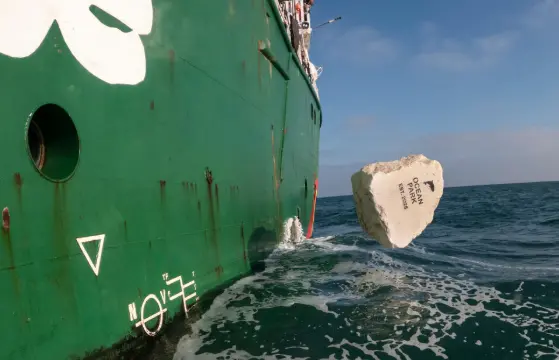
Now that nine boulders have been dropped into the seabed within the commissioning area, questions have been asked about whether it will delay installation.
“RWE is aware of the recent activity within the array boundary of the Vanguard East offshore wind farm project. We have had constructive communication with Greenpeace and will continue to investigate the precise implications. We are unable to comment further at this point,” said a spokesman for RWE.
“We dropped the boulders in the Southern North Sea because this is the UK’s most intensively bottom-trawled MPA (Marine Protected Area), and this part of the North Sea is heavily fished on a regular basis,” said Will McCallum, co-executive director of Greenpeace UK. “The government has repeatedly dragged its heels on properly protecting UK waters. Anyone familiar with offshore wind in the North Sea knows that energy companies routinely move naturally occurring boulders from the seabed before building a wind farm. Some of these boulders can be ten times heavier than those we placed.
“The suggestion that nine well-publicised rocks pose a genuine obstacle to clean energy is absurd. It’s not a case of one or the other, we need the UK government to invest in wind power and legislate to stop industrial fishing in our so-called marine protected areas.”
And in the air
Greenpeace is very enthusiastic about wind farms.
“And the towering modern turbines that jostle with oil rigs on the North Sea skyline are real engineering marvels: hundred-metre-long blades slicing through the air, generating enough power in a single rotation to power a house for two days,” it says.
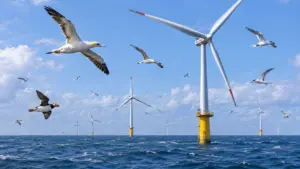 Research commissioned by the Dutch government has estimated that as they slice through the air, offshore wind turbines across the southern North Sea cause about 11,900 seabird collisions a year under a modelled 2030 development scenario. The study, published in 2022 by Bureau Waardenburg, considered 10 seabird species, with northern gannets accounting for an estimated 7,001 collisions a year.
When 18 seabird and migratory bird species are combined, the model estimates about 38,000 annual collisions, although the nature of the deaths – that the birds fall into the sea – makes it very difficult to get accurate figures.
“European models for the heavily developed 16 North Sea estimate bird collisions in the tens of thousands per year for planned 2030 buildout of this region,” says a report by the Bird Communications Specialist Committee of the Environmental Technical Working Group, with support from the Biodiversity Research Institute. “However, there is a great deal of uncertainty in these modelled estimates and offshore wind turbine collisions are thought to be much rarer than at land-based wind facilities.
“Bird mortality from offshore wind development needs to be balanced with the benefits of renewable energy in reducing climate change, as climate change is a leading cause of bird population declines globally.”
Related Articles
 ENVIRONMENT
 DECKS & LIFTING GEAR
 FINANCE, LEGAL & INSURANCE