![MaritimeJournal[Seawork]](https://www.maritimejournal.com/wp-content/uploads/2026/09/MaritimeJournalSeawork.svg)






High profile inauguration for London Array
“A great win for Kent, a great win for renewable energy and a great win for Britain”, were the closing words of UK Prime Minister David Cameron’s speech at the inauguration this month of London Array, the world’s largest offshore windfarm.
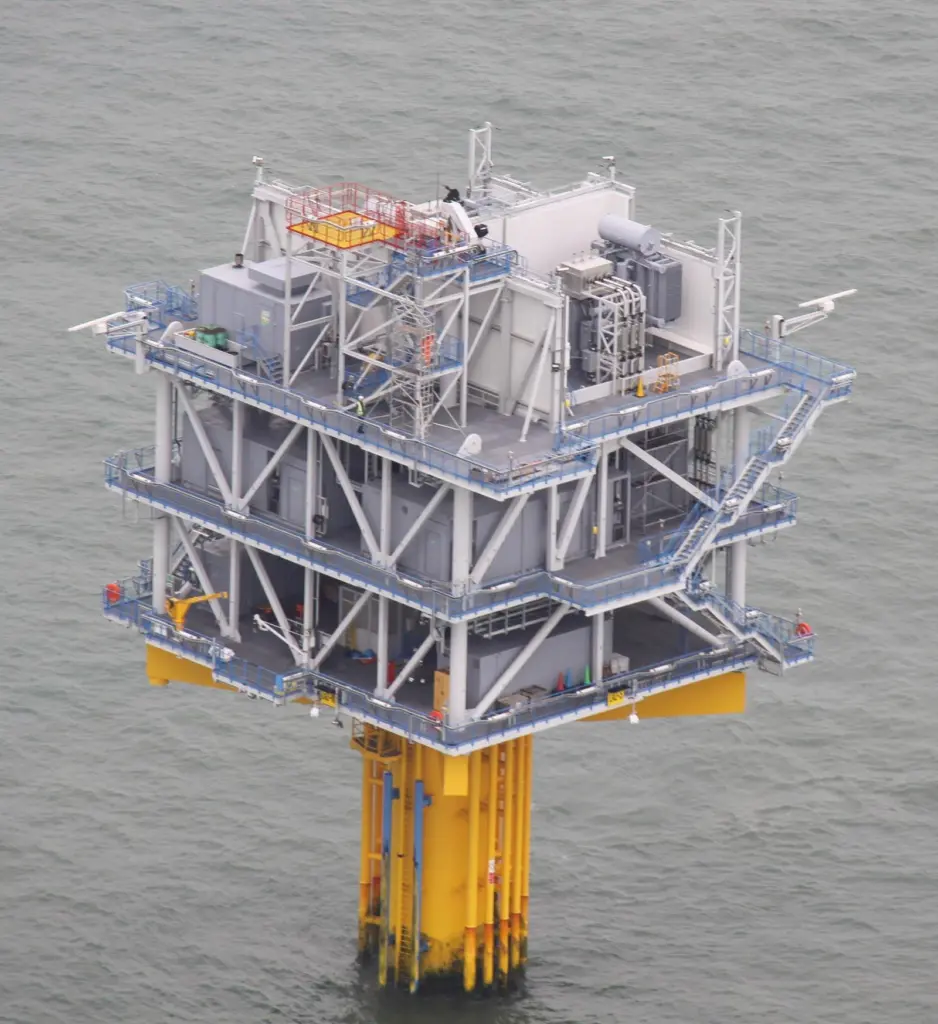
Travellers who regularly use London’s City Airport will be familiar with the sight of London Array as they approach or take off over the Thames estuary. It is actually just one of five offshore windfarms visible from the north Kent coast on a clear day but with 175 turbines, it is London Array that will likely dominate the view.
The somewhat lower aerial view from a helicopter experienced by Maritime Journal on the media day provided a clearer indication of scale that cannot be appreciated by walking along the clifftop at Margate, where the inauguration ceremony was held.
The impressive Turner Contemporary art centre was the venue and the day was one for due celebration of what is probably the most important event to date in the UK industry’s history. But thoughts will have been closer to earth for the invited audience of around 350, including the world’s media, listening to every word of the ‘A-list’ presenters at what is a crucial time for the UK offshore wind industry.
The industry was digesting publication, a week earlier, of the draft strike prices for renewable technologies, including offshore wind. The finer details are yet to be announced but with decision day fast approaching on the degree and, importantly for the UK, location of investments to meet the huge projected demands of the likes of UK Round 3, those involved are on the cusp of making decisions that will shape the future of the industry for the next 20 years.
Putting aside the crystal-ball gazing, London Array can rightly lay claim to be a success story for the consortium comprising DONG Energy (50%), E.ON (30%) and Masdar (20%). Maritime Journal has followed progress at London Array since the very beginning, but with such a line-up of speakers it is not surprising they produced just a few more details of interest. There were a total of 260,000 tonnes of materials transported offshore, the extremes of water depths (from 0m LAT to 25m LAT) and various seabed conditions resulted in every one of the 175 foundations being unique in its own design and dimensions and, finally, they produce enough energy to power almost 500,000 homes. A roll-call lists 102 main international suppliers, with an estimated 200 more local small support businesses in Kent alone benefitting from the £1.5bn project.
DRESS REHERSAL
The future of the industry will have been in everyone’s mind at the inauguration. During an offshore visit in October 2011, with just 70 foundations and monopiles installed, project director Richard Rigg told Maritime Journal the world was viewing London Array as a dress rehearsal for Round 3 to judge if the industry really was capable of delivering a project of such scale. Speaking exclusively to Maritime Journal on the media day nearly two years later, Mr Rigg was asked how he felt the rehearsal had gone. He replied: “I think that is still the case. There is of course a round two and a half bridging the gap with Round 3 but I do think that what we have learned on London Array, particularly what we managed to achieve in 2012 because we were slightly delayed in 2011, is important. We totally caught up in 2012, managing to install all 175 turbines, 90 foundations, nearly all of the array cables and three of the export cables in less than a year. That has to be something that is relevant for the industrial scale of Round 3”.
The belief that the industry in general, and the UK in particular can face up to future challenges of scale on the back of those faced so far was a common thread with the speakers both from the developers and, in particular, the Prime Minister himself.
Paying tribute to those involved with the project, Peter Löscher, president and CEO of Siemens AG said: “People talk about fighting climate change but it takes some very special people to actually do the fighting to produce and ship the equipment across the sea. It is a hard day working offshore”. Mr Löscher touched on the international, particularly European, nature of the industry and was not the only speaker directing comments at the high profile government line-up, adding: “My personal vision when we talk about the energy transition in Europe, it also has a European dimension. One can easily assume that we find the best technologies at the best locations to the benefit of the wider European community but let’s think about how transmission lines connect between different countries and this project is giving us the opportunity to say that with offshore wind”.
Dr Johannes Teyssen, chairman and chief executive of E.ON, started his speech with a simple yet apposite comment about wind turbines: “They are not run by energy, they are producing energy”.
He acknowledged, however, the importance of the debate around costs and subsidies. “Renewables will be a vital part of any energy mix in the future but they will have to live in the market in years to come, they cannot live on special support forever so we need to deliver the cost decline so we can prove that this is competing on its feet with other energy means. We have to strive for the target of lowering the costs by 40% by 2015. It is an ambitious goal for offshore but we are doing everything we need to make this vision a reality”.
His summary was upbeat. “London Array is a seven year project delivered in one year of construction time almost at the day it was expected and a tiny bit below budget. So offshore has left the kindergarten, offshore is growing up, and we are proud to be part of that”.
Brent Cheshire, UK country chairman for DONG Energy, addressed the debate about the importance of a stable supporting political environment head-on. “As currently the windiest country in Europe, we would expect that the UK would be in the vanguard of offshore wind developments but it takes a supportive framework and the hard work of government and all of the industry to deliver this. Given the announcement last week by government about infrastructure spending and their senior representatives here today, it would be odd if I didn’t mention the EMR. Progress has been made and it is very welcome, the success of EMR is critical if we and others are to deliver energy investment and win the infrastructure. It is real projects like this one that will deliver security of supply, low carbon generation and jobs for now and decades to come”. He repeated his stated target to reduce the cost of offshore wind to €100 per MWh by 2020.
The speakers built on the theme of the UK’s ability to deliver large scale projects with H.E. Dr. Sultan Ahmed Al Jaber, UAE Minister of State and CEO of Masdar said: “London Array is a true testament to the economic opportunity of large scale renewable energy projects, the investments they attract and the industries they reinforce. The UK government’s bold commitment to renewable energy with strong policy and robust frameworks provided the foundation necessary and the stability required for such a successful partnership”.
POLITICAL PRESCENCE
The British government is facing a degree of opposition to (mainly onshore) windfarms from within its own ranks, along with a perceived reluctance to commit to the long-term renewable targets the industry sees as essential for making the long-term investments required.
Against this backdrop, the significance of the presence of the Prime Minister, (along with Energy Secretary Ed Davey and Minister of State for Energy and Climate Change Greg Barker) and his endorsement of London Array’s achievement will not have gone unnoticed.
Speaking without notes, Mr Cameron said: “Today is a triple win; first of all it is a huge win for Kent. This project has been built by some of the bravest seamen, some of the most talented engineers, some of the hardest workers and it is going to continue to bring great benefits to people in Kent for many years to come and we should congratulate everyone involved in the construction and operation to date.
“The second thing, it is a big win for renewable energy. Sometimes people wonder can you really have renewable energy projects at scale. What London Array shows, powering half a million homes, the biggest offshore windfarm anywhere in the world, it absolutely shows you can do scale renewables and you can do them right here in Britain.
“That leads me to the third and perhaps most important win of all; it is a very big win for Britain. Sometimes people wonder can we in the west do the big projects any more, can we do the big investments? Isn’t that always happening somewhere else in the east and south of the world? But if you look at the UK right now you can see we do big projects. This demonstrates Britain is a great place to invest. It is absolutely right there have been great contributions from European countries and European people all over this project”.
Explaining this aspect further, Mr Cameron cited the Olympics, Crossrail and London Gateway as major projects carried out in Britain. He claimed not to want to have too much schadenfreude in mentioning that it is a fact that last year when foreign direct investment into Europe as a whole went down by something like 40%, in the UK it went up by 24%.
As with all the industry speakers, Mr Cameron stressed the importance of reducing costs, but he concluded: “We are making this country incredibly attractive to invest in and that is part of what this project is about. When it comes to green energy I think we have one of the clearest, most predictable investment climates and we are going to add to that by completing the energy bill this year so we will have a fantastic market for investors to come and build in. So a great win for Kent, a great win for renewable energy and a great win for Britain.”
By Peter Barker
Related Articles
 OTHER NEWS
 FEATURES & VIDEOS
 MARINE CIVILS