![MaritimeJournal[Seawork]](https://www.maritimejournal.com/wp-content/uploads/2026/09/MaritimeJournalSeawork.svg)



Innovative tidal energy project launches in Northern Ireland
A new project, launched at the start of March, is exploring the potential of a novel energy generating system that pairs floating hydrokinetic energy with battery storage technology.
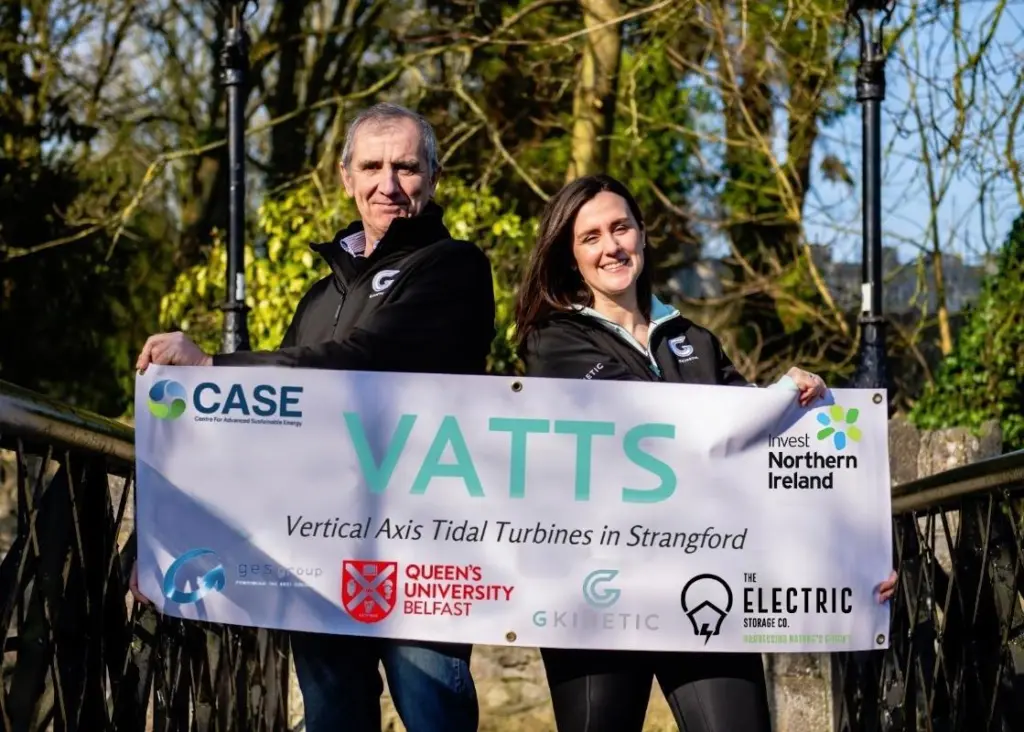
As part of the CASE-funded Vertical Axis Tidal Turbines in Strangford (VATTS) project, a consortium of partners – including Queens’ University Belfast, GKinetic Energy, Grant’s Electrical Services (GES) and The Electric Storage Company (TESC) – will harvest kinetic energy from two market-ready 10kW vertical axis tidal turbine device deployed in Strangford narrows, Northern Ireland, and develop enhanced resource assessment standards to validate the Annual Energy Predictions (AEP) for floating tidal energy technology.
In an effort to edge the technology even closer to commercialisation, the team will also explore the potential of linking the GKinetic system with cutting-edge energy storage technologies and end user demand profiles – and develop a framework for ‘specifying an integrated system to provide an affordable, zero carbon alternative for baseload electricity directly to end users.’ By removing the need for a cable connection to shore the team also expect to demonstrate how costs, complexity and environmental concerns can all be ‘immediately reduced.’
As Roisin McCormack, Co-Founder & COO of GKinetic Energy, explains, traditional subsea cables ‘are not always feasible and, depending on the deployment site, can be expensive.’ In recognition of this fact, the VATTS project is viewed as a ‘really exciting opportunity’ for the project consortium to investigate the use of energy storage technologies as an alternative for power delivery in a move that ‘could accelerate market rollout of tidal energy solutions.’
Meanwhile, Vincent McCormack, CEO at GKinetic, points out that floating marine energy solutions have ‘really come to the fore in recent years, with fantastic large-scale projects in floating wind and floating solar proving that this is more than a pipe dream.’
“With continued support, floating solutions can be a viable player in the clean energy mix and hydrokinetic energy has huge advantages and benefits it can bring to the table. The predictability of supply means power can be flexible and reliable, allowing it to be managed in an incredibly efficient way and that is a huge part of the work that will be carried out in VATTS,” he adds.
POTENTIAL APPLICATIONS
Key potential applications identified for the system so far include local energy generation for remote areas with good hydrokinetic resources nearby, such as rivers, canals and estuaries – as well as ‘smart city or urban applications where land space is scarce.’
According to Roisin McCormack, a number of other potential applications currently being looked into include floating ‘charge points’ for drones, electric ferries and outboard vessels, aquaculture, survey vessels – and tying in with solar-topped canal projects and floating solar.’
“GKinetic is also a key technology solutions provider in a leading smart cities project involving 32 consortium members from all across Europe called +CityxChange – and sees huge replication potential for deploying turbines in various smart city applications,” she says.
Moving forward, McCormack reveals that the first step for the project team will be to carry out a site evaluation – including preliminary resource assessment and micro-siting for the turbines – in parallel with commencement of the environmental consenting process alongside local authorities.
“Environmental consenting is an important part of the project, because Strangford Lough contains special protection areas and is a marine conservation zone and area of special scientific interest. In tandem, GKinetic will begin building two 10kW hydrokinetic turbines. Deployment of the two turbines is scheduled for later this year,” she says.
“Deployment should be relatively straightforward thanks to an experienced team and test site that is set up for this type of demonstration. The design of the unit means it can be craned in and towed to site, up and running within a matter of hours. Challenges foreseen include limitation of testing by weather and daylight hours and how much the team will be able to meet in person as a group due to ongoing COVID restrictions,” she adds.
By Andrew Williams

Related Articles
 OFFSHORE RENEWABLES
 OFFSHORE RENEWABLES
 ENVIRONMENT