![MaritimeJournal[Seawork]](https://www.maritimejournal.com/wp-content/uploads/2026/09/MaritimeJournalSeawork.svg)


Leviathan to work on worlds largest wind farm
The newbuild 5,500gt jack-up vessel ‘ Seajacks Leviathan’ arrived in Harwich UK at the end of September to begin work installing wind turbines at the Greater Gabbard Wind Farm. Situated some 25km off the Suffolk/Essex coast, it will be the world’ s largest offshore wind farm to date.
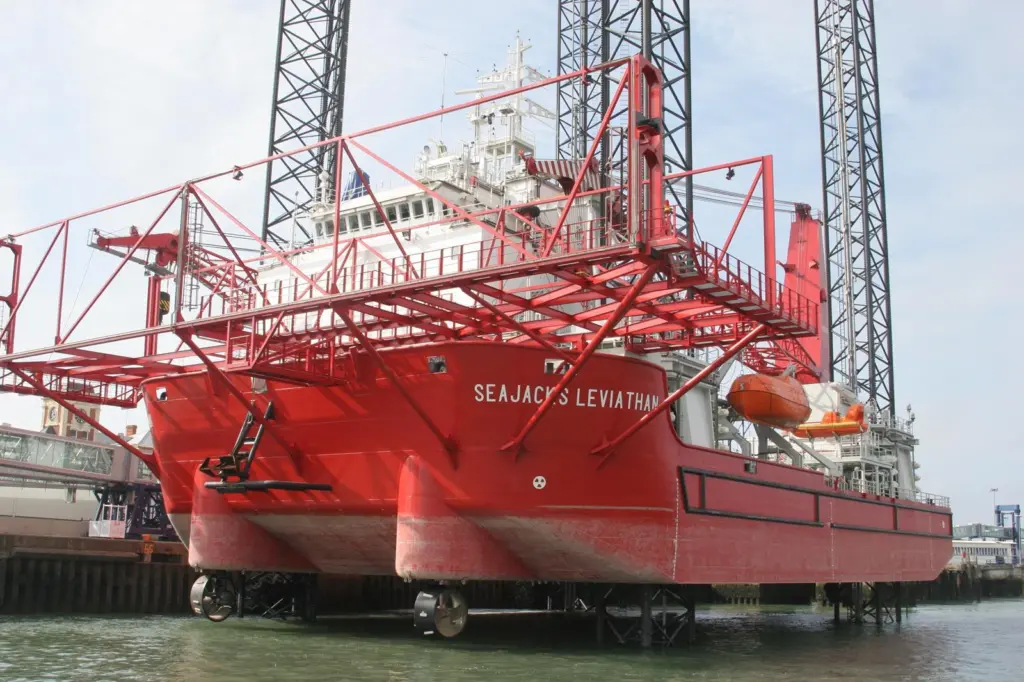
In January of this year Seajacks announced that it had signed a contract with Fluor Ltd for Seajacks Leviathan to work for a firm period of 14 months. The total secured contract has a value for Seajacks of approximately $100m, including mobilization and demobilization. A sister vessel, the ‘Seajacks Kraken’ has been contracted by Dong Energy to work on the Walney 1 and Walney 2 wind farms in the Irish Sea. The Kraken is currently contracted to Exxon Mobil in Canada as the offshore accommodation unit for the Sable Project, located off Nova Scotia.
Each of these modern, self propelled jack-up ‘liftboats’ has been designed to perform under environmentally harsh conditions such as found in the North Sea for the oil and gas industry as well as for the offshore renewable energy sectors. They are equipped with Class 2 dynamic positioning technology, enabling them to operate in wave heights of 2m (compared to the 1m to 1.5m of standard three legged jack-ups). They comply with all the relevant regulations and standards set by UK, Dutch and Danish authorities.
Built at Lamprell Energy’s yard in Dubai, the construction of Seajacks Leviathan took 18 months to complete at a cost of $112m. The vessel was delivered from Dubai aboard the Dockwise semi- submersible heavy lift carrier vessel ‘Teal’ and was floated off at Flushing on 7 September.
Seajacks Leviathan provides a platform for support and maintenance of oil and gas production infrastructure, well intervention and offshore wind farms. Based on the Dutch GustoMSC NG-2500X design, the vessel has a hull length of 61m and is 36m wide, with a depth of 6m and 84m legs. It will be able to operate in water depths up to 48m.
Being self propelled, it can move swiftly and cost effectively between locations without the need for tugs. Propulsion is provided by four 1,500kW azimuthing thrusters, giving a working speed of 8 knots.
There is comfortable accommodation for 90 personnel and 900m2 of clear deck area to carry construction equipment and transport wind turbine components. A 300 ton crane with 50m and 70m optional booms provides extended reach for access to platforms and wellheads and for wind turbine installation. The vessel is also fitted with a helideck.
Seajacks hold options to build five more of these specialist vessels for use within the international offshore energy sectors. The company’s operations are managed from its office in Great Yarmouth and another at Lowestoft, although the company is incorporated in Bermuda and managed financially from Oslo.
Seajacks had previously announced that, wherever possible, the recruitment for the crewing of the Leviathan would be handled locally, with several dozen new staff expected to be recruited for the current project.
As Seajacks UK managing director Blair Ainslie told MJ, ‘If half the proposed renewable projects actually come to fruition, then there will be a real bonanza for those involved in the supply chain for renewable energy.’
By Graeme Ewens
Related Articles
 OTHER NEWS
 FEATURES & VIDEOS
 MARINE CIVILS