![MaritimeJournal[Seawork]](https://www.maritimejournal.com/wp-content/uploads/2026/09/MaritimeJournalSeawork.svg)






MHI Vestas record breaker
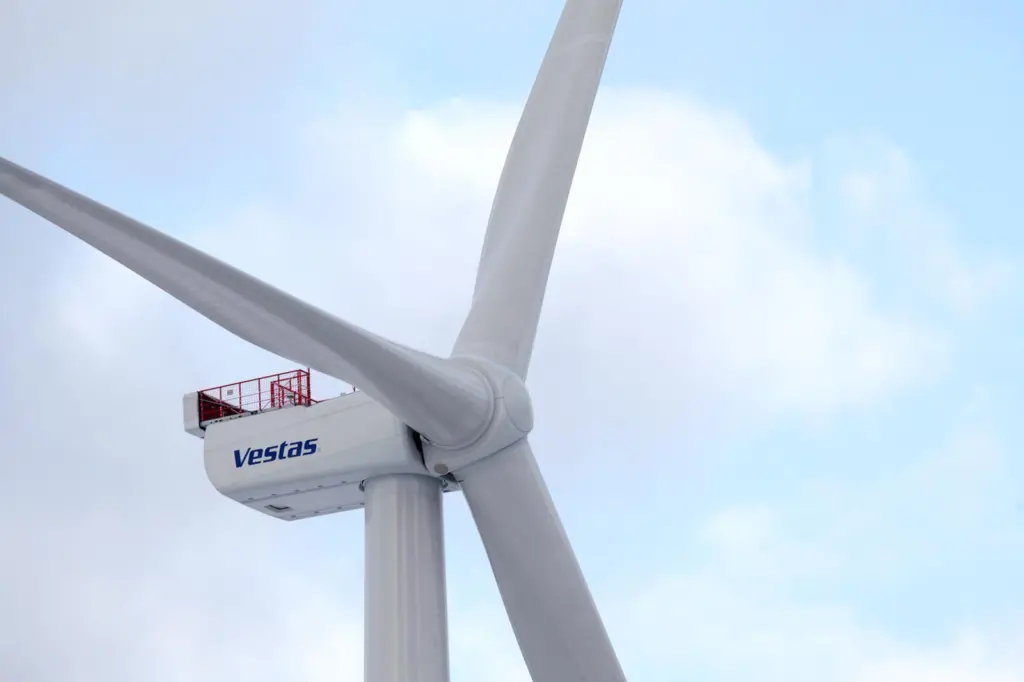
Development of large custom built offshore wind turbines has taken a step forward with MHI Vestas’ 8MW prototype turbine breaking the world record for wind energy production in a 24 hour period.
Denmark is an ideal country to take a look at the earliest examples of offshore wind turbines and their steady progress since. One of the country’s first project was Vindeby, commissioned in 1991 with the deployment of eleven 450kW turbines, modest to say the least by today’s standards. In 2003 the Frederikshavn windfarm comprised a mix of 2.3MW and 3MW Nordex, Vestas and Bonus (Siemens) turbines. In the subsequent period Vestas (now MHI Vestas) and Siemens have largely dominated the offshore turbine market, 3MW and 3.6MW models from each company respectively becoming particularly popular at European sites.
As of July 2014 there were 2,304 turbines fully grid-connected in European waters with a combined capacity of 7,343MW equating to an average turbine size of just over 3MW. Considerable technological experience has naturally been accrued since and most major turbine manufacturers are now developing larger models intended to reap the benefits of larger windfarms further offshore in more productive (windier) locations.
The European windfarm market has dominated global offshore developments and if markets beyond Europe take off, turbine manufacturers could see new models above 5MW capacity being the entry level standard as the with the 2.3MW versions at the industry’s birth with subsequent huge potential.
The MHI Vestas V164-8.0 MW prototype was installed and commissioned in January 2014 at the Østerild test site in northern Denmark (owned by Denmark’s Technical University) and is currently undergoing testing. The world record for power production by a wind turbine in a 24 hour period was broken early in October when the 8MW turbine produced 192,000 kW/h during steady wind conditions. The power produced by the turbine in one day was enough to supply the energy needs of approximately 13,500 Danish households, roughly equivalent to Thisted; a city close to the test centre.
The turbine is understandably larger than earlier variants. The three blades are each 80m in length, with a swept area of 21,124m2, larger than the London Eye. The nacelle is 24m long, 12m wide and 7.5m high and weighs in at approximately 390 tonnes. The hub height of the Østerild prototype is 140m and tip height 220m: the normal heights in service are quoted as 105m and 187m respectively.
MHI Vestas Offshore Wind’s CEO Jens Tommerup said the record demonstrates the full capacity of the V164-8.0 MW adding: “[the turbine] has been operating with over 90% availability. Our main focus now is continuing to document the performance of the turbine to measure the power curve and the power quality in order to receive type certification.”
By Peter Barker
Related Articles
 OTHER NEWS
 OTHER NEWS
 FEATURES & VIDEOS