![MaritimeJournal[Seawork]](https://www.maritimejournal.com/wp-content/uploads/2026/09/MaritimeJournalSeawork.svg)


Mooring chain laser inspection
A laser scanning company has been awarded funding for the development of mooring chain laser inspection that could help reduce the cost of floating wind writes Dag Pike.
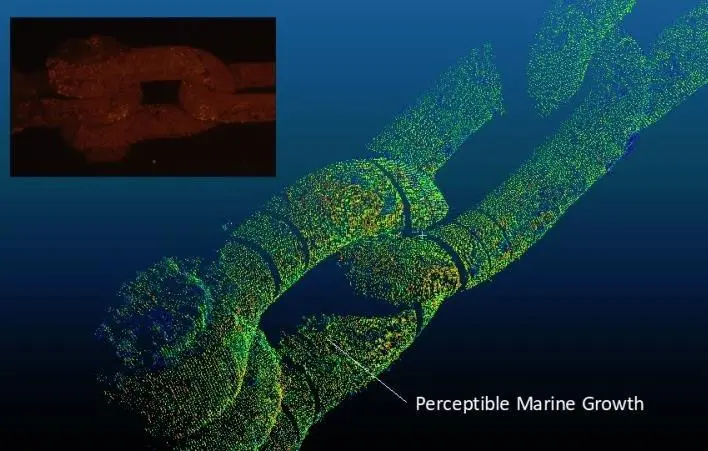
Last October Kraken and Husky collaborated to test Kraken’s SeaVision® 3D underwater laser imaging system as a potential inspection tool for mooring chains. This demonstrated that the technology can complete an inspection of a mooring chain and provide all the specifications required by the regulators. Under the new 16 month development project, Kraken will work to address the remaining technology gaps identified.
Asset integrity regulations require regular inspections of the mooring chains at defined regions with millimetre accuracy to monitor for signs of wear and verify system integrity. Current practice for mooring chain inspection requires a large support vessel, to deploy a work class ROV equipped with a mechanical calliper to measure link diameter. This process must be repeated several times, sampling several links in each mooring chain and there are concerns about the efficiency and risks involved.
Kraken’s laser scanning sensor solution performs contact-less mooring chain inspection from a two-metre stand-off distance and continues to provide the required accuracy. The advantages of this solution are considerable time saving, improved safety and reduced environmental concerns. SeaVision® uses an electro-optical system to obtain the required measurements.
It is estimated that the SeaVision® scanner sensor technology will reduce a mooring chain inspection campaign from approximately ten days to two days, which represents a significant improvement in efficiency and cost.
The technology is considered relevant in the floating wind farm sector. Each floating wind farm is expected to have over 50 mooring legs per farm, which is five times more than an oil and gas floating facility. Offshore wind is expected to see significant growth and floating wind farms will create new growth opportunities for this technology. According to industry analysts, there are currently 50 floating units in projects under development out to 2022, worldwide, but that number could increase to 300 floating wind turbines by 2025 and over 1,500 by 2030, a fivefold increase. The global floating wind market has enormous potential and a cost-effective mooring chain inspection tool is one of the technology gaps identified by floating wind farm operators.
Related Articles
 OFFSHORE RENEWABLES
 OFFSHORE RENEWABLES
 ENVIRONMENT