![MaritimeJournal[Seawork]](https://www.maritimejournal.com/wp-content/uploads/2026/09/MaritimeJournalSeawork.svg)


Nailing turbine installation’s sweet spot
Predicting the future of wind turbine installation jack-ups isn’t easy, and over-simplistic guesses may be looking in the wrong direction, writes Stevie Knight.
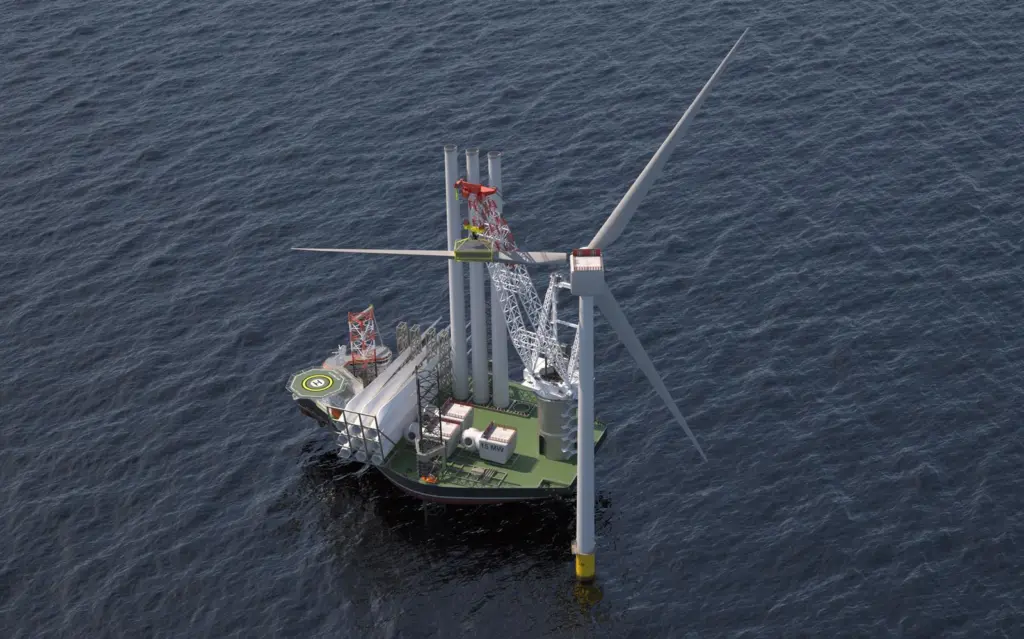
The industry has been caught out before. The first generation, dating from 2005 had an average crane capacity of 500t and were soon found wanting “but the second generation, just five years later, were almost obsolete by the time they were launched”, said Ko Stroo of Ulstein.
The current, third generation jack-ups are still in use for the 8MW to 10MW nacelles, “but will be struggling with the 12MW designs probably coming in 2022”, he added.
Further, according to Shashi Barla of Wood Mackenzie: “The offshore wind turbine sizes are expected to be around 20MW in a 2030 time frame.” Peter Alexandersen of Wind Denmark also told MJ that the Danish test centre, Østerild, “has now been expanded to accommodate turbines with 330 metres maximum height”, giving the industry “an indication” of where it’s headed.
They’re not alone: owner Jan de Nul Offshore has likewise noted currently available jack-ups are “facing increasing difficulties… due to turbines’ sizes and installation heights”. Its own response has been to prepare a fourth-generation design, Voltaire, able to work at more than 270 metres with blades 120 metres long. Key features of the mega-sized vessel include a 3,000t crane and 14,000t payload.
So, it’s a race for bigger and better, right? Well, no, said Stroo. Upping the size is one approach, but he remains unconvinced it’s always the most effective strategy. Therefore the question he asks is, if too small a jack-up risks becoming obsolete within a few years, but too large a vessel could lack competitiveness, “how do you nail the sweet spot?”
To find out, Ulstein didn’t “jump to the drawing board to sketch the ultimate installation unit for the largest wind turbine we could find”, he underlined. Instead, the company developed a tool that would coolly evaluate multiple solutions on the complete business case, not just capacity.
And this clearly showed that the ‘economies of scale’ argument has its limits.
Ulstein put together two studies, the first for a 2022 windfarm development 100nm from base, deploying the 8MW to 10MW turbines presently available.
Here, it was found Ulstein’s current 145m J102 design has the advantage over a larger sister. Its 10,500t deck load and 6,500 m2 area (the result of an 88m beam) can carry eight of these wind turbines: counter-intuitively, installation works out 20% more economical than a bigger, twelve-turbine capacity vessel of similar design. So, what’s going on? “Although larger jack-ups make fewer runs up and down from harbour, the price of the smaller jack-up is significantly cheaper. The time saved just doesn’t balance the extra costs,” explained Stroo.
Most surprisingly, this still holds true for the second, 2030 scenario which sees 15MW to 20MW turbines being carried 150nm to site. Even here, the J102 still appears to be the most effective option, being able to take four turbines per trip, with installation figures roughly 15% lower than the bigger J103 that can take up to six next-generation turbines, “and that’s including an offset to balance slightly faster deployment”, said Stroo. He added that although the larger nacelles could reach around 1,000t apiece, the J102’s current crane has a 1,250 to 2,500t capacity at a practicable turbine height and outreach, without further upgrades.
While these projections focus on the company’s own designs, the principle could hold true for a number of other vessels, throwing the rationale for a size race into doubt; although for a longer life the balance of onboard cranes and plant will have to be future-proofed.
What about the wild cards? Could the technology’s trajectory change and catch the industry unawares? Probably not: while foundation, tower and blade alternatives are being explored, nacelles are a big lump of heavy machinery that’s not easy to pare down. Further, “having landed on a working principle the industry is, justifiably, most interested in scaling up proven solutions”, concluded Stroo. Turbine innovation may not have a chance to get a foot in the door.
Related Articles
 OFFSHORE RENEWABLES
 OFFSHORE RENEWABLES
 ENVIRONMENT