![MaritimeJournal[Seawork]](https://www.maritimejournal.com/wp-content/uploads/2026/09/MaritimeJournalSeawork.svg)



New turbine installation vessel concept
A collaboration agreement between two well established marine companies has revealed the latest concept in the fast developing wind turbine installation vessel market.
At the opening of Vattenfall’s Thanet windfarm in 2010, when asked what lessons had been learned, a company spokesman said it was to do as much assembly and preparation work as possible ashore.
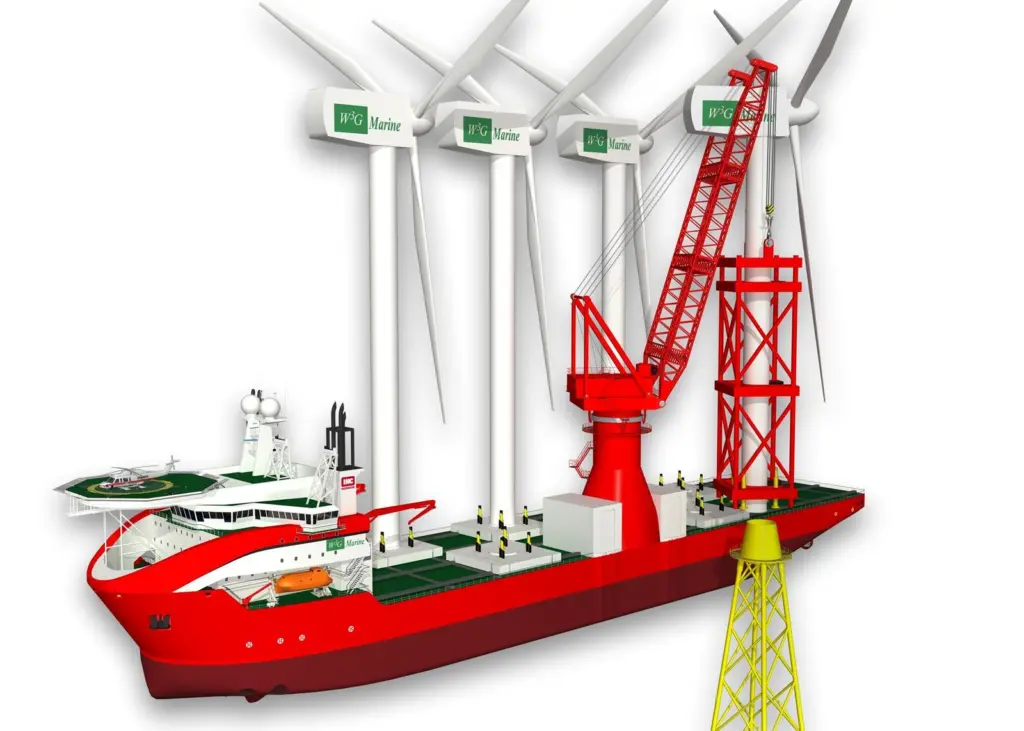
This latest concept adopts the principle of transporting turbine towers, nacelles and blades as complete and commissioned assemblies, and installing them directly onto pre-installed foundations. The project also sees further evidence of the adoption of established offshore oil and gas industry expertise within the maturing offshore wind industry.
Aberdeen based W3G Marine Ltd (W3GM) is an independent company, providing installation, management and engineering services to the offshore, marine and renewable industries. Its collaboration agreement with the Dutch IHC Merwede Group can be viewed as a natural joining of expertise, with W3GM providing its patented turbine installation frame and lift system along with the concept and full functional specifications of the offshore wind turbine installation ship (OWTIS).
IHC Merwede is a major global force in the specialist offshore vessel design and construction market, including increasing involvement in the offshore wind industry. It is taking W3GM’s specifications forward and completing the detailed design, with the vessel expected to be built at one of IHC Merwede’s shipyards.
Similar to the recently announced A2SEA/Teekay concept, the W3GM/IHC design uses a DP class 2, free-floating vessel rather than the jack-ups, operational and under construction, which currently dominate the industry.
Two key considerations with OWTIS are safety and efficiency. Safety is enhanced through minimising the tasks to be performed offshore, resulting in fewer vessel round trips during the installation phase. Efficiencies will be also be achieved through a reduction in weather delays during jacking phases, together with savings resultant from the size of the vessel, making possible operations in harsh weather, and at more exposed, deeper water locations, together with the ability to accommodate large loads. The vessel is expected to be capable of operating for 270 days per annum compared to the current norm of 240, installing piles in winter, jackets in spring and autumn, and turbines in summer.
Vital statistics are 194.5m LOA, 38m breadth, 8m draft, 4,500m2 working deck area and a speed of 14 knots. A crane lift capability of 1,500 tons is included, along with active roll damping. Operational sea states include 3.5mHs for pile installation, 3mHs for jacket installation and 2.5mHs for turbine installation.
The partners describe the vessel as ‘industry changing’ and capable of reducing the cost of installing turbines, piles and jacket foundations by at least one third. Financing arrangements are underway with 80% of the ship’s value obtainable through an export guarantee facility. Building is expected to be completed late in 2013 with the vessel available early in 2014.
By Peter Barker
Related Articles
 OTHER NEWS
 FEATURES & VIDEOS
 MARINE CIVILS