![MaritimeJournal[Seawork]](https://www.maritimejournal.com/wp-content/uploads/2026/09/MaritimeJournalSeawork.svg)

Pelamis making waves in UK waters
Following a recent announcement by EON-UK, Pelamis wave power looks set to become an increasingly important renewable energy source.
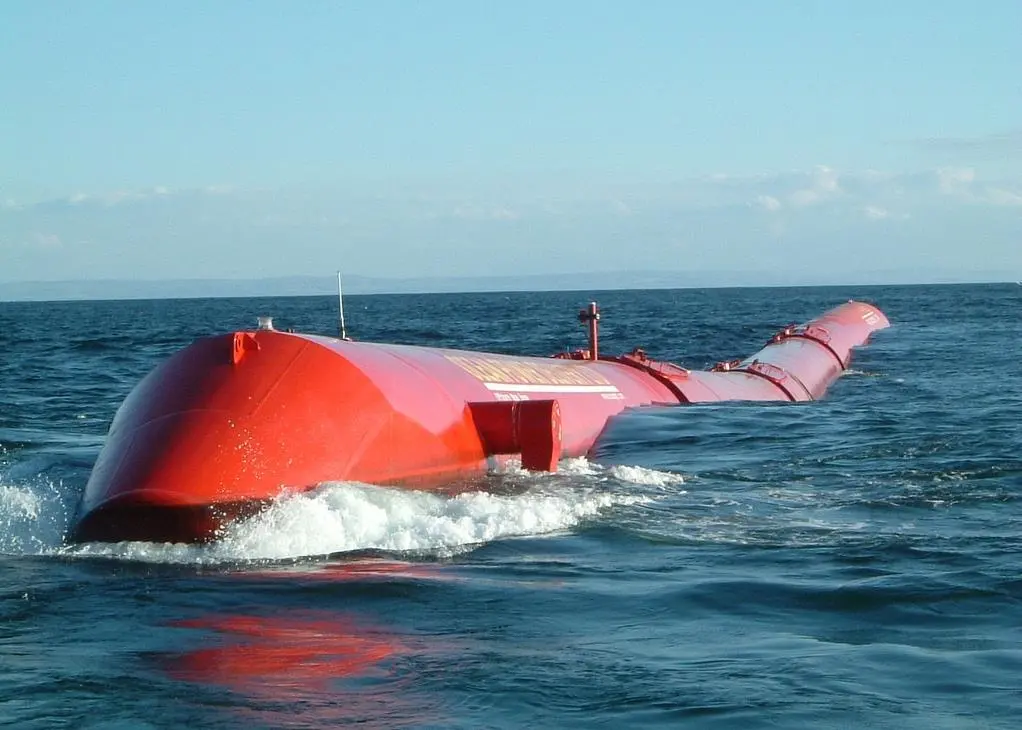
But how long will it be before it is commercially viable and what ecological benefits might it bring? In November last year, EON-UK revealed that its prototype wave power device, the Vagr Atferd, (meaning ‘wave power’), had generated power in UK waters for the first time. The news was hailed by Scottish first minister Alex Salmond as ‘another significant step’ in Scotland’s journey to becoming the ‘green energy powerhouse of Europe’.
The 750kW device, currently on trial at the European Marine Energy Centre’s Billia Cross site in Orkney, is the first of its type to be tested anywhere in the world. The 180m long Pelamis Wave Energy Converter weighs around 1,300 tons and works by using wave motion to produce electricity by driving a set of hydraulic rams at the hinged joints, which link the cylindrical sections of the device.
E.ON-UK’s approach is to gradually expose the Vagr Atferd to increasingly severe sea states to prove the machine can operate in the full range of conditions. The expectation is that this testing stage will continue throughout 2011 and possibly beyond.
‘We need to do this in a series of stages to manage exposure, build up confidence and gather the operating data that we and our partners need’, said Amaan Lafayette, marine development manager at E.ON UK.
‘We currently envisage a joint programme of four to five years, together with our partners Scottish Power Renewables, who have commissioned another machine to run alongside ours in a joint project’.
However, it is likely that the success of any future commercial development will also depend upon a range of additional factors, ranging from the industry’s ability to overcome offshore technical challenges and ensure the availability of adequate finance, to the establishment of a supportive regulatory and consenting regime for long term development.
In the wake of ongoing debates about the environmental consequences of wave and tidal power, the potential contribution that Pelamis technology might make has also been largely welcomed by some commentators within the wider environmental community.
‘[We] welcome the development of wave energy devices as an essential mechanism to address climate change. While the site specific impacts are yet to be fully understood, we are confident that if placed sensitively and executed with care, wave energy devices such as Pelamis should be truly sustainable developments’, said Melissa Moore, senior policy officer at the Marine Conservation Society (MCS).
‘It is an exciting time for developing offshore wind, wave and tidal electricity in Scotland, and as an important report that MCS in Scotland helped to coordinate outlined, sustainable development of the industry is welcomed and can be done so without endangering important environmental interests’, added Calum Duncan, MCS Scottish Conservation Manager.
By Andrew Williams
Related Articles
 OTHER NEWS
 FEATURES & VIDEOS
 MARINE CIVILS