![MaritimeJournal[Seawork]](https://www.maritimejournal.com/wp-content/uploads/2026/09/MaritimeJournalSeawork.svg)





Predicting the movement of unexploded ordnance
The presence of unexploded ordnance (UXO) in the sea can present an obvious hazard during the construction of offshore grid connections and the laying of offshore wind cables.
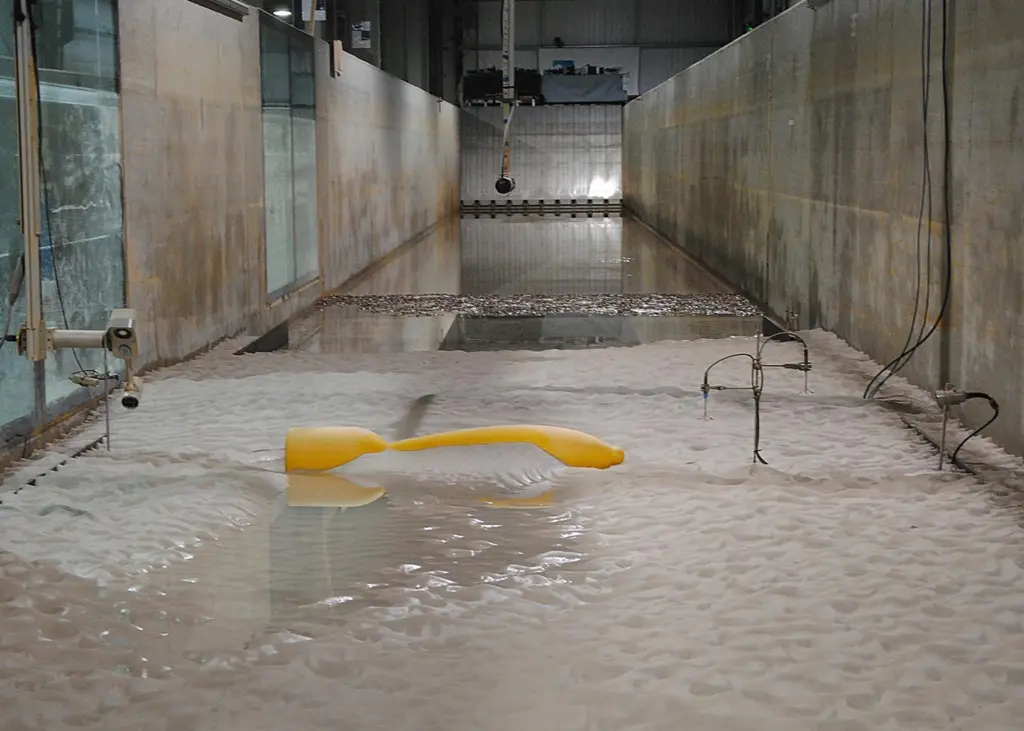
So, HR Wallingford has been using its Fast Flow Facility to help TenneT and the University of Rostock obtain data that will help to predict the movement of unexploded ordnance in the North Sea.
“Our Fast Flow Facility provides a controlled environment in which to evaluate the effects of currents on full-sized UXO, and so provide the University of Rostock with validated data across a range of flow conditions, burial depths and mobilisation speeds,” said Professor Richard Whitehouse, chief technical director, Sediment Dynamics at HR Wallingford.
UXO movement
The University of Rostock is currently developing a model of unexploded ordnance movement for which it has already conducted small-scale modelling.
Now, with co-funding from TenneT, a leading European electricity transmission system operator in the Netherlands and Germany, this new project is seeking to generate large-scale data to better inform and validate this model.
“The ability of the Fast Flow Facility to replicate the scour, self-burial and mobilisation processes involved with UXO prediction at full-scale gives us great confidence in the results,” said Dr Peter Menzel, from the Sediment Transport Research Group at the University of Rostock.
“We are investigating self-burial, so how deeply UXO bury themselves over time, how current speed affects the movement of UXO and how rates of flow affect scour around UXO.”
The end goal of the project is to help ensure that knowledge in the industry about UXO movement is as accurate as possible, improving safety by quantifying, and thereby minimising, the risk to people and equipment.
By Anne-Marie Causer

Related Articles
 OFFSHORE RENEWABLES
 OFFSHORE RENEWABLES
 ENVIRONMENT