![MaritimeJournal[Seawork]](https://www.maritimejournal.com/wp-content/uploads/2026/09/MaritimeJournalSeawork.svg)



Realistic offshore windfarm rescue exercise
Hochtief Solutions has conducted the first comprehensive rescue exercise in the offshore windfarm sector at a construction site in the North Sea (Global Tech I).
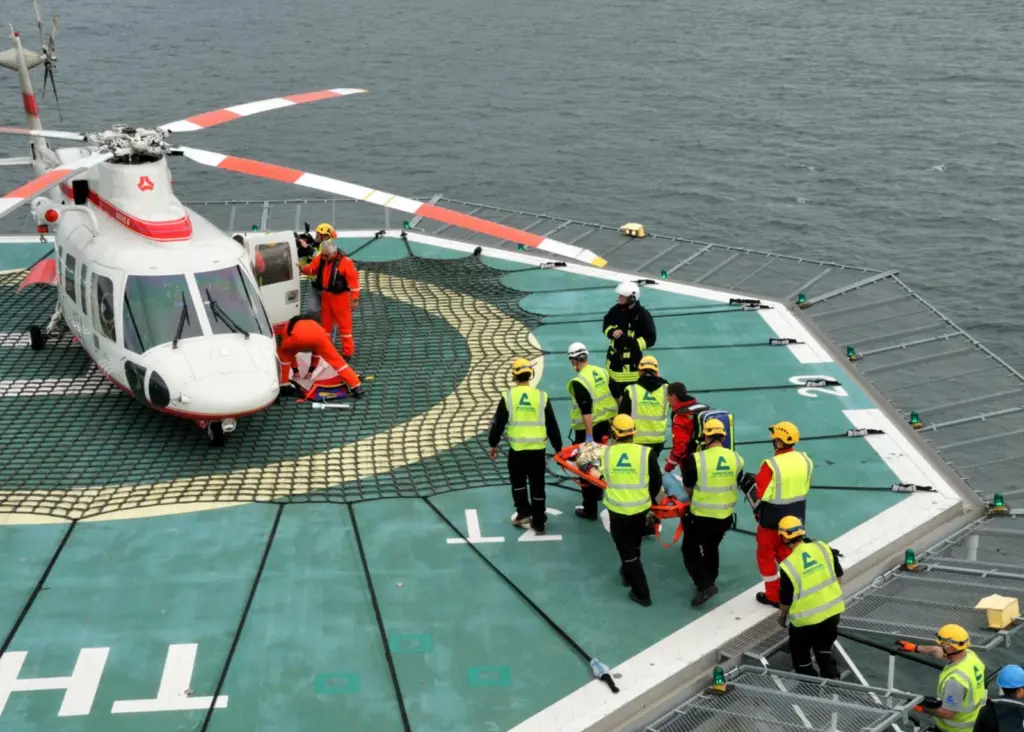
Together with its partners, the team from the Civil Engineering Marine and Offshore branch practiced all processes related to the emergency rescue and the transportation of a severely injured offshore worker on the Hochtief jack-up vessel Thor some 180km off the coast of Bremerhaven.
Hochtief has developed its own emergency and rescue concept against the background of the potentially dangerous activities on board installation vessels on the high seas and the difficulties in accessing such vessels in the case of an emergency.
The rescue concept is embedded into the client’s emergency management concept. It includes professional first aid for an accident victim, deployment of an emergency physician team, setting up internal crisis teams and communication with external participants. Apart from round the clock availability of a rescue assistant capable of providing professional first aid, a rescue helicopter with an emergency physician shall be permanently on call in the case of an emergency via cooperation with Wiking Helikopter Service and the air rescue service ADAC Luftrettung. The aim of the rescue exercise was to completely test this concept.
The concept involves the most sophisticated planning and implementation ever in such a rescue exercise in Germany. More than 80 people were involved in it. Before conducting the exercise only just a few elements of the rescue network were informed in advance. This enabled the most realistic implementation possible of the various processes, from alerting the rescue assistant on board, treatment and care for the victim, as well as transportation in the rescue helicopter and setting up internal crisis teams.
The exercise scenario, a severe occupational accident involving injuries to extremities and the head, which made prompt medical help necessary, was prepared and supervised by an expert group from the ADAC air rescue service (German automobile club) using a remote controlled crash dummy on board the jack-up vessel Thor.
The installation crew provided first aid to the injured dummy and at the same time alerted the on board rescue assistant (cooperation with Promedica rescue service) and notified the bridge and the site manager about the accident. The captain of the vessel coordinated the other rescue measures.
While the rescue assistant was able to provide professional help, the bridge requested the Bremen based emergency office Notfallleitstelle Offshore-Windparks (NOW), operated by the maritime emergency management organization Gesellschaft für Maritimes Notfallmanagement (GMN), to order a rescue helicopter. The site manager initiated the internal crisis alert and crisis teams were established in Bremerhaven, Hamburg and Essen.
Within an hour the ‘patient’ could be handed over to the emergency physician who had arrived by helicopter. The physician took further emergency measures and then accompanied the transportation of the ‘patient’ to the hospital that was best suited to treat the particular complex injuries. The exercise was also monitored by a representative of the professional association of the construction industry (BG Bau).
In addition to an initial internal emergency exercise, which Hochtief Solutions carried out in 2012 to test communication processes between participants, the latest practical exercise was used to specifically test the rescue concept.
“We are very satisfied with the result of our first offshore rescue exercise in the North Sea, said Dr. Stefan Woltering, a member of the management board at Hochtief Solutions Civil Engineering Marine and Offshore. “It fully confirmed our concept. I am proud of the whole team. If this had been a genuine accident, we would in this scenario have saved a human life through consistent and structured action on the part of all those involved. The company was able to conduct the exercise in an ongoing project under realistic conditions.”
“The findings obtained show that our rescue concept on the high seas functions”, added Dirk Schreiber, head of the Health, Safety and Environment department of the branch.
On the German offshore market Hochtieg Solutions is partly oriented to the stringent health, safety and environmental protection (HSE) standards from the UK. On the basis of the strict requirements of the company’s own management system, managerial staff and employees in the offshore sector comply with stringent requirements in the sense of an integrated HSE management, amongst other things in combination with the ISO 9001 standard for quality, ISO 14001 standard for environmental protection and SCC/OHSAS 18001 for health and safety.
In 2012 the Hochtief branch Civil Engineering Marine and Offshore together with its partners also qualified 50 employees in a training course for offshore workers that is unique throughout Europe. Amongst other things, the training involves learning content from the HSE sector. All offshore workers also received professional first aid training. Furthermore, the company itself operates jack-up vessels with its own qualified crews. These employees also received HSE and first aid training.
In addition, Hochtief has an OSHEP Competence Center which ensures that occupational safety and health protection have top priority in the Group. The most important tasks include continually optimizing Group-wide integrated environmental protection and occupational safety management. The Competence Center monitors the implementation of and compliance with regulations in the individual Hochtief units.
Related Articles
 OTHER NEWS
 FEATURES & VIDEOS
 MARINE CIVILS