![MaritimeJournal[Seawork]](https://www.maritimejournal.com/wp-content/uploads/2026/09/MaritimeJournalSeawork.svg)






Schottel Instream Turbine
The recently announced Instream Turbine from German propulsion giant Schottel, allows the harvesting of hydrokinetic (tidal) energy for commercial projects at what Schottel calls ‘a reasonable cost’.
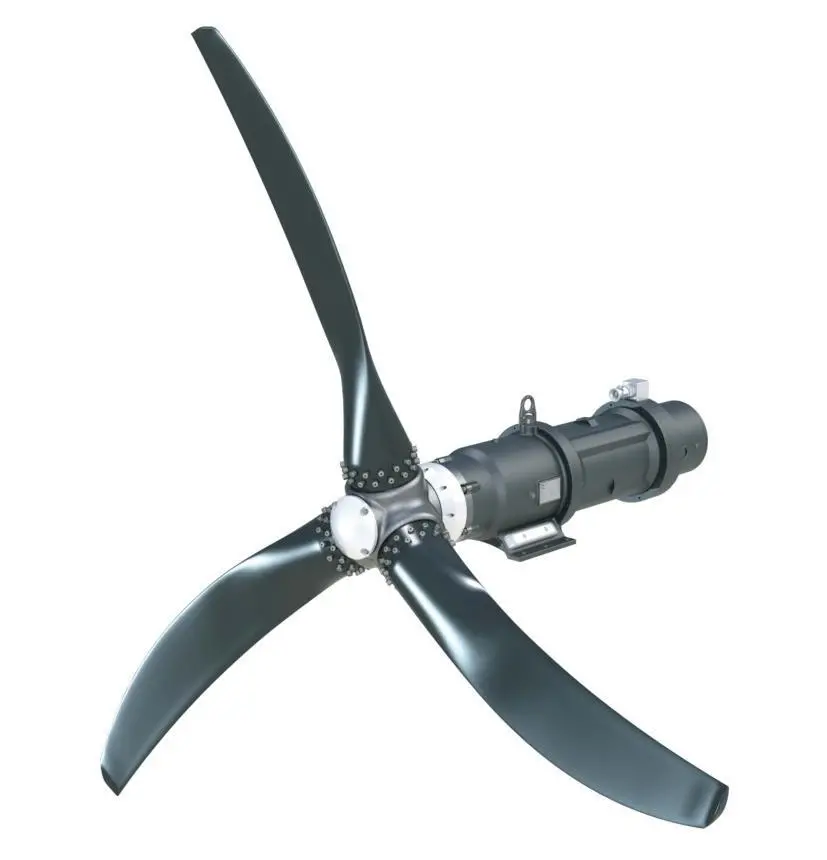
Hydrokinetic energy will play a major role as a future energy source, and Schottel claims that SIT makes it commercially viable for utility-scale and community-scale network applications.
The SIT (which simply stands for ‘Schottel Instream Turbine’) design purposely avoids complex subsystems: SIT features passive-adaptive composite blades with no need for any active pitch mechanism. Its drive train is standardised with a two-stage planetary gearbox and an induction generator. The ambient water ensures a steady operating temperature of the generator, thus no additional cooling mechanism is needed. An optional multi-disc brake is available for very harsh environments or in case it is required by a regulator.
SCALABILITY
“The simple turbine layout results in a robust and lightweight device,” explained Niels Lange, Managing Director of Schottel Hydro, “In contrast to other instream energy converters with nacelle weights of 130t to more than 200t, a single SIT only weighs about 1t.”
SIT turbines are scalable in terms of quantity, depending on the required output. For example 1 MW of installed power requires about twenty SIT turbines. The multi turbine principle therefore leads to an optimum ratio of power and material use. Each of the turbines is connected to a frequency converter feeding into a common DC bus installed on the tidal platform. The system therefore includes redundancy and ensures a high availability of the power plant. SIT turbines are compatible with various support structures: fixed land-based, floating, semi-submerged or full submerged platforms are suitable.
SPEEDS AND SIZES
Schottel Hydro identifies three flow speed standard classes for SIT applications. These classes result in three SIT rotor diameters of five, four or three metres optimised to the respective flow speed and application. Depending on the diameter and the current velocity, one SIT produces between 54 and 70 kW rated, grid-ready electric power.
By Jake Frith
Related Articles
 OTHER NEWS
 OTHER NEWS
 FEATURES & VIDEOS