![MaritimeJournal[Seawork]](https://www.maritimejournal.com/wp-content/uploads/2026/09/MaritimeJournalSeawork.svg)




Schottel tests tidal turbines
In the last months, German propulsion giant Schottel, has successfully tested its hydrokinetic turbines in Strangford Lough, Northern Ireland. The full-scale tests included 260 operating hours under realistic conditions.
The headline results, in which Schottel seem particularly pleased are that one turbine with a rotor diameter of four meters generates 50 kW per second at a rated water velocity of 2.75 meters per second. 10 hours of operation provide enough electricity to supply an average household for a month.
The Strangford Narrows in Northern Ireland is a strait between the enclosed Strangford Lough and the Irish Sea with strong tidal currents. It offers an ideal testing environment for tidal turbines. Due to the long period of testing, the recorded data include a large number of tidal cycles with highly turbulent current conditions.
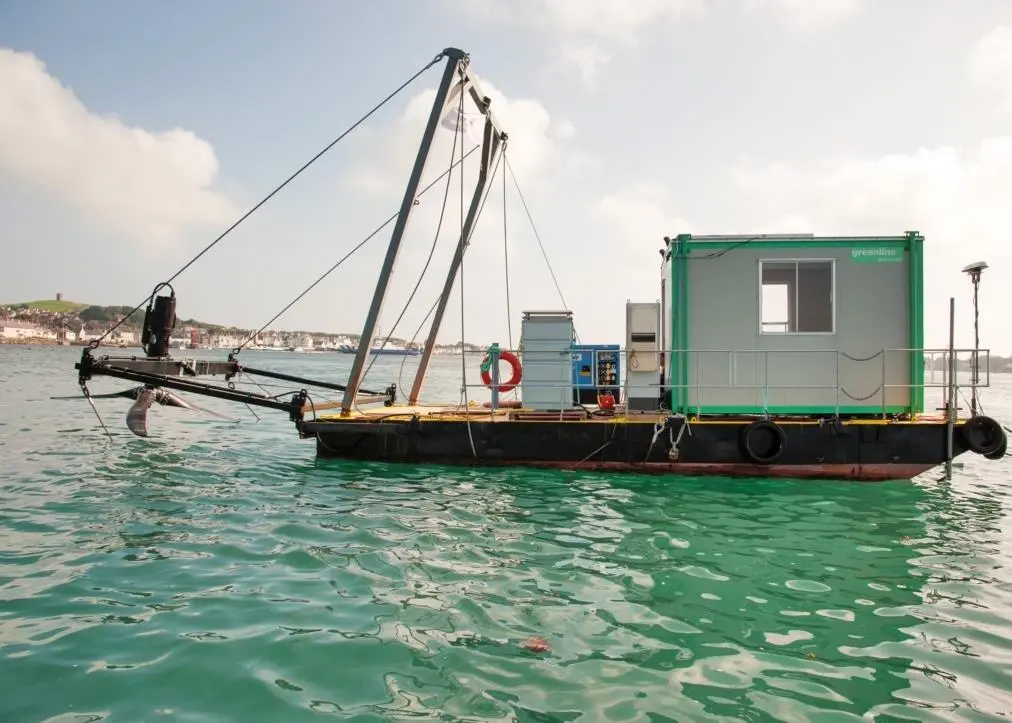
For the trial Schottel attached the turbine with a rotor diameter of four meters to a moored barge. It was mounted on a lifting frame at the stern and lowered down into the operating position for testing. Additionally, the barge was equipped with a large range of measurement devices and sensors to monitor the test results: The turbine shaft rotations, torque and power output were recorded for use in the performance assessment. Load cells measured the resulting thrust force, while detailed measurements of flow conditions were also taken.
The testing method and characterisation of turbine performance have been developed according to the latest standards of the International Electrotechnical Commission (IEC). The test series in Strangford Lough has also been the first scientifically monitored testing of a Schottel turbine, in collaboration with Marine Research Group at Queens University of Belfast, supported by the European Marinet programme. “We greatly enjoyed these fruitful co-operations,” said Dr.-Ing. Ralf Starzmann, Research Engineer at Schottel. “We already tested our turbine under lab conditions and with another sea test, but this time the testing conditions were certainly perfect and most realistic.”
Schottel claim that the recent tests prove once again that its Hydrokinetic Turbines are a reliable and effective solution for hydrokinetic power generation. “Our turbines are based on the fact that reducing turbine size leads to a better ratio of power and material use,” explained Ralf Starzmann, “they produce grid-ready electric power and are individually adaptable”.
The turbines are available with a rotor diameter between three and five meters. They can be used in rivers, sea straits and tidal races offshore, on jetty, floating or submerged platforms in varying quantities, according to the customer’s needs.
By Jake Frith
Related Articles
 OTHER NEWS
 OTHER NEWS
 FEATURES & VIDEOS