![MaritimeJournal[Seawork]](https://www.maritimejournal.com/wp-content/uploads/2026/09/MaritimeJournalSeawork.svg)



Sensory perception for wind farm workboats
Firms in the shipping and marine industry continue to benefit from efforts to innovate around sensor technologies, writes Jesse Bonfeld of Sherborne Sensors.
Load cells are employed to manage hoist and mooring loads, platform retention and towing forces, while inclinometers can monitor how much a vessel is pitching or rolling and are also found in ballast transfer systems, where they check a vessel’s load balancing to ensure safety and optimum trim.
However, accelerometers are currently attracting interest, with the industry looking to develop motion control systems to measure and improve passenger comfort. This has been a goal of the military for some time. Where special operations teams are transported to hot zones via small tactical vessels, they can often arrive incapable of completing the mission.
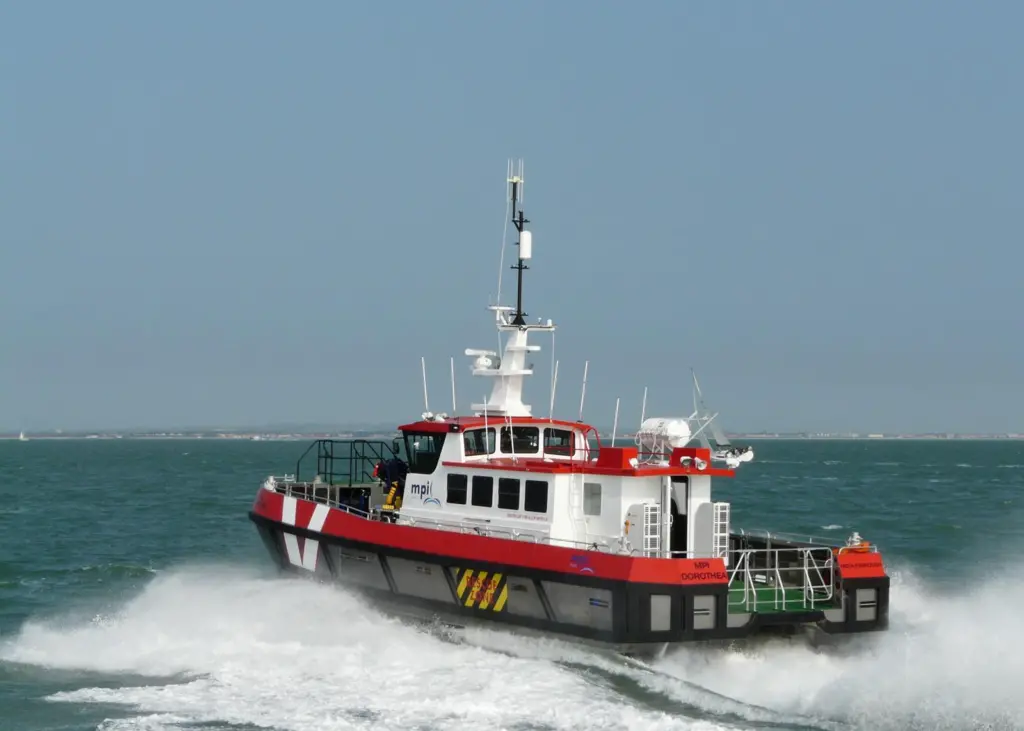
More recently, this has proved a problem in the fast growing market for offshore wind farm support vessels.
In a perfect journey, as the wave builds, the vessel climbs to the crest and declines the other side. Unfortunately, the wave either breaks early or breaks late, forcing the hull of the vessel out of the water. When it re-engages with the water, the slapping motion generates a vibration and a change in acceleration.
This is exactly the type of motion an accelerometer is designed to measure. When the slap occurs, the accelerometer assigns a numerical value to the force of the impact, which can then be translated into level of passenger discomfort. Within a motion control system, it would be possible to employ the real-time data provided by an accelerometer to decide whether to increase or decrease the speed of the vessel.
If the shocks being experienced are below whatever threshold is deemed acceptable, the vessel can go faster to make the trip shorter. Likewise, if the shocks are above the threshold, the vessel can slow down to greatly improve the level of passenger comfort. The data logged could subsequently be used to associate distance travelled, potential speed and expected journey time against anticipated weather conditions.
Given that any kind of vessel carrying a significant number of people over distance already has a series of control systems and sensors associated with propulsion and navigation, the available data could be integrated with that from a motion control solution and reported to the ship’s captain manually, or form part of an automatic intervention like a cruise control system.
It is a lot easier to control the rocking motion of a vessel than the slapping that results from hitting the wrong part of a wave. Gathering more data via the use of accelerometers not only makes it possible to put some relative measure on the comfort of the passenger, but might also lead to the development of technology or improvements in hull design that can address it.
Related Articles
 OTHER NEWS
 FEATURES & VIDEOS
 MARINE CIVILS