![MaritimeJournal[Seawork]](https://www.maritimejournal.com/wp-content/uploads/2026/09/MaritimeJournalSeawork.svg)




Shipping sectors show confidence in offshore wind
After a decade of caution, established maritime sectors including offshore oil and gas are showing increasing interest in offshore wind, indicating confidence in the industry’s future.
The early days were suitably representative of the word pioneering. Technicians were ferried out in small commercial fishing vessels, mooring up alongside turbines. Non-propelled jack-up barges, adapted from the marine civil construction industry with limited deck space and crane capability, were pressed into service as installation vessels. Both sectors have steadily evolved, in particular the potential shortage of installation vessels suitable for the increases in water depths and turbine size and numbers. Long vessel construction lead times were soon recognised, resulting in a flurry of orders for dedicated installation vessels. This programme may now be all but complete but some commentators suggest even more will be required in the long-term. Readers of MJ will be more than aware of the phenomenal growth of the crew transfer vessel market, again another sector gradually evolving, but one that may soon be heading for change. Vessel requirements go far beyond these two sectors however and include: surveys, cable trenching, laying and burying; turbine component transport and long-term O&M requirements.
HEAVY GETS HEAVIER
When built back in 2003, what is now the installation vessel MPI Resolution was considered ahead of its time but now has an impressive record of turbine installation behind it. It is telling that when less than ten years later, MPI Offshore ordered two new vessels, they chose beefed up versions of the same basic principles found in the MPI Resolution, a self-propelled six-legged jack-up based on a conventional ship-shaped hull with deck space and crane capacity to install up to nine turbines per round trip.
Cost reductions through innovation have been explored with the installation of foundations and transition pieces (TPs). At this stage, height is not such an issue compared to the turbine and blades phases. Weight, while not insignificant, is however within the capabilities of cranes on conventional heavylift ships. Jumbo Shipping has been active here and in 2010 its DP2 heavy-lift vessel Jumbo Javelin installed 131of the 140 TPs at Greater Gabbard windfarm, the first time such components had been transported and installed with a free-floating vessel using DP. Jumbo later completed a similar operation at Denmark’s Arnholt windfarm.
Other innovations aimed at cost cutting could provide new opportunities for the maritime transport industry. While traditional methods involve installation vessels returning to port to load components, planners have explored the idea of supplying them via a shuttle service of conventional cargo carriers loaded with components. This allows the installation vessel to spend the bulk of its time carrying out its prime role, taking advantage of what can be restrictive weather windows. The supplying vessels of course need to be capable of carrying larger and heavier components, ideally with DP for manoeuvring close to the installation vessel. Finnish project cargo specialists, Meriaura Group, have been active here, including supplying monopiles and TPs directly to the installation vessel Svanen during construction of the Sheringham Shoal offshore windfarm.
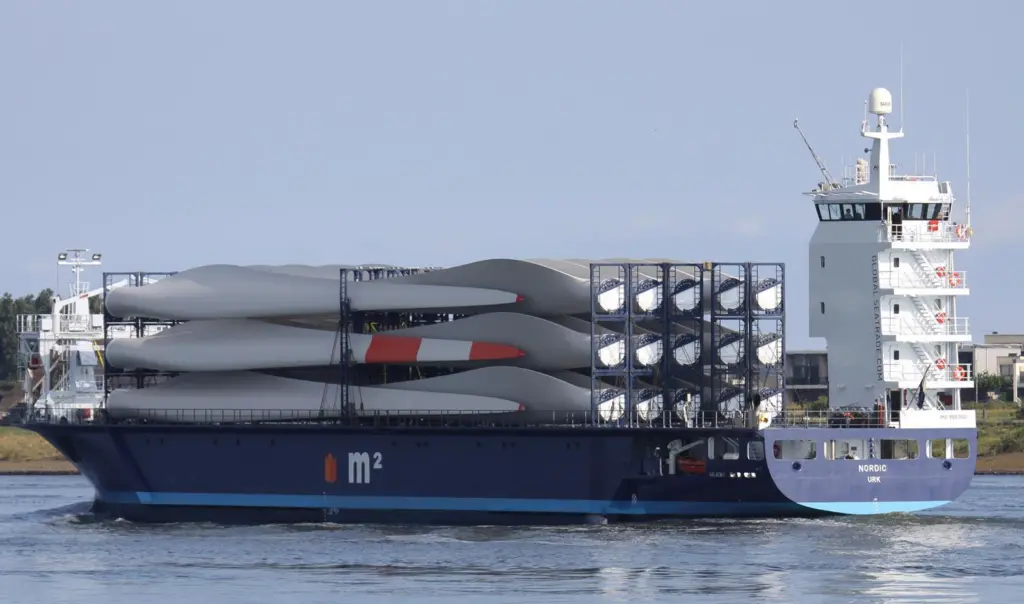
The general cargo and heavylift shipping sectors have been handling transfers of onshore windfarm components for decades, for them just another outsized specialist cargo project. With the likes of Vestas and Siemens now developing offshore turbines of 8MW and 6MW respectively however, individual component size is increasing. Vestas’ 8MW turbine blade is 80m long compared to 44m of their popular V90-3MW model, in turn requiring ships capable of transporting these larger components and, importantly, in a cost-effective manner. Once again exploring innovation, there can be no better example than with the M² Runner class of three specialist cargo carriers built for Global Seatrade. Able to accommodate a range of specialist cargoes, the requirements of the wind energy market are a particular target for these vessels. Cargo space and volume are seen as more important than deadweight, and the design focuses on maximising deck space area. A compelling visual feature is the slender accommodation block on the vessels’ starboard after corner, taking up only around one third of the vessel’s beam. Clever attention to detail has produced a vessel below 3,000gt and 85m length, permitting lower crew requirements and space-saving benefits including no requirement for a free-fall lifeboat. It is claimed they can carry 80% to 100% more turbine parts than other vessels of similar deadweight.
TAPPING EXPERIENCE
It is important to acknowledge that offshore oil and gas industry involvement in offshore wind has been evident since the very beginning. Offshore wind largely evolved however from its onshore cousins, rather than oil industry experience taking the lead transferring the technology from a dry to a wet environment. This is changing with projects moving into deeper and more hostile waters substantially further offshore. Scotland’s target of generating 100% of its domestic electricity from renewables (including marine renewables) by 2020 is also geographically convenient for the concentration of oil industry expertise and resources in Scotland.
The supply chain covers a broad spectrum including manufacture of foundations, turbines and subsea cable, but also services including vessels and expertise. A factor with oil industry involvement, particularly vessel availability, is levels of demand within their own arena and differences in charter rates commanded by the two industries. A steady stream of newbuilding offshore support vessels have entered the market in recent years, allowing older tonnage long paid for, to become available for other work. Such vessels have for some time now been adapted for gainful employment in various roles in offshore wind, including stand-by safety, guard boat, survey work and cable-laying.
Satisfying cable-laying requirements of offshore windfarms has been a particular sector to test the ingenuity of those involved. Subsea cable-laying has its origins in the mid nineteenth century. Unique factors with offshore wind however have proven to be particularly challenging. Both the export cable and inter-array elements usually involve comparatively short distance runs, especially with UK projects close to shore. Shallow water and strong tidal conditions also present challenges including the requirement to lay short runs of cables between individual turbines involving manoeuvring in restricted areas between turbines and sub-stations. In the early days, non-propelled work barges were modified for cable-laying, requiring a mooring spread and attendant support vessels to handle the barge itself and anchors, a solution that delivered mixed results.
An alternative was to use DP equipped vessels, suitably adapted for cable-laying and this option soon became one of the most visible examples of the use of vessels more usually seen in the oil industry. Norwegian owner Solstad Offshore, primarily involved in the oil industry, contributed to cable laying activities at two of the UK’s most significant windfarm projects, mobilising their offshore construction vessels Normand Mermaid and Normand Flower for inter-array cable-laying operations at Thanet and London Array respectively. GC Rieber Shipping’s construction support vessel Polar Prince is another example with involvement in inter-array cable-laying at the Thanet project. Dredging and marine construction industries have also been quick to identify potential opportunities. Stemat Marine Services’ DP2 workboat Stemat Spirit, built in 2010, is an example of vessels particularly suited for cable-laying in shallow water, carrying out work at, for example, London Array, Ormonde and Walney 1 and 2 windfarms. Dutch marine contracting giant Boskalis recently introduced two similar shallow-water multi-purpose vessels, Ndurance and Ndeavor, to the market. Initially they are fitted out for cable-laying and stone-dumping duties respectively and suitable for mobilisation in the offshore wind industry if required.
OPERATIONS AND MAINTENANCE
An area with significant potential for tapping into offshore oil and gas industry expertise is long-term provision of O&M services, an area seeing recent developments of interest. It is recognised that there is a limit to the existing model involving catamarans, mostly below the 24m, 12 passenger HSC/SOLAS regulatory limit maintaining a ‘day work’ rota transferring technicians to the turbines. As windfarms move further offshore, the transit times each way, on top of a full day’s work makes for a long working day with H&S implications. It can, after all, be a somewhat more exacting commute to work than the typical shore job equivalent. A number of options are available, an important factor being the length of stay offshore. These can include larger capacity vessels operating along similar lines with accommodation suitable for remaining on location for a few days at a time, up to larger floatels, typically converted ferries, offering superior accommodation with technicians remaining offshore for typically a month, smaller shuttle transfer vessels taking them to work to individual turbines each day. Day working with helicopter transfer is another option being explored.
A number of motion-compensated transfer systems suitable for small transfer vessels are available but the larger floatel and shuttle craft option usually still involves the transfer craft maintaining physical contact with the turbine itself, influencing the number of working days depending on conditions.
Recent developments originating from the oil industry have the potential however to establish a model that could become a serious contender for cracking this particular nut. Since the very start, offshore oil and gas exploration has required vessels to maintain accurate position very close to fixed structures, often for long periods. These include platform supply, dive support and offshore construction vessels typically between 70m and 150m LOA, DP equipped and capable of accommodating up to 150 persons for extended periods. Another development significant to the case for offshore wind is the development of motion-compensated offshore access systems, Ampelmann systems being just one typical example, allowing safe transfer of personnel for prolonged periods, no direct contact required between the ship itself and structure.
Adopting these elements for the operation and maintenance of windfarms may therefore seem a natural progression and potential opportunities have not gone unnoticed by the offshore industry. At the time of writing, Siem Offshore AS was planning to take delivery of the Siem Moxie, (to be featured in a forthcoming MJ), an SX163 design vessel featuring Ulstein’s patented X-Bow and a three-axis motion compensated 5t SWL offshore crane suitable for repairs, maintenance and general service duties for both renewables and oil and gas markets, publicity material emphasising its potential windfarm role. Similarly, Danish company Esvagt, well-known in the oil and gas industry, recently announced orders for two Havyard design ships to service offshore windfarms, including personnel access systems. Both the Siem and Esvagt examples originate from the oil and gas vessel design stables. Netherlands based Damen, well known as prolific builders of a wide range of specialist vessels, recently unveiled its own proposal for a windfarm service vessel. Called a ‘walk-to-work’ vessel, the design involves a ship 90m long with accommodation for 45 technicians, remaining at sea on one month tours. As with the previous two examples, DP capability, motion-compensated gangways and suitable craneage is included. These three features alone could well set the scene and crack the aforementioned nut when it comes to the provision of O&M services at the deepwater windfarms of the future.
This article has only covered offshore wind’s influence on the marine support vessel scene in general. If one expands the definition of supply chain to include components such as foundations, both monopiles and jackets and other services, the industry is possibly now on the brink of seeing a far-reaching influence of the oil and gas industry in offshore wind with significant cost saving potential through the former industry’s long and respected history.
By Peter Barker
Related Articles
 OTHER NEWS
 FEATURES & VIDEOS
 MARINE CIVILS