![MaritimeJournal[Seawork]](https://www.maritimejournal.com/wp-content/uploads/2026/09/MaritimeJournalSeawork.svg)






Simulator for underwater marine power plant
Swedish marine energy technology company Minesto has developed a simulator to aid the development of its Deep Green anchored flying underwater vehicle marine power plant.
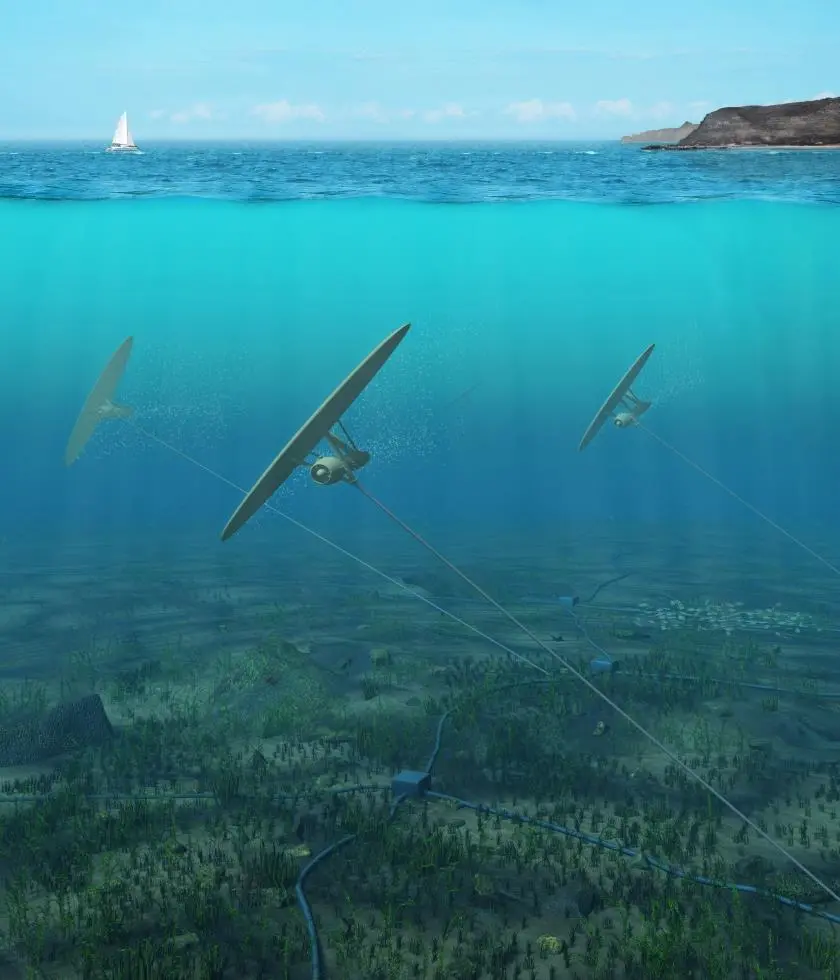
Deep Green is claimed to be the only marine power plant that is able to cost efficiently produce electricity from low velocity tidal and ocean currents.
The simulator has been developed in-house by Minesto’s own research and development department, and is in essence based on two existing open source programs: one for commercial flight simulation and one for marine vehicle simulation.
The end result is an analysis and simulation tool called HAMoS, Hydrodynamic Analysis and Motion Simulation, believed to be the first in the world to simulate the movements of a flying tethered underwater vehicle. It will be used to predict how Minesto’s marine power plant, Deep Green, moves subsea in various ocean environments and depending on the plant’s design.
Minesto’s research, development and testing staff can change a number of variables in the power plant’s design to simulate and optimize its performance. The simulator can be used to predict Deep Green’s behaviour and power performance in different real-life site conditions.
Deep Green resembles a sweeping underwater kite, comprised of a wing and a turbine, which is secured to the seabed with a tether and moves with high speed in an 8-shaped path in the tidal or ocean current. Deep Green produces 100% renewable tidal energy.
HAMoS combines CFD analysis with a flight simulator and a simulator for marine vehicles. The CFD analysis is used to calculate lift, drag and added mass acting on the body. The flight simulator is used as the main simulation platform formulating the equations of motion. It utilises both the results from CFD computations and also specific formulas for underwater motion from the marine vehicles simulator.
Related Articles
 OTHER NEWS
 FEATURES & VIDEOS
 MARINE CIVILS