![MaritimeJournal[Seawork]](https://www.maritimejournal.com/wp-content/uploads/2026/09/MaritimeJournalSeawork.svg)

Six platform problems
Short sighted platform design and a tendency to place short term cost savings over full lifecycle costs are increasingly complicating subsea cable installation projects for offshore wind farms, according to an industry expert.
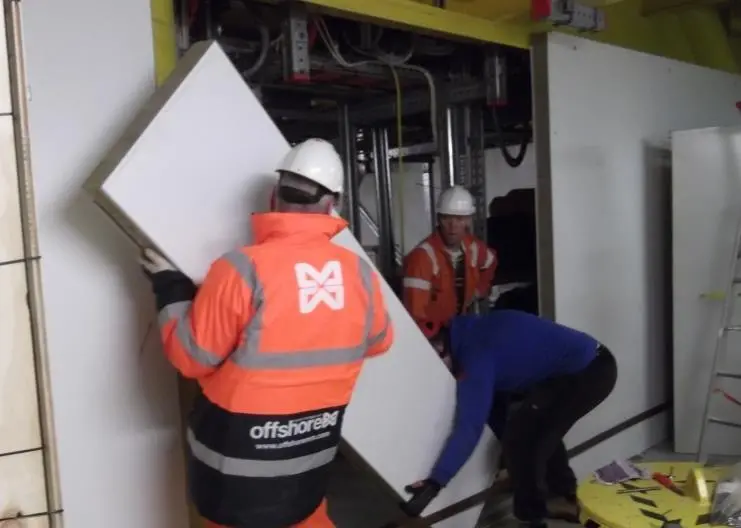
Maritime Journal spoke to Paul Hampton, operations manager at Offshore Marine Management, who draws on recent project experiences in the German Bight and discusses how he believes improving offshore platform design can reduce costs, both during construction and throughout the operational lifecycle of a wind farm:
“At Offshore Marine Management (OMM), we are faced with many design issues surrounding platforms and often have to invest a great deal of time into mitigating problems and devising solutions before we can even begin our work.
“Due to the nature of our work in offshore locations, we’re exposed to the elements such as wind and waves so it’s vital that safety is our top priority while we deliver services such as cable installations, repairs and maintenance, as efficiently as possible. Unfortunately efficient work practices are being compromised, with platforms only providing very basic facilities – a result of designers trying to minimise costs and focussing on the end result rather than a total picture.”
With these full project lifecycle efficiency gains potentially up for grabs, it is clear that it is becoming more and more important for designers to consider the entirety of platforms as well as what is required of the end product. Here are six of the problems that OMM has repeatedly encountered in platforms and towers:
INSUFFICIENT ACCESS
For the correct routing of cables through a platform it is necessary to pass the cables through room bulkheads. On several platforms OMM have worked on recently, the openings have been extremely tight for them to pass the cable through. The worst example was a 300mm x 300mm hole which gave less than 25mm clearance per side – posing a potential risk of damage to the cable.
OMM resolved these issues by setting up additional rigging to assist in guiding the cable through, however this slows the processes down.
To help mitigate this issue, designers could perform a review of cable sizes which are routed through various bulkheads. Additionally, an understanding of the cable installation process would better enable them to allow suitable space.
LACK OF STRONG POINTS
Strong points on the platforms to attach equipment to are essential; without these, specialist such as OMM are unable to attach the necessary installation equipment, including winches and pulleys. In many cases Paul cites, strong points have either been missing or were in poorly sited locations meaning it was unsafe to carry out work. On many occasions OMM have had to design and install strong points offshore, or modify the installation process around what is available, but both solutions have taken up time and resulted in additional costs.
INADEQUATE LANDING AREAS
Another example of design issues complicating cabling work was OMM’s experience of a platform landing area that was too weak to support the weight of the equipment necessary to perform the pull-in. This caused delays as they had to identify and revise a suitable route for transferring the equipment.
RESTRICTED ACCESS
Adhering to strict health and safety practices is vital for any offshore work. In vulnerable offshore conditions where contractors are often faced with strong wind and fierce waves this can be a challenge, especially when you mix this with live cables and trying to gain access via boats and helicopters.
Many platforms are designed for cables to be inserted in a sequential manner. However, the cables OMM, and many other similar organisations, work with are not necessarily being installed in the sequence originally envisaged.
To resolve this, where space allows, OMM have to construct scaffold towers to provide better access into the platforms. Designers are therefore urged to review cable sequences to gain a better understanding of the installation process.
UNEXPECTED INFRASTRUCTURE
To help assist with installation planning, drawings are provided by platform designers which often do not reflect the actual infrastructure and items inside platforms, such as beams, bulkheads and fuel tanks. Often these have been placed in the most convenient site rather than the location shown on the drawings. This may restrict the route available for cables and requires a comprehensive site visit prior to installation.
INSUFFICIENT SPACE
Finally, where a jack-up barge is not in place to support installation work, there is often a severe lack of space for equipment containers. To get around this, equipment containers are placed away from working areas and tools and equipment are moved manually, as and when required. Consequently, there is a time loss issue as the time to mobilise equipment significantly increases, ultimately putting pressure on to the overall project schedule.
Platform designs need to incorporate space for equipment containers and where permanent space for the storage of equipment is not possible, a temporary structure should be built to land equipment containers, this can then be removed following the completion of the work.
LESSONS
In conclusion, the global offshore renewables industry has a responsibility to ensure that all processes, leading to the smooth operation of offshore generators, are built upon solid foundations and close collaborations. OMM would encourage designers of offshore platforms and towers to gain an understanding of the scope and complexity of a subsea cable installation project.
The lessons OMM has learned, having this year alone completed ten cable pull-in projects totalling 39 cable pulls for the European Offshore Renewables industry, prove that more consideration needs to be given to the functional requirements of platforms and that potential cost savings should be viewed holistically.
By Jake Frith
Related Articles
 OTHER NEWS
 OTHER NEWS
 FEATURES & VIDEOS