![MaritimeJournal[Seawork]](https://www.maritimejournal.com/wp-content/uploads/2026/09/MaritimeJournalSeawork.svg)


Suction Bucket innovation at Dogger Bank
The Forewind consortium will employ an innovative new foundation design concept when it installs two meteorological masts on the Dogger Bank offshore wind farm zone.
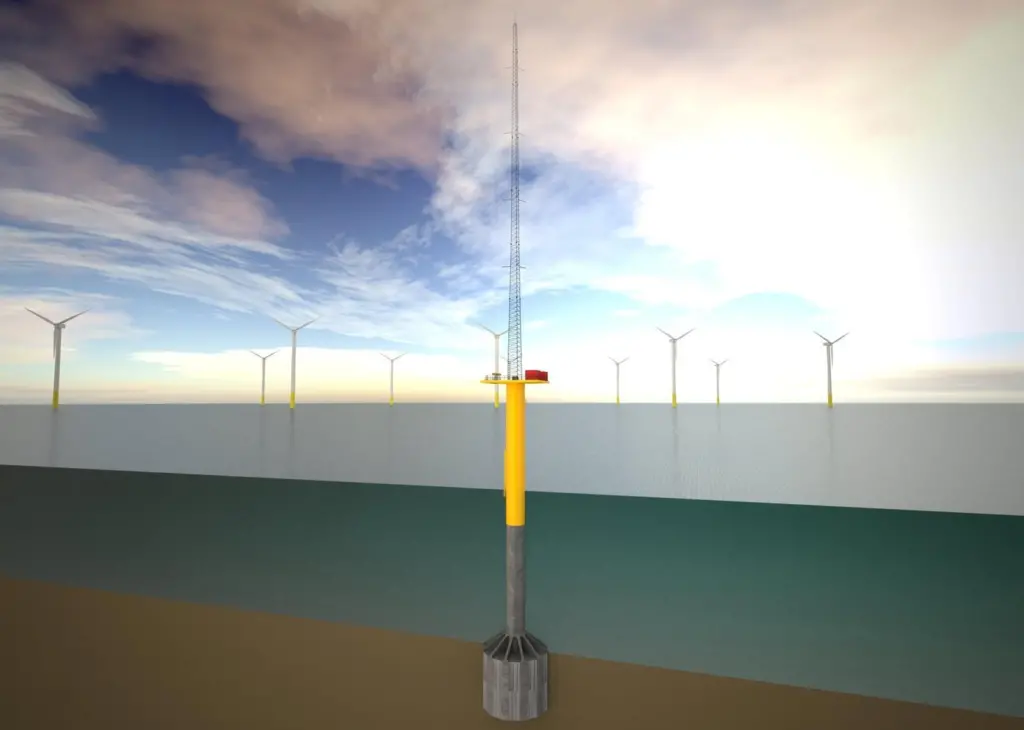
The consortium, which consists of Statoil, Stakraft, RWE, and Scottish and Southern Energy, is developing a site which could meet up to 10% of the UK’s energy requirements at the Doggers Bank site, located between 125 and 290 km off the UK’s North Yorkshire coast. It covers a vast 8,660 km2 and could eventually have more than 2,000 individual wind turbines, becoming the world’s largest offshore wind farm.
Forewind has signed a contract with Fred. Olsen United AS to design, construct and install the two met masts and foundations at the site by late 2012. Fred. Olsen related companies Universal Foundation A/S, SeaRoc and Fred. Olsen Windcarrier will provide the foundation design, topsides and installation respectively. Harland and Wolff will produce the foundations for the met masts, which will monitor wave and wind conditions at Dogger Bank, in Belfast.
The foundation design, known as a suction installed bucket, was identified as part of the Carbon Trust’s collaborative Offshore Wind Accelerator programme, an initiative which aims to reduce the cost of offshore wind energy by 10% via research, development and demonstration.
The Carbon Trust held a foundation design competition that attracted 104 entries from throughout the world and resulted in seven finalists including the suction bucket, designed by Danish specialists Universal Foundation A/S.
The foundation is guided into place via an operator varying the pressures within hundreds of water jets integral to its base, as the vacuum sucks it into the seabed. It uses less steel than conventional piled foundations and its design removes the need for pile driving, seabed preparations, scour protection and a transition piece.
The foundations will be installed on Dogger Bank using Fred. Olsen Windcarrier’s new 132m jack-up vessel, Brave Tern, which is now under construction.
To confirm the performance of the innovative foundations, verify the design parameters and measure the loads and conditions they endure on Dogger Bank, one will be equipped with strain gauges, meters and data collection systems.
Royal Haskoning has agreed a framework with Forewind to provide coordination and lead consultancy roles for Environmental Impact Assessments (EIAs) relating to projects within the Dogger Bank Offshore Wind Farm Zone.
The EIA process is vital to ensure that a development consent order to proceed with the scheme is gained from the Infrastructure Planning Commission (IPC), which approves all nationally significant infrastructure projects.
Complex and wide-ranging, the EIA and pre-application process involves initial site selection for all components of onshore and offshore infrastructure, route-finding for export cables, planning and executing survey programmes, undertaking data analysis and interpretation and extensive stakeholder consultation. The EIA for the first project of the Dogger Bank was due to be submitted to the Infrastructure Planning Commission (IPC) last month.
Royal Haskoning will provide EIA services for both the onshore and offshore elements of the individual projects. As well as the turbines and undersea cables to convey the electricity to the shore, each project will need to be connected to an onshore converter station.
Related Articles
 OTHER NEWS
 FEATURES & VIDEOS
 MARINE CIVILS