![MaritimeJournal[Seawork]](https://www.maritimejournal.com/wp-content/uploads/2026/09/MaritimeJournalSeawork.svg)




The Crown Estate, promoting safety for offshore wind
Of the many factors developers have to consider when planning various phases of offshore wind projects, arguably the most important will be health and safety considerations.
Despite similarities with other closely related industries, there are however specific differences with offshore wind that require careful thought if the potential of overburdening and restrictive regulation, resultant from an unhealthy safety record, is to be avoided.
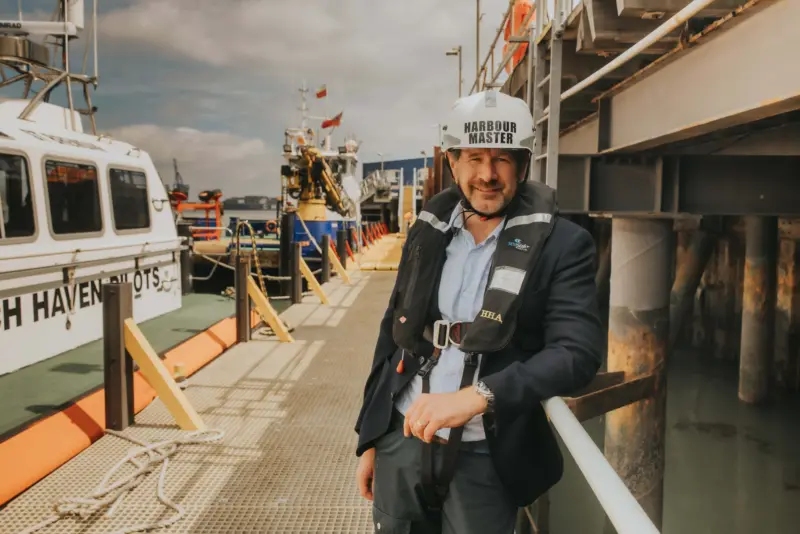
In the last of MJ’s exclusive interviews with The Crown Estate (TCE) in London, marine renewables correspondent Peter Barker talks to Peter Hodgetts, Marine Health & Safety Champion at TCE, to see how the organisation’s role of helping steer the industry through the various strands of windfarm development in UK waters, deals with this most important of subjects.
After a career at sea when he gained his master’s ticket, Mr Hodgetts attained a degree in mechanical engineering (he describes himself as ‘a kind of weird hybrid mixing oil and water’) and following 25 years in the oil and gas industry, including a role of warranty surveyor, has spent the last twelve years in the renewables industry, primarily offshore wind. While clearly qualifying as an expert, he expresses the view that once someone decides they are an expert they stop learning. He sees learning as a vital part of addressing H&S within the industry.
DIFFERENT RISK PROFILES
Mr Hodgetts sets the scene of the early days in the industry: “It wasn’t an offshore industry, it was an onshore industry with turbine manufacturers, utilities, developers, maybe civil engineers who have worked out of harbours thinking, well it is shallow, slightly wet, not too deep so probably the same as onshore, without realising the consequences, and we are still, I think, building that awareness in the industry of what offshore means from a safety point of view.”
He visits developers and meets a small handful of marine or offshore people, stating that while there isn’t a huge amount of experience in depth, the experiences of those involved in Round 1 and 2 are now starting to feed through.
While recognising the industry can learn from oil and gas, Mr Hodgetts points out that the risk profile is quite different. Offshore wind doesn’t have the hydrocarbon risk element of oil and gas for example, but aspects such as the relevance of soil conditions are an example of differences that dictate design and operation that impact on safety. “When I first looked at where were we going to build these windfarms, in shallow water, on sandbanks? Can you think of a worse place to take boats? Its steeper waves, tidal conditions. I give this background to put into some context where we are as an industry”.
The Crown Estate’s deeper involvement in Round 3 over previous rounds, includes a benchmark of 25% of the ‘marks’ for H&S in the tender rounds, something Mr Hodgetts described as a big wake up call to the industry, pushing it higher up their agenda. TCE’s relationship here is an ongoing process, including a series of milestones developers have to comply with, including mandatory reporting of incidents and monthly forums involving H&S managers.
Together with RenewableUK and DNV, TCE recently launched a new vessel safety guide for the development phase of offshore renewable energy projects. Mr Hodgetts describes the thinking behind the publication: “We found a lot of developers were rushing out to their various bird, geophysical, geotechnical surveys with a big demand on vessels and they were pretty much grabbing what was there rather than what I call fit for purpose, simply because developers didn’t know the questions to ask. It wasn’t that they were being negligent”.
Intended to be first of a series of safety documents, the vessel safety guide addresses issues facing developers, including vessel selection and regulatory aspects. Mr Hodgetts is keen to allay concerns of yet more paperwork. “The idea of the guidelines was not to have another layer of what you should or shouldn’t do, but to point people in the right direction”.
The UK Health & Safety Executive (HSE) also aim for no new regulations, but keeping a watching brief on the industry, which after all has been operating in the area of offshore oil and gas for over 40 years. Offshore wind is presenting different risk profiles however.
A feature with offshore wind is the two regulatory disciplines that apply. For example a jack-up is a ‘vessel’ while underway, conforming to MCA regulations, but becomes an ‘offshore installation’ conforming to HSE regulations once jacked-up. Mr Hodgetts explained that a memorandum of understanding exists between the two bodies, the industry also coming under the CDM Regulation 2007. He added, “We have to apply robust H&S standards that don’t confuse people and we are finding that the CDM regulations are becoming the principle vehicle we are using for projects.”
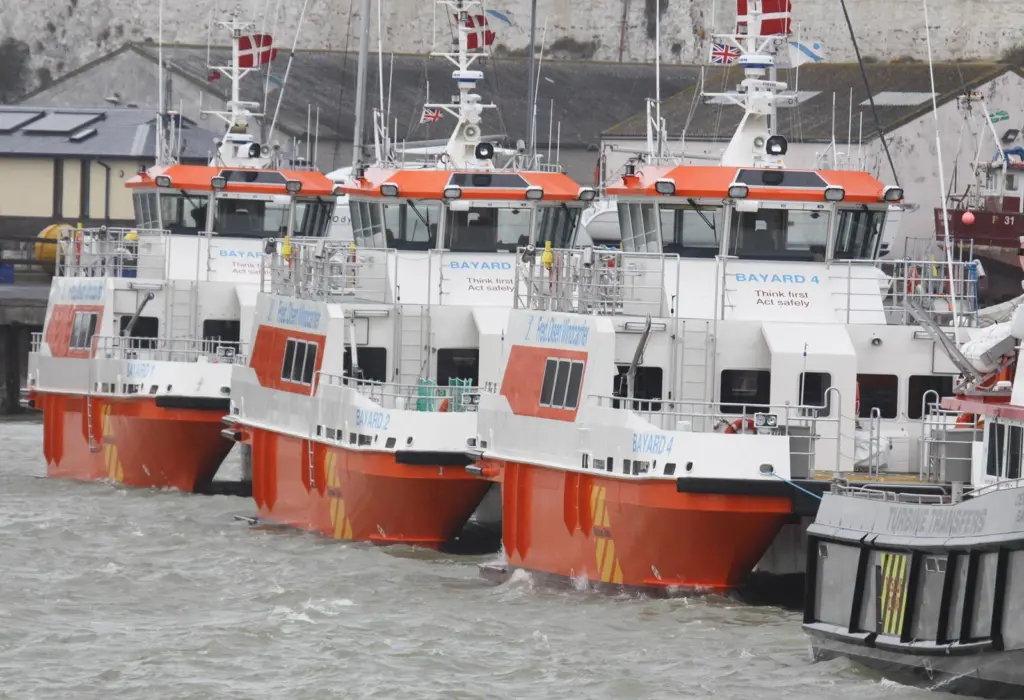
Addressing the increasing number of smaller craft working in the industry, Mr Hodgetts reports positive progress with safety issues. “A number of companies including Turbine Transfers and Windcat Workboats are talking about training courses and even a training academy because they recognise there is a pool of people with qualifications but there are also unique elements about our industry, not least the huge number of crew transfers. Are they ahead of it? hard to say, resources are a challenge for the industry”.
While acknowledging the importance of local knowledge, he says it is equally important that appropriate benchmarks are set with recognised vessel standards and personnel qualifications. He states that developers’ ambitions to maintain vessel standards are demonstrated by them almost certainly instructing their own marine warranty surveyors when chartering vessels, alongside the relevant checks made by the MCA.
THE CROWN ESTATE’S ROLE
Mr Hodgetts describes TCE’s H&S role as being a facilitator, stating, “We look to prompt people, pull them together, arrange workshops. It’s not for us to tell people what they should be doing but to be the catalyst to prompt people to get it right. It is our responsibility to be answering the questions and telling people what the expectations of the industry are”.
TCE’s responsibility covers only UK waters, different regulations applying at windfarm projects ‘over the border’, for example in The Netherlands and Germany. Mr Hodgetts stated that TCE liaises regularly with other European countries, everyone wanting to see common standards across national boundaries, adding that the same developers, such as E.ON and RWE for example, operate in different countries.
The Crown Estate, along with the industry, is keenly aware of the potential reaction from regulators should a bad safety record develop, not to mention the personal and financial costs. As Mr Hodgetts explains, “I think as an industry we are trying to stay ahead of regulation and trying to set really robust attitudes to H&S so we don’t have a disaster that brings the HSE down on us with a whole set of regulations. We are a young industry, vulnerable to reputational risk, and a major incident would be damaging for all of us.”
Gathering and collating incident data is important and together with RenewableUK, TCE has developed an accident database, although it is a voluntary one. He states there is a big push at present to encourage more anonymous reporting which can lead to ‘lessons learned’ safety alerts circulated throughout the industry.
Personnel qualifications are a complex area for the industry, applying to vessels from small RIBs up to jack-up installation vessels. Mr Hodgetts explains, “A qualification is necessary, but experience is even more valuable. Getting a qualification doesn’t mean you are competent in certain situations. The International Jack-up Barge Owners Association has developed ‘passports’ that are a combination of not only a record of qualifications but also of work experience, which I consider is just as important.”
Of particular relevance is the situation where, as the onshore wind industry has moved offshore, technicians who are well qualified in their role may not be familiar with working in a marine environment, particularly with the unique method of commuting to work. Mr Hodgetts states he is “worried” about the implications of a potentially rough, hour long journey to work, an 80m climb to the top of a turbine, then an eight to ten hour working day before returning ashore.
Turbine manufacturers are, however, quickly learning lessons, introducing rigorous training schedules and, importantly, sending technicians offshore first, to assess their suitability to adapting to this different environment. Mr Hodgetts makes an important comparison with oil and gas, “You typically go offshore for two weeks, you don’t have alcohol, you certainly don’t have an hour’s transit to work and I think one of the things as an industry we are looking at is the occupational H&S of people as well because we have to be cognisant of what we are putting these people through before we start getting incidents caused by that lifestyle.”
The importance of TCE’s H&S role in the big picture cannot be underestimated, something they are clearly aware of and promoting.
The author and MJ would like to thank TCE and the interviewees for facilitating this series of articles.
Related Articles
 OTHER NEWS
 FEATURES & VIDEOS
 MARINE CIVILS