![MaritimeJournal[Seawork]](https://www.maritimejournal.com/wp-content/uploads/2026/09/MaritimeJournalSeawork.svg)




The future of WFSV hull design
Isle of Wight UK based South Boats Special Projects, which has built some 100 WFSVs since 2005 for a variety of operators, has recently completed a £1m research project comparing hull form performance against prevailing conditions.
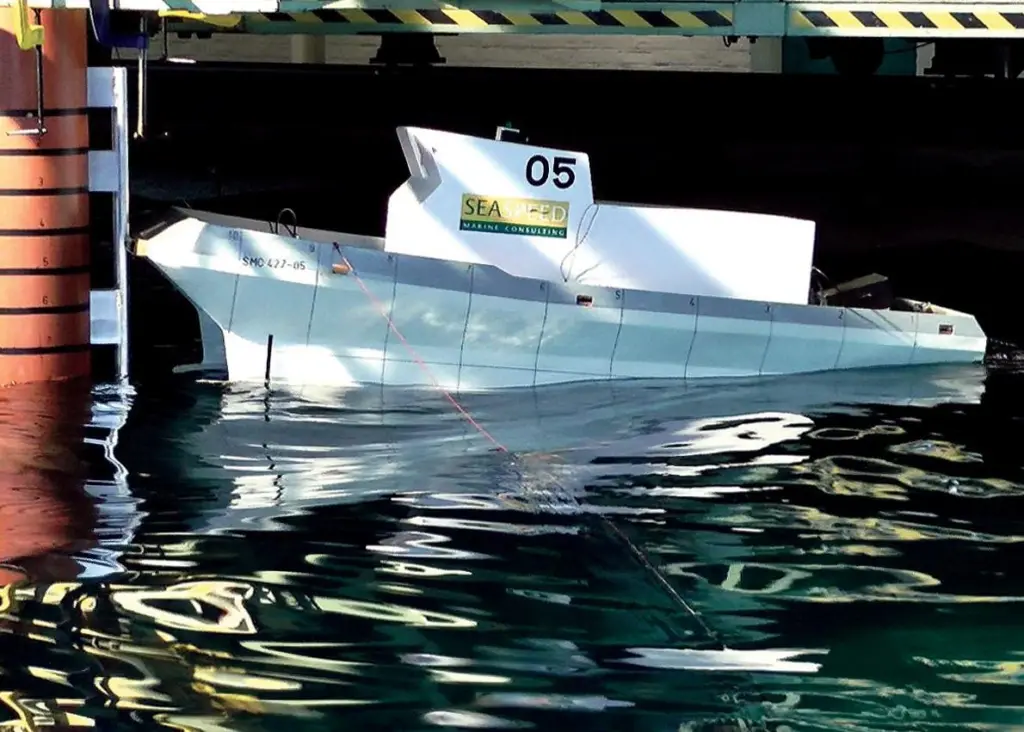
The research project tested key hull forms head to head and was conducted by independent technical consultancy Seaspeed Marine Consulting in order to ensure impartiality.
Thousands of additional offshore wind turbines will be installed when the UK’s Round 3 construction commences in 2015 and a massive expansion is also ongoing off mainland Europe. Against this background, the future of offshore wind farm crew transfer vessels is now sharply in focus. During the operations and maintenance phase, the ratio of workboats to turbines is estimated to be in the region of 1:30. With many of the new windfarms positioned much further offshore and in harsher operating conditions, the performance capabilities for these boats needs to be recalibrated.
The challenge is to design and build vessels that can operate in higher sea states, further offshore and still be able to transfer personnel in safety once they have reached the site. Recent research suggests four key performance parameters for the industry as Round 3 approaches.
1. Vessels should be able to passage and transfer in 2m Hs wave height or higher
2. Achieving higher speeds in rougher weather, but with lower fuel consumption
3. Greater versatility, with good cargo capacity and higher crew comfort levels
4. An overall improvement in reliability.
Although the sector is currently investigating, and in certain cases putting into production, innovations which will go some way to achieving these objectives, appropriate hull design for the prevailing conditions remains the main area for development.
In preparation for Round 3 South Boats had already made significant investment in R&D and utilised the expertise of leading marine consultants. Equipping existing South Boats WFSVs with monitoring equipment, the company had already gathered the predominant wave and weather conditions on existing and planned offshore wind farms.
Whilst this data effectively set the criteria for future vessels, South Boats acknowledged that it was only one side of the story. With a wide range of hull forms being offered by different competitors, South Boats decided that the time was right for the first head to head hull form comparison ever undertaken.
The research aimed to characterise the performance of different fast workboat hull designs from 15m to 40m in length with the objectives of:
1. Defining the performance benefits and drawbacks of each hull design approach
2. Assessing the limiting factors of each hull design approach in relation to wind farm support activities, including hull form, main dimensions, speeds and sea conditions
3. Determining improvements that could be made to each hull design to improve performance and increase operational availability in rough weather
Seapeed Marine Consulting was asked to investigate a number of different competitor designs, grouped broadly into three main categories, which were: Load carrying vessels – generally broader water plane area hulls; General purpose vessels – generally more slender water plane area hulls; and Specialised passenger vessels – generally very small water plane area hulls.
All designs assessed were multi-hull vessels as these provide the required deck area, stability and manoeuvring characteristics preferred by the industry. The range of designs included existing industry standard hull forms along with a number of new and novel design proposals.
Six of the more promising hull forms were selected and physical models constructed and tank tested, to verify and compare their calm and head sea rough water performance over a range of speeds, displacements, trims and hull separations. The testing also enabled a more detailed investigation into the designs’ added resistance in waves and the effect of freeboard and hull form on slamming and deck wetness than was possible from a theoretical approach. The ability of each design to carry a significant cargo load on the foredeck was established along with limitations this
imposed on the operability of some designs. Various hull appendages were also investigated at this stage, including bilge keels, hull foils, active/passive fins and interceptors, in order to assess their effect on motion damping and powering performance.
Whilst a number of interesting findings were made during these important early studies, it was clear that a true picture of the overall operational performance of the designs could not be determined from conventional test programmes, particularly their limiting conditions. Thus it was decided to outfit the physical models for free running, open water testing, providing for the most realistic operational assessment possible, short of building the full-scale vessel.
Propeller and waterjet propulsion systems were modelled along with appendages and superstructures. These fully instrumented models were then run in measured open sea conditions over a range of significant wave heights and at both transit and loiter speeds. Long fast runs at different headings, impossible in the confines of conventional research facilities, allowed good statistical data to be logged. Manoeuvrability and handling characteristics in all these conditions became clearly apparent early in the test program. Data-loggers and cameras on the models recorded the vessel’s onboard characteristics, including the control inputs from the remote helmsmen. Combined with external cameras on the chase boats, a full technical and visual record of the open water tests was captured. The data was then analysed in the time and frequency domain to provide comprehensive insight into the performance and limitations of each design.
The performance of the models when manoeuvring on a wind turbine tower was also investigated over different sea conditions, tidal rates, thrust levels and fender arrangements. It was essential to establish the effect of each of these parameters on the time that the bow remained stationary and available for personnel transfer. Passive and actively controlled passenger transfer systems were also trialled during these tests, assessing their benefits in increasing the weather window for transfer operations. The relative motions and forces imposed on the tower and vessel were also measured. The results provide an excellent basis for the selection of the most appropriate transfer systems and procedures.
In parallel to this hydrodynamic research programme, instrumented sea trials of newbuild vessels undertaken prior to delivery and the performance monitoring of vessels in service has provided a unique opportunity to correlate theoretical, test and trials data. In particular, personnel safety and comfort were considered in detail with assessments of sea-sickness, whole body vibration and the safety of operational personnel working on the vessel.
The results of this research project have provided South Boats with a significant advance in the understanding of the design of small fast workboats for wind farm support activities. South Boats now has the unique ability to predict the likely performance, operational availability and fuel economy of these hull designs for particular sea areas, routes and tasks, reducing the risk of selecting an inappropriate vessel for a given task. The results provide South Boats with the confidence to improve and consolidate current design practice.
Armed with a significant database for the development of the next generation of fast offshore work boats and wind farm service vessels, South Boats can now also act in a consultancy capacity for energy companies and wind farm owners.
Related Articles
 OTHER NEWS
 FEATURES & VIDEOS
 MARINE CIVILS