![MaritimeJournal[Seawork]](https://www.maritimejournal.com/wp-content/uploads/2026/09/MaritimeJournalSeawork.svg)




Tidal barge design
A Canadian yacht design company has recently completed the design of a tidal energy generation floating plant. Backers claim the catamaran-type barge by ER Yacht Design, (28m LOA and 17m Beam), is the first of its kind in the World and it could potentially launch a new alternative method of low-cost, tidal energy generation for coastal communities.
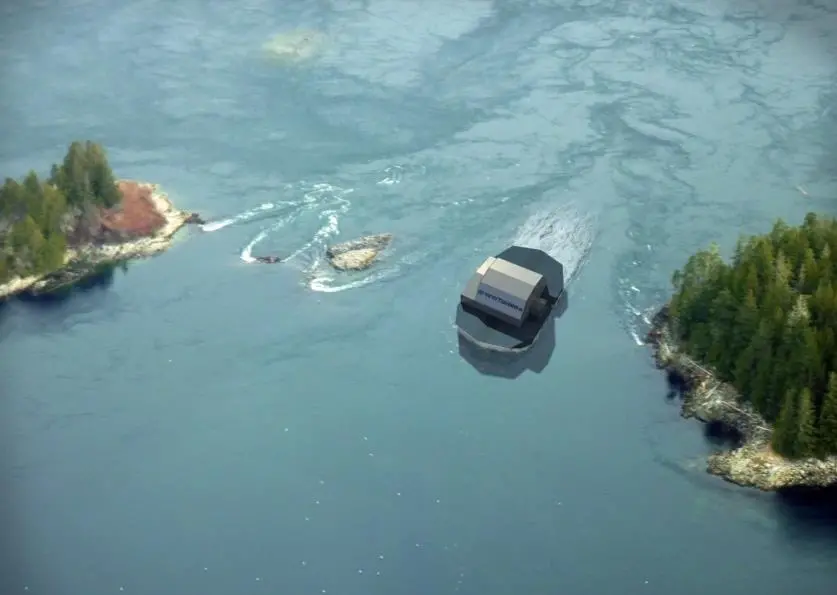
Ivan Erdevicki, President of ER Yacht Design said “the main and biggest challenge of the barge design was to ensure a high degree of stability, which was achieved by multiple ballast tanks that allow the vessel to meet the requirement for minimal movement despite the constantly changing flow of tides and water velocity. The ballast tanks in each hull regulate stability and optimise flotation for the maximum turbine efficiency”. Furthermore, the structural integrity of the barge is imperative considering that the water turbine alone weighs just over 80 tonnes!
The barge, part of the Dent Island Tidal Power Generation project, is a development by Water Wall Turbine Inc. idea, a Canadian company focused on developing renewable energy generation technology from marine and fresh water currents. The company, after eight years of R&D work, is building the first full-scale, floating power plant that they claim will be capable of generating up to one megawatt of electricity with a potential to generate up to 4 MW from tides or river currents in remote areas.
By installing rotating turbine components within a specially built barge, the self-floating power plant can operate in shallow waters with a minimum of four to five metres depth. The life expectancy of the plant is anywhere from 25 to 40 years, depending on maintenance of the mechanical components, which makes the ROI a medium-term proposition depending upon the price of electricity and the surplus fed into the national grid during the off-peak local demand.
The barge is being built in Vancouver BC, Canada and the construction is expected to take three months, with the fitting of electricity generators and controls will take a further two to three months.
By Jake Frith
Related Articles
 OTHER NEWS
 OTHER NEWS
 FEATURES & VIDEOS