![MaritimeJournal[Seawork]](https://www.maritimejournal.com/wp-content/uploads/2026/09/MaritimeJournalSeawork.svg)




Tidal energy used to produce hydrogen gas
In mid-September, the European Marine Energy Centre (EMEC) announced that it had successfully completed its project to produce hydrogen gas using electricity generated from tidal energy in Orkney – the first initiative of its kind anywhere in the world.
So, what exactly did the project entail? What technology did it use – and how does it work? And what are the prospects for the future commercial exploitation of the new approach?
ELECTROLYSER UNIT
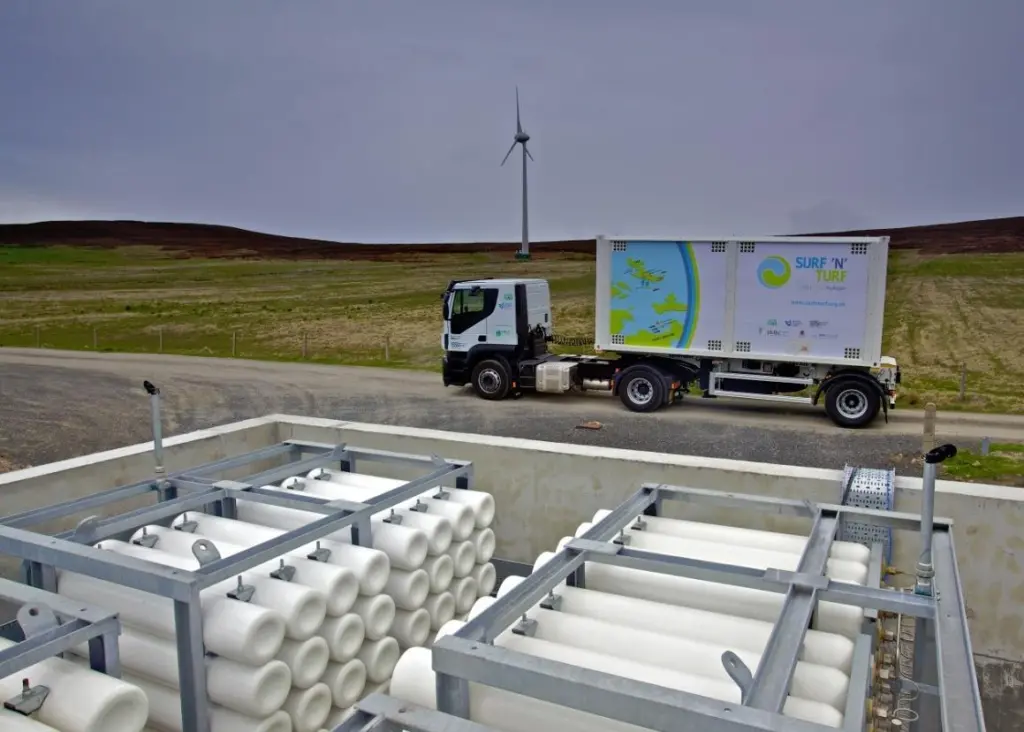
The initiative, dubbed the Surf’n’Turf project, fed power from the Scotrenewables SR2000 and Tocardo TFS and T2 turbine prototype tidal energy converters currently testing at EMEC’s tidal energy test site – as well as from a community-owned wind turbine run by Eday Renewable Energy – into an innovative 0.5MW rapid response ITM Power electrolyser unit located alongside EMEC’s onshore substation. This unit was then used to generate hydrogen – which can be stored and moved for use as needed.
“The electrolyser splits water into its component elements – hydrogen and oxygen – in an electrochemical process. Whilst generating hydrogen isn’t a new process, this is the first time that it has been generated from tidal energy,” Says Jon Clipsham, Hydrogen Development Manager at EMEC, explains.
As Kris Hyde, Technology Development Manager at ITM Power, explains, the process works by converting the renewable AC power to DC and applying it to water in a series of electro-chemical cells via catalysts that split the water into its constituent components of hydrogen and oxygen in two separate streams.
“The oxygen is vented and the hydrogen self-compresses and is delivered to downstream equipment,” he says.
‘HYDROGEN ECONOMY’
According to Clipsham, Orkney has an ‘abundance’ of renewable energy – so much so that parts of the electricity grid ‘routinely hit full capacity.’ When the grid is full, some of the renewable energy generators in Orkney have to limit production or stop completely, meaning that the region ‘misses out on its full clean energy potential.’
In view of the fact that a planned grid upgrade keeps being pushed back, Clipsham says that EMEC needed to look to ‘future proof’ its test sites using other means and started looking at different ways to store and use electricity in Orkney. Following the award of some £3 million in funding from Scottish Government, via Highlands and Islands Enterprise, this led to EMEC issuing a tender for an electrolyser which could convert surplus electricity into hydrogen.
Hyde agrees that Orkney is rich in renewable energy but the inter-island grid and the interconnection to Scotland is ‘weak’ – leading to the ‘curtailment of renewable generators, with some losing up to 50% of their energy.’ Moreover, although he believes that EMEC are in a ‘better position than many,’ largely because they have a ‘firm grid connection, meaning that they can export energy up to a ceiling,’ he points out that its testing on Eday has expanded, meaning it ‘soon hit this limit and will need to turn away clients.’
In Clipsham’s view, the main advantage of the new process is that it enables constrained electricity to be harnessed and stored as hydrogen, which can later be converted back into electricity, or used as a transport fuel.
“There are various other applications that we’re also looking into. Essentially this is just the start of Orkney developing a hydrogen economy,” he says.
“In the absence of the electrolyser, the energy and its associated FIT [feed-in tariff] and ROCs [Renewables Obligation Certificates] would be lost. This enables it to be captured, stored and transported, while allowing EMEC to avoid turning away customers,” adds Hyde.
LOGISTICAL CHALLENGES
Although Clipsham is bullish about the future prospects for the system, he admits that the location of the EMEC tidal testing facility on the island of Eday ‘presents some logistical and access challenges.’
“The project also requires an electrolyser, which can respond rapidly to changes in supply, as well as accommodating supply from a variety of sources. The ITM electrolyser was selected after a competitive tender process as being best suited to this project,” he says.
Hyde confirms that the main project challenges are linked to the remote location, as well as the extremes of weather, which he says have both ‘influenced the design and led to challenges during commissioning.’
“We overcame these challenges mainly through the use of an expert team of design, process and commissioning engineers to ensure that the equipment operates as expected in a timely manner,” he says.
Hyde also reveals that the prospects for the ongoing commercial development of the ITM Power technology over the next few years look rosy.
“We have multiple sales around the world of units from 10kW to 10MW and have a pipeline of £37.7m. Our key markets are Power to Gas, via the conversion of electrical energy to hydrogen, hydrogen transport, via public hydrogen bus refuelling station networks, which we are rolling out, and the use of hydrogen in the chemicals industry,” he adds.
Looking ahead, Clipsham reveals that the collaborative team – which, in addition to EMEC, Eday Renewables and ITM Power, also includes Community Energy Scotland and Orkney Islands Council – is currently in the process of completing the commissioning phase of the project, and confirms that plans are already well advanced through the Surf’n’Turf project ‘to utilise the hydrogen to provide auxiliary power to the inter-island ferry fleet at Kirkwall.’ Another project – BIG HIT – is supporting the deployment of a fleet of electric vans, each fitted with a hydrogen fuel cell range extender, in Orkney as well as using hydrogen for heating applications.
“There are numerous other opportunities for the Orkney community with EMEC and partners investigating options for future commercialisation,” adds Clipsham.
By Andrew Williams

Related Articles
 OFFSHORE RENEWABLES
 OFFSHORE RENEWABLES
 ENVIRONMENT