![MaritimeJournal[Seawork]](https://www.maritimejournal.com/wp-content/uploads/2026/09/MaritimeJournalSeawork.svg)


Tidal stream developer seeks manufacturing partner
East Yorkshire UK based Neptune Renewable Energy Ltd (NREL) has successfully completed a series of rigorous in-water tests on the multi-million pound full scale demonstrator of its Proteus NP1000 tidal stream power generator.
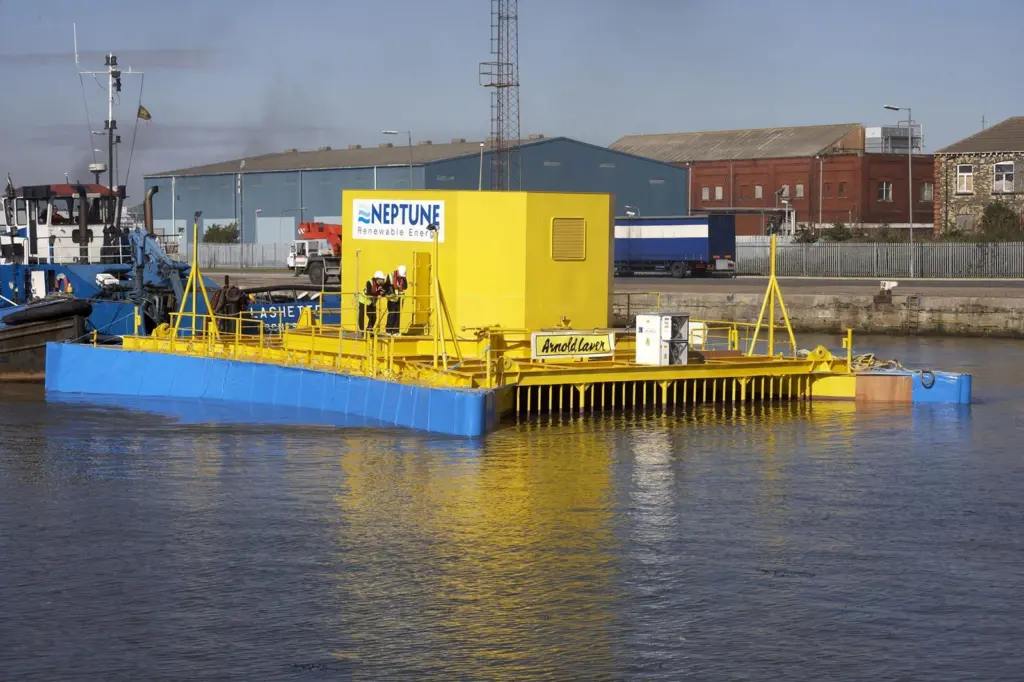
Neptune is now seeking a trade partner, which could be a shipyard or heavy engineering concern, which can demonstrate the capability to fabricate and build future production devices.
Weighing more than 150 tons and measuring 20m in length, with a beam of 14m, the Proteus NP1000 consists of steel buoyancy hulls, a vertically mounted turbine with a 6m by 6m rotor, and computer controlled flow vanes within a Venturi duct.
When deployed, despite its size, the floating pontoon design means that the Proteus is largely unobtrusive compared to many other energy generation techniques, with more than 80% of its bulk always hidden from view under the water. This low environmental footprint has now been approved by the British Government’s Department of Energy and Climate Change. When optimised for the tidal stream, Neptune’s engineers believe, based on the dock test data, that the Proteus NP1000 will be able generate at least 1000 MWh/year. To put this into context, the projected output would be enough to meet the annual energy needs of more than five hundred homes.
A key landmark in the recent testing process was the powering up and generation of electricity as proof of the commercial potential of the device’s power curve. Tow testing was carried out in three phases during August, September and October in Hull’s Albert Dock. The third set of experiments provided the final, critical, ‘proof of concept’ hurdle and mean that the pioneering device will now be prepared for commercial deployment in early 2011 at Sammy’s Point in the Humber.
The electricity generated will be used to power The Deep aquarium at Sammy’s Point to further develop its ‘green energy’ operations. Billed as ‘the world’s only submarium’, The Deep is a UK National Lottery Millenium Commission project which has attracted more than 2m visitors since opening in 2002 and is also a marine research centre.
Nigel Petrie, chairman of NREL said, ‘We are delighted to have successfully come through the in-water testing phase for the Proteus Demonstrator, which paves the way for the device to be commissioned shortly and installed, with the first electricity delivered in 2011. Having reached this key milestone, at Neptune we are now looking to identify a trade partner who is able to demonstrate that they have capability to work with us to manufacture and deliver future devices. Potential partners should possess strong, large scale fabrication and assembly skills, using steel, composite and plastic materials, possibly also with experience in the marine sector. Following on from this, we are also seeking equity providers to work with in order to help fund a series of arrays of the tidal stream power generators which are planned for the Humber in 2011 and 2012.’
Neptune sees tidal streams as a largely untapped resource where there is a tremendous opportunity, working with its partners, for future growth using the latest technology like the Proteus. A major advantage of tidal stream power, according to the company is the potential to deliver a predictable source of renewable energy compared to more variable, less consistent, options such as wind. This can be is a key consideration when it comes to building up generating capacity.
Related Articles
 OTHER NEWS
 FEATURES & VIDEOS
 MARINE CIVILS