![MaritimeJournal[Seawork]](https://www.maritimejournal.com/wp-content/uploads/2026/09/MaritimeJournalSeawork.svg)






UK wave and tidal energy resources reassessed
The size and distribution of UK wave and tidal energy resources have been reassessed in light of new findings and presented in a report aimed at providing a clearer understanding of the potential for project developers.
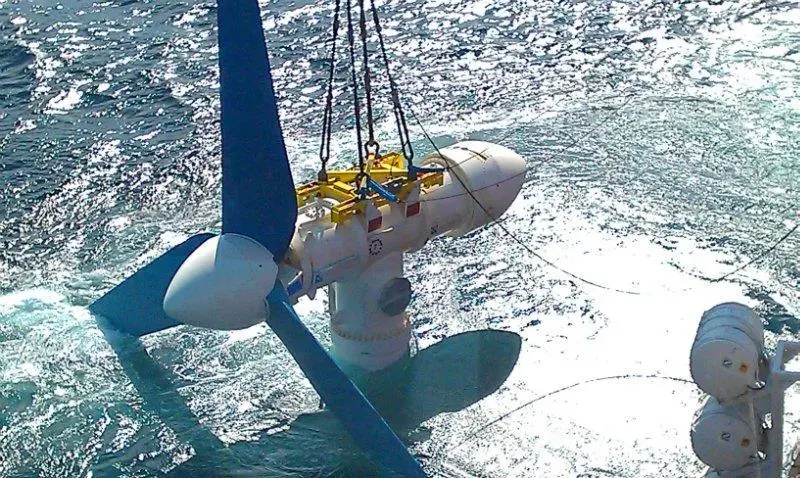
The report, produced by The Crown Estate, uses its Marine Resource System (MaRS) with support from engineering consultants Black & Veatch Ltd, the Marine Management Organisation, statutory authorities from the Northern Ireland, Scottish and Welsh governments, RegenSW, and input from industry. The report, entitled UK Wave and Tidal Key Resource Areas Project, follows earlier similar studies, improving on previous work with a consolidated view of wave, tidal stream and tidal range resources, including improvements in spatial analysis to determine geographical distribution of resources.
It is pointed out that the results are theoretical estimates covering broad geographical areas around the UK. The figures, however, send a clear message of the huge potential existing around the UK coastline from these forms of renewable energy, thanks to the UK’s unique geographical circumstances and exposure to elements in the form of wind and wave. Total theoretical resources are estimated as follows: Wave 69TWh/year (27GW), tidal stream 95TWh/year (32GW), tidal range (barrier schemes) 96TWh/year (45GW), tidal range (lagoon schemes) 25TWh/year (14GW). The resultant total (theoretical) resource figures are 285TWh/year and118GW, worth bearing in mind when considered alongside completed and planned offshore wind capacity figures.
The geographical distributions are predictable. Scottish waters offer the majority of UK wave resources, with significant resources also found off southwest England and Wales. English, Scottish and Welsh waters have similar amounts of tidal stream resources, along with resources in Northern Ireland waters. England and Wales share the largest single area of tidal range resources, in the Bristol Channel and Severn Estuary.
The figures are based on generating devices being deployed across large areas of seabed, the study not taking into account existing sea uses, sensitivities or environmental factors which are likely to constrain deployments to smaller areas of seabed in practice. This is simply because at the industry’s present stage of development, it is difficult to quantify those constraints. While the study naturally uses latest available data and techniques, scientific understanding of wave and tidal resources is still currently emerging, a number of simplifying assumptions therefore having to be made. Further work is expected to clarify the resources that are practically available.
The report understandably draws attention to the ‘ifs and buts’ to be considered in interpreting the data but will still form an important backdrop as this developing industry moves forward. It would clearly be wrong for those who set the level of support for these industries to ignore the potential from these forms of renewable energy.
By Peter Barker
Related Articles
 OTHER NEWS
 FEATURES & VIDEOS
 MARINE CIVILS