![MaritimeJournal[Seawork]](https://www.maritimejournal.com/wp-content/uploads/2026/09/MaritimeJournalSeawork.svg)




Vertical floating wind turbine tests
The Maritime Research Institute Netherlands (MARIN) is in the closing stages of testing a vertical floating wind turbine concept for the Deepwind Consortium, led by the Technical University of Denmark (DTU).
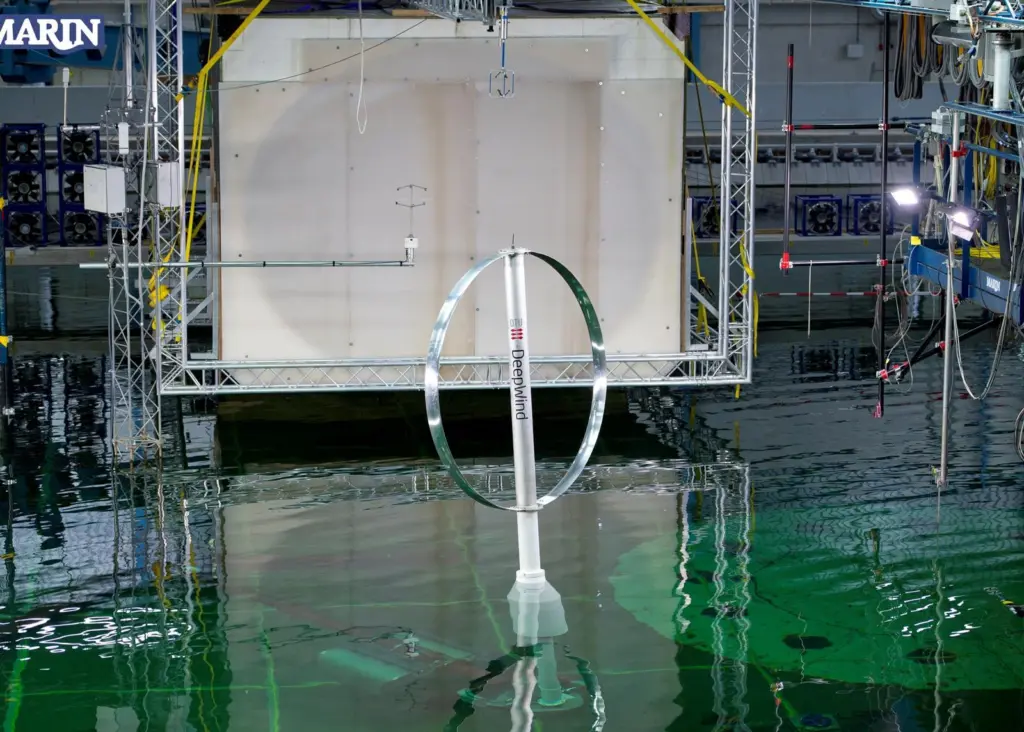
Vertical floating wind turbines are considered by some to be the next step in development of offshore wind energy.
Floating wind turbines allow wind energy generation in deeper areas with more wind and more space. The hypothesis of the DeepWind project is that a new wind turbine concept developed specifically for offshore application has potentials for better cost efficiency than existing offshore technology. Based on this hypothesis the project has the overall objective to explore the technologies needed for developing a new and simple floating offshore concept with a vertical axis rotor and a floating and rotating foundation. The concept consist of a long vertical tube that rotates in the water, a vertical axis rotor at the top, a bottom based generator and a seabed fixing system at the bottom. However, although being simple, the technology behind the concept presents extensive challenges needing explicit research.
Erik-Jan de Ridder, responsible project manager at MARIN said: “A key point in these tests is that wind and waves are present simultaneously in a controlled environment, allowing the study of the complex motions and loads of the rotating wind turbine in wind, waves and current. Therefore these tests serve as high quality benchmark data to validate simulation methods for the coupling between aerodynamic and hydrodynamic behavior”.
After having conducted initial tests with the demonstrator in the fjord at Riso last autumn, and the controlled test in the MARIN basin, the next step of the DeepWind consortium is to deploy the floating wind turbine at Riso for further testing in the fjord. Data from these tests and the model tests will be used to further look into the physics behind this concept and for further concept development.
DeepWind is a four year project, funded by FP7 – Future Emerging Technologies, and runs from 1 October 2010 to 30 September 2014. DTU is coordinating the consortium of 12 international members comprising DTU Mekanik, TUDelft, Institut for Energiteknik/Aalborg Universitet, DHI, MARINTEK, SINTEF Energy Research, Nenuphar SA, Statoil, Universita Degli Studi di Trento, MARIN, National Renewable Energy Laboratory (NREL), and VESTAS Wind Systems A/S.
Related Articles
 OTHER NEWS
 FEATURES & VIDEOS
 MARINE CIVILS