![MaritimeJournal[Seawork]](https://www.maritimejournal.com/wp-content/uploads/2026/09/MaritimeJournalSeawork.svg)

Falmouth for orders
The Cornish port of Falmouth has many maritime industries and ship visits are interesting if unpredictable, writes Graeme Ewens
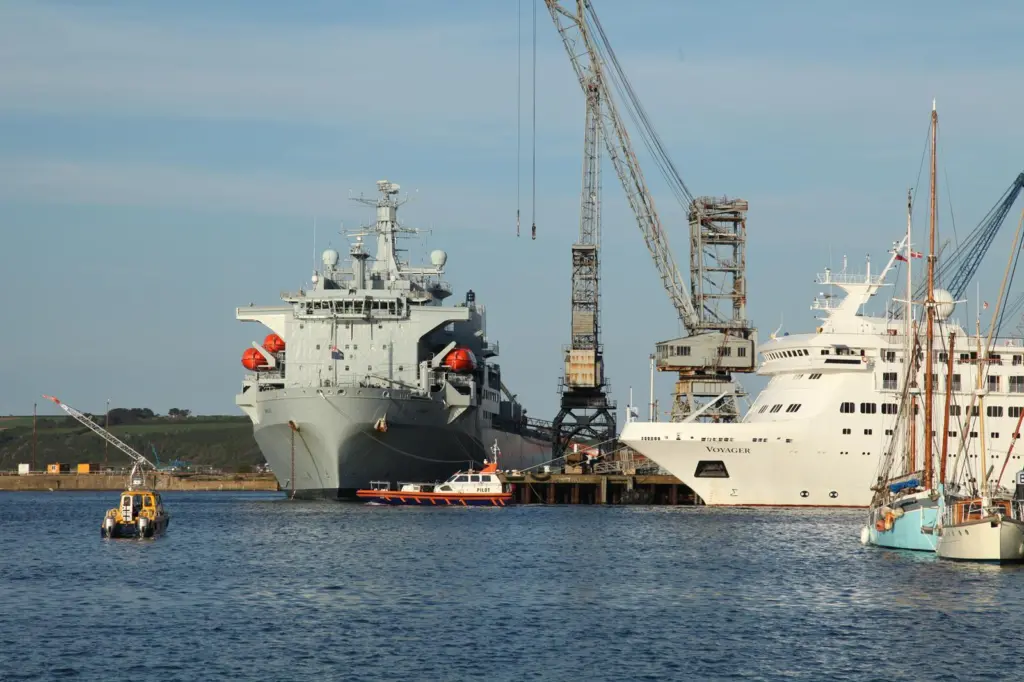
The port of Falmouth, therefore, sees a wide range of vessels visiting for bunkers, stores, crew change, repair, drydocking, shelter, layup or simply ‘waiting for orders’. For such a busy port Falmouth has no regular cargo trade, although it does have facilities for handling fuel, dry bulk, project and general cargo. The only scheduled visits are by cruise ships which either berth alongside or anchor in the harbour during the summer months.
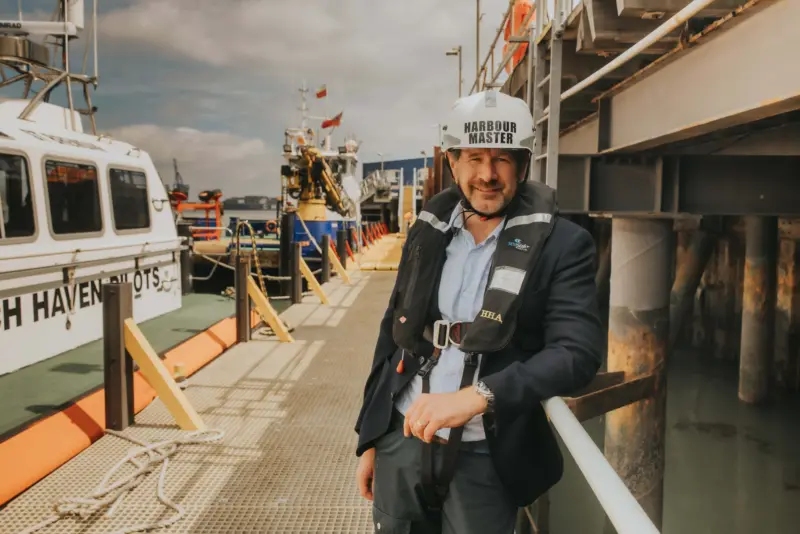
The variety of traffic is interesting, if unpredictable. “We are used to peaks and troughs,” says Capt Mark Sansom, Chief Executive of Falmouth Harbour Commissioners (FHC) and Harbour Master, who has held the post since 2000. FHC are the statutory port authority with responsibility for the Inner Harbour (excluding Falmouth Docks), the Penryn River as far as Boyers Cellars, the southern part of the Carrick Roads and a large part of Falmouth Bay.
The port limits are 3 1/2 miles south of the harbour entrance extending into the Carrick Roads below Truro (which is administered by Cornwall Council). The coastal trade into the old city has shrunk recently with only a handful of ships visiting each month to load scrap for export. The previous trade in fertiliser has finished and that cargo is now trucked in by road. The quarry jetty at Porthoustock across Falmouth Bay is also served by Falmouth Pilots.
The Commissioners have recently separated the functions of their pilotage division and the recreational department that manages over 600 leisure moorings. There are six pilots, contracted through a self-employed partnership , and two launches, the 2006-built 16m Halmatic Arrow and the veteran Nelson launch TK Mitchell, which was recently refitted and re-engined with two Scanias to give another 10 years of useful life. These boats are used in rotation in order to keep both ready for service. Pilots are required for any ship over 75 metres entering the harbour. Navy ships do take a pilot, although that is not compulsory and they also make use of the harbour tugs.
There are three harbour tugs operated by the dock owners A&P, two 1960s-built Voith Schneider tractors, the Percuil and Ankorva, bought in from Slovenia, and the ex-Svitzer St Piran. In addition, a sister to St Piran stationed at nearby Fowey can be called in when needed.
One unique feature of the River Fal is that ocean going ships use it to lay up; most commonly reefers on the seasonal transatlantic fruit trade, car carriers and other cargo vessels. Even several miles inland, the river Fal has a channel depth of almost 30m, making it one of the few suitable locations for lay up in the south of the UK. Ships of up to 219m loa can be accommodated here on head and stern moorings.
Falmouth Docks, including dry docks and the quay frontage are operated by Falmouth Dock and Engineering, now a division of A&P.
During the early 1980s the docks were closed briefly and fish transhipment was the only trade to survive until the millionaire yachting enthusiast Peter de Savary reopened the docks and subsequently established Pendennis Shipyard (now one of the world’s leading superyacht builders and refitters) as well as Falmouth Oil Services. These businesses are still going and are major pillars of the local economy.
Fish are still landed at Falmouth Docks by Fal Fisheries (Falfish), which mostly specialises in scallops. The company is a leading buyer, processor and exporter of fresh and frozen seafood, with its own quayside freezing plant and processing factory.
After 2007, low sulphur fuel regulations saw the number of ships bunkering effectively treble and the port was once rated as the sixth busiest in the UK. Falmouth Petroleum Limited, a division of World Fuel Services, supplies all grades of fuel, including low sulphur, via the tanker Lizrix (1942dwt). Sales are handled by an affiliate company, Fuel & Marine Marketing (FAMM), while its subsidiary Tamlyn Shipping acts as agent. When their terminal rebuild is complete it will be one of the most environmentally compliant bunkering terminals in the UK
The port is home to a wide range of maritime businesses. MTS (Marine and Towage Services) has had an office here for many years providing a base for several of its tugs which are registered at Falmouth. Sub Marine Services handle underwater ship repair and maintenance, survey, mooring maintenance, dredging, piling, maritime civil and underwater engineering with a fleet of specialist vessels.
Also based in Falmouth, Fugro Seacore specialise in marine rock drilling, large diameter piling, foundation installation and jack up platform operation. Close to their workshops are berthed two of Serco’s fleet supply tenders, used primarily for MoD training exercises in the bay with helicopters from nearby RAF Culdrose. The port is also a base for marine surveyors, diving companies, ship’s agents, paint suppliers and victuallers.
There is a lifeboat station with an ILB and all weather Severn class boat, and the MCA Coastguard Marine Rescue Co-ordination Centre is sited at Pendennis Head. Responsible for civil maritime search & rescue for most of Cornwall, the station covers the largest region of any station in western Europe – around 660,000 square miles
Capt Sansom says the docks estate is the economic driver for the whole area. “If they do not do well, we all suffer. The MARS contract is good for the whole port and will help to keep the A&P workforce occupied.” (see A&P story)
The dry docks were brought up to their current capacity in 1958 when the old Number 2 (Queen Elizabeth) graving dock was converted. Some 3,000 men were employed on the expansion which included blasting away the cliff side. The QE dock holds 28 million gallons of water and can be dewatered in three hours. The two smaller docks can be emptied in one and two hours. The largest dock can accept ships of up to 100,000dwt, with length overall of 250 metres and a beam of 39 metres. Number 3 dock can take ships of 220m and the smaller number 4 dock takes up to 172 m vessels.
One mainstay of the dockyard has been short term refits. Frequent users include ferries of all shapes and sizes, car carriers, specialist vessels and, of course, the grey fleet of RFA and Royal Navy ships.
During March this year, when MJ visited the port, vessels using the dock included the Condor Express superfast ferry which had reportedly been sold to Greek owners, Condor Lines’ conventional ferry Commodore Clipper, the Red Funnel Isle of Wight ferry Red Osprey, several of Serco’s larger tugs and the RFA Mounts Bay, which is home ported in Falmouth.
Alongside the Northern Arm awaiting disposal was the coaster Sea Breeze, brought in as a casualty in 2014 then laid up in Carrick Roads and which was waiting to be towed to Holland by Griffin Towing’s tug Kingston. A few weeks earlier the car carrier Hoegh Osaka had been repaired alongside County Wharf, following its grounding in Southampton Water.
Capt Sansom says “Sometimes we get the ships that other ports don’t want, especially if they would be blocking access to their commercial berths. For a while it was thought the MSC Napoli when it was initially under tow would be brought here, and it is a handy port for casualties in the Atlantic or Irish Sea.”
The biggest question mark hanging over the port and the local economy is the continuing stalemate over dredging the main channel to improve access for the cruise ships which would bring much needed revenue into the County.
The arguments against dredging are based on the protection of a form of calcified seaweed known as dead maerl that exists in only a few coastal areas and which provides a home to the minute marine life at the bottom of the food chain. After some 15 years of arguing the case a decision is still awaited and port workers fear that without dredging the whole harbour will silt up, eventually killing Falmouth’s existence as a working port. Its fate lies in the hands of the MMO who will make the final decision and Natural England who provide conservation advice.
“The Port is in a Special Area of Conservation which imposes exacting conditions on works undertaken. A mitigation package was proposed but there was uncertainty about the outcome,” says Capt Sansom. “There has been a trial dredge and a scientific study of the results. The evidence is being used to provide updated information to the MMO but it is a lengthy process.”
The trials appeared to show that, 44 weeks after dredging, the maerl habitat had been successfully re-colonised. The irony is that until the 1980s maerl was dredged from the seabed and sold as a fertiliser.
Today there is no programme of maintenance dredging. To accommodate commonly sized cruise ships the channel would require 8.2 metre depth and the alongside berth would need to be increased to 9.5m. The cruise trade already suffers from competition from other ports in the South West and Channel Islands. In past years there were as many as 60 cruise visits but this year it is down to around 20 in the season between April and October.
When ships cannot come alongside they anchor in the bay and tender passengers ashore with their own boats, but the logistics are complicated when dealing with up to 2,500 people and tendering has become increasingly unpopular with cruise lines.
”Adapt and Survive” is one of Capt Sansom’s mottos. With a cut back on commercial trade FHC had to look at the leisure sector. Falmouth Haven now manages that aspect in a more modern user-friendly way, which better serves the needs of the customer. The leisure sector is significant in this area and it is estimated that there are between 7500 and 1000 boat berths in the Estuary as a whole.
In 1993, following a severe storm that dragged many moorings and drove at least 20 boats ashore, a differential GPS system was first used. The moorings had originally been laid in relation to each other with no fixed positions, and they had to be completely relaid. For the 1998 Tall Ships event, they had to lay in temporary pontoon arrangements, giving shore access which required precise mooring design and positioning. The Tall Ships have started from here several times in the 1960s, 1980s and 1990s and last year’s event saw another outstanding collection of sailing vessels from around the world.
Offshore renewables provide a possible area for some growth and there is a wave energy test site known as Wave Hub off Hayle and a local wave device test site known as FabTest has been created within the Harbour Area. A&P has recently built its second wave energy converting device for the project. Oceanus 2 is a 10m diameter floating ring made from marine grade aluminium that travels up and down with the waves and operates a pump to pressurise sea water to drive a hydroelectric turbine that produces electricity. It was built in the fabrication workshops, assembled on the quayside and deployed from a wharf at A&P’s shipyard. Seatricity plans to develop a full-scale 10MW grid-connected array over the next two years at Wave Hub, just around the coast from the Falmouth shipyard.
By Graeme Ewens
Related Articles
 OTHER NEWS
 OTHER NEWS
 FEATURES & VIDEOS