![MaritimeJournal[Seawork]](https://www.maritimejournal.com/wp-content/uploads/2026/09/MaritimeJournalSeawork.svg)




Rostock rebuilds strategic Cruise Pier 7
Being completed by April in the east German Baltic port of Rostock is the nine-month rebuilding of Pier 7, a facility seen as strategically essential for the future of the port’s Warnemünde Cruise Centre and its booming cruise shipping business.
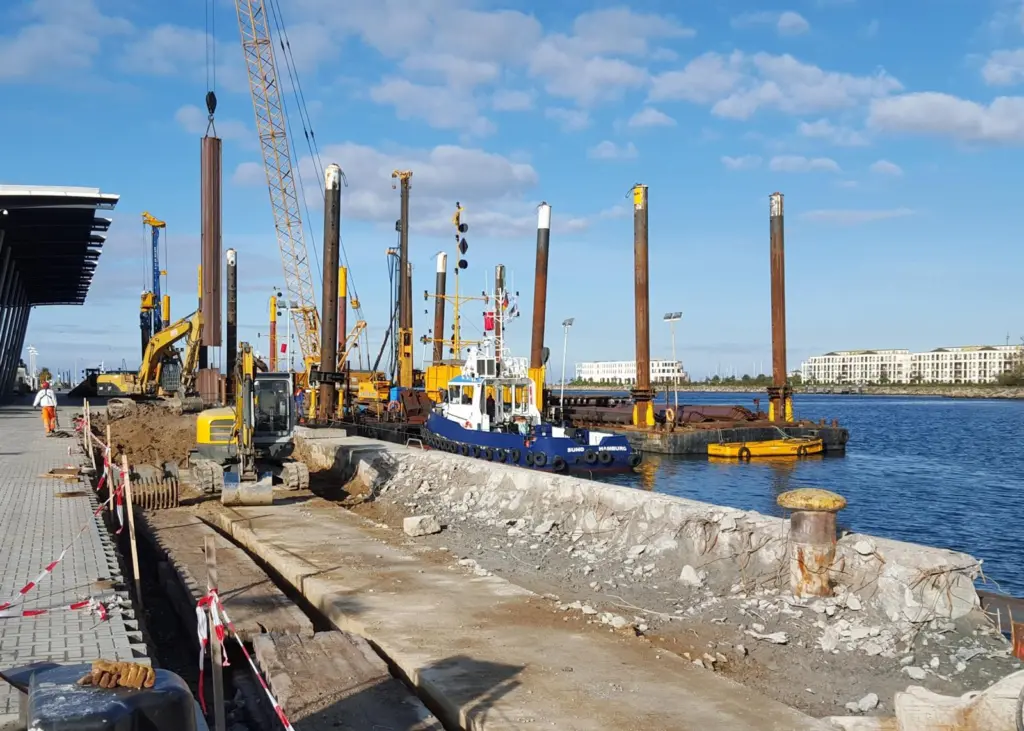
The 280m long Pier 7 is the centre berth of three at the Cruise Centre. Located directly in front of the main terminal it is capable of handling most existing cruise ship types and that, say City authorities, makes it “of central importance for Rostock’s cruise shipping business”. Which is why some €4.5 million is being spent on rebuilding it.
Rostock used to be the main port in the old GDR and saw its cargo handling plummet from nearly 20 million tons in 1989 to eight million after German re-unification in 1991. It has risen again steadily since then to nearly 26 million tons last year as the port has established itself as an east-west European and also Scandinavia-Europe cargo and passenger route of note.
Cruise shipping has also grown significantly and berths have been continuously expanded as part of high port investment in its potential recent years. Last year 175 cruise ship called and nearly half a million passengers were handled. Operators Rostock Port expect at least the same figures this year.
However, large cruise ships with modern controllable pitch propellers and bow and stern thrusters have taken their toll on Pier 7. Persistent alongside water turbulence has over time played havoc with the quay wall, officials said.
The original Pier 7 was built around 1900 as a concrete gravity retaining wall and was reinforced in the1960s with a built-up embankment. That in turn was last reinforced in the early 1990s with underwater piles but more recently, the authorities determined that the old structure was in need of complete replacement. Officials said it was “in a desolate structural condition and no longer able to guarantee the safety of existing port facilities”. One official was even quoted as saying recently that the condition of the wall was so bad that “the structure will, someday, simply collapse”.
In the light of the structural situation and in advance of the permanent work which has, in the meantime, begun, emergency stabilisation measures were undertaken on Pier 7 during the winter months between the 2013 and 2014 cruise shipping seasons. The City of Rostock commissioned locally-based marine architecture and engineering concern Inros Lackner SE to design and monitor the installation on Pier 7 of shore-side, tie-back anchors to reduce load bearing pressures and stabilise the existing structure.
At the same time the old gravity wall was anchored using small-diameter cast-in-place piles that were attached to a new reinforced concrete beam placed above the gravity wall. To facilitate the connection of the stabilised structure to the planned replacement structure’s new sheet pile wall, the cast-in-place piles were fitted to the anchor points on the reinforced concrete beam using horizontal anchors. Three additional bollards with a load capacity of 1000kN each were also installed to ensure safe mooring.
Permanent replacement work on P7 began after the end of the cruise shipping season in Rostock on September 21st last year and is taking place during the winter months to minimise cruise shipping disruption – although alternative berths remain available at the Cruise Centre for unexpected calls. The project is for completion by April and before the first cruise ship of the season arrives on April 28th.
Rostock City’s Civil Engineering and Port Construction Office (Tief und Hafenbauamt) also commissioned Inros Lackner SE to design the sheet pile wall and tieback attachment on the replacement structure. The design also takes into consideration basic parameters such as an admissible traffic load of p=20kN/m2, bollard capacity of 800kN on the coping and the re-use of existing fenders.
STRABAG SE subsidiary sister companies Ed Züblin AG and Strabag AG were contracted to carry out construction. STRABAG’s Nils Klute explained that Ed Züblin AG had overall site technical management responsibility and was handling pile driving as well as hydraulic steel construction and concrete work. STRABAG AG was handling the demolition of the old quay facility and the building of a new one as well as building the necessary roadworks, Klute told Maritime Journal.
Replacement work covers demolition of the existing Pier 7 and the construction of a new berth, 12m wide, along the entire 280m berth. It began with soil exchange in the area of the new sheet pile wall where boreholes were sunk to 2m using a BG25 drilling rig operated from a spud barge. This was followed by deep pile driving using PSp 500 king piles and Pzi 675 intermediate piles.
That work was completed by last November and was followed by the attachment of the new sheet pile wall and flow drainage system using horizontal anchors to the emergency structure installed in 2013/14. The tieback anchoring was being secured using the new cast-in-place piles or additional tiebacks.
The area between the new sheet pile wall and the gravity wall was being backfilled with dredged sand filler using deep compacting techniques as the old wall was being demolished. The sheet pile wall was being capped with a reinforced concrete coping and the front-end sheet pile wall was being provided with an anchor wall and horizontal anchors. Some existing piles were having to be removed.
Finally quayside equipment like bollards, ladders and fenders were being located on the reinforced concrete paved coping.
The overall scope of the project involves 180 replacement bores, about 940 tons of sheet pile wall material with pilings of up to 22m, 70 horizontal anchors, about 2,000 m3 of demolition concrete, 17000 m3 of sand filler, 700 m3 of reinforced concrete and about 3,000 m3 of surfacing.
By Tom Todd

Related Articles
 OTHER NEWS
 OTHER NEWS
 FEATURES & VIDEOS