![MaritimeJournal[Seawork]](https://www.maritimejournal.com/wp-content/uploads/2026/09/MaritimeJournalSeawork.svg)



Sea and land civils increase Norddeich clout
The small German ferry port of Norddeich on the North Sea is adding more berths and new land logistics handling areas to meet increasing traffic and bigger ships.
The expansion covers two projects, one on the Nord-Ost Kai and the other in the Westhafen. The Nord-Ost Kai work is being completed next year while the Westhafen project has just been finished.
Norddeich serves a variety of roles within Niedersachsen Ports (NPorts) – the Oldenburg-based Lower Saxony organisation which is responsible for five sea ports, seven island supply port facilities and three regional ports on the German North Sea coast.
Norddeich functions as a service and supply port for offshore wind park facilities. Its main function however is as a ferry port for the nearby East Frisian islands of Norderney and Juist. It handles around 2.5 million people a year and some 574,000 tons of cargo.
A spokeswoman for NPorts told Maritime Journal that because of the port’s structure and its location on the North Sea’s shallow-water East Frisian tidal flats no further expansion of ports facilities into the sea was possible.
“As a result, internal capacities have to be fully utilised and expanded”, she said. At the same time however, she added “all port functions – supply, offshore service and tourism have to be in step with each other and offer sufficient development potential”.
Norddeich has developed in recent years into an important location and supply centre for the local offshore wind farm industry in the German Bight. The operational centres of DONG Energy, RWE, Semco Maritime, Senvion and the Norden-Frisia Shipping Company have all been established in Norddeich. NPorts reported that that nine supply ships regularly use the port’s facilities to serve six offshore wind farms – Alpha Ventus, Godwewind 1 and 11, Borkum Riffgrund 1, Nordsee One and Gemini.
Now halted at the port’s Nord-Ost-Kai after first phase construction is a project by NPorts to create what will eventually be four additional berths for crew transfer and supply ships serving offshore wind farms. Because of seasonal German restrictions on coastal construction work between October 1st and April 15th, the second phase of the project will not begin until next April and be completed June.
The project covers the transformation of a section of the pier measuring about 68m into a quayside. When in operation this facility will offer space for two offshore supply ships or equivalent tonnage.
In addition, the existing 70m long quay wall at the entrance to the harbour is being raised by half a metre to offer tide-independent, flood-proof berths for two more offshore supply ships.
The new quay will be some 10m wide and because it is very close to the Lower Saxony tidal flats National Park – across which people can walk to Norderney when conditions are right – a special stone screen wall has been erected to protect flora and fauna.
Thieling Bau in Stadland, which is responsible for the Nord-Ost Kai work, reported that the first two-month expansion phase work on the Nord-Ost Kai cost NPorts €695,000. Total cost was put at €1.4 million.
The works include the delivery and installation of about 180 tons of sheet piling along with some 900 m² of sheet piling coatings, 36 grouted anchors and ten friction pilings. It also covers the provision of some 160 running metres of Wulstholm pile coverings and some 25 m³ of reinforced concreting. Other work included the provision and installation of fenders, ladders, crossovers and guide rails as well as dry and wet dredging work.
NPorts said the first phase project had covered the delivery, installation and anchoring of the sheet piling and coatings along with the heightening of the existing quayside and the manufacture of the back-anchored bollards. Next April, when work resumes, surface areas will be laid and prepared for use.
When pile driving work started on the Nord-Ost Kai expansion earlier this year, Lower Saxony Ports Minister Olaf Lies said that with the settlement of significant energy companies Norddeich had assumed important service functions in the offshore sector and had become a base port of preference for many.
“The new berths will strengthen the Port of Norddeich as a service location for offshore supply and will secure the ability of Lower Saxony ports to compete”, he declared.
When officials marked the completion of the port’s Westhafen revamp project a little earlier, another official, Holger Banik, pointed to the links between the two developments for optimising ship and traffic movements in Norddeich.
Banik, the Managing Director of NPorts, stressed: “We have always had the whole port in mind and have expanded not just capacity on water but also optimised traffic areas on land as well”.
The four-month Westhhafen project has been jointly headed by NPorts and ferry shipping company Reederei Norden Frisia. It has involved the relocation of access roads and created a single terminal area with improved surface availability for passengers and baggage at the terminal handling traffic between Norddeich and Juist, another Easy Frisian island served by the port.
Construction, which has not involved the ferry berth itself, was in the hands of Tell-Bau in nearby Norden and divided into two parts. To minimize traffic disruption NPorts first tackled the infrastructural creation of a 200m long, 6.5m wide two lane access road and a parallel 2.5m pedestrian walkway. Once the new road was finished, work started on the construction of the new 5,500m2 reception and logistics areas of the Juist ferry terminal – a project for which Reederei Norden Frisia was responsible.
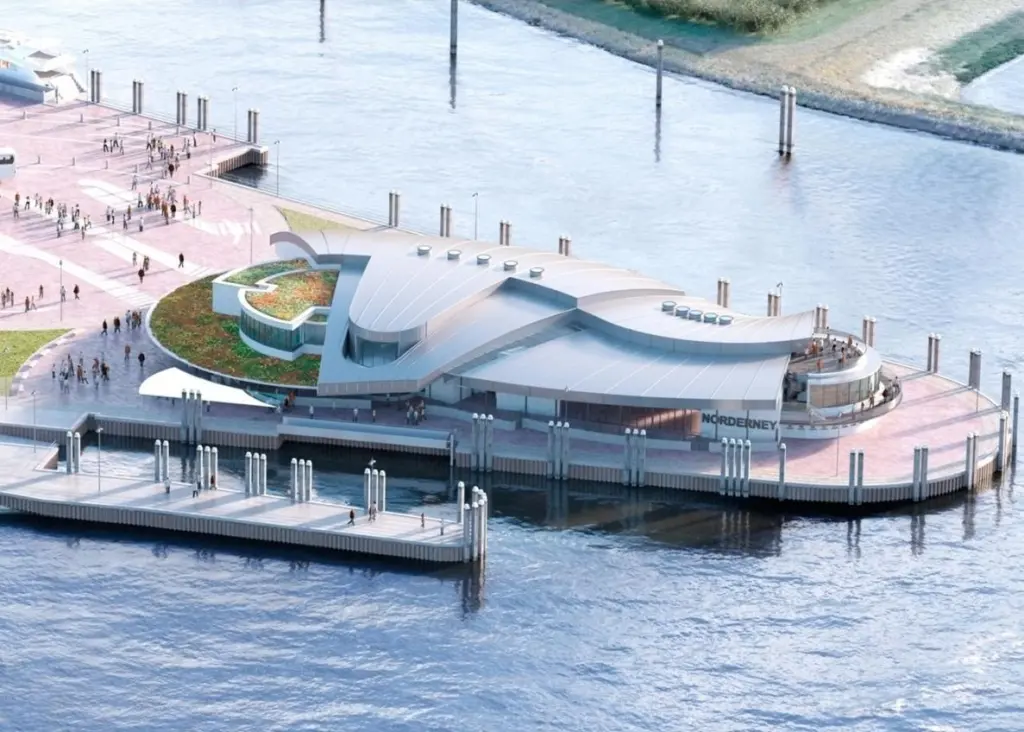
The Norddeich story would not be complete without reference to Norderney’s new futuristic €10 million ferry terminal, opened just this summer. It is of course the destination of many of the ferry travelers from Norddeich.
By Tom Todd

Related Articles
 OTHER NEWS
 OTHER NEWS
 FEATURES & VIDEOS