![MaritimeJournal[Seawork]](https://www.maritimejournal.com/wp-content/uploads/2026/09/MaritimeJournalSeawork.svg)



Netherlands wins EU handout for hydrogen, methanol vessels
The European Commission has approved a €103 million Dutch State aid scheme to accelerate the deployment of hydrogen- and methanol-powered seagoing vessels.
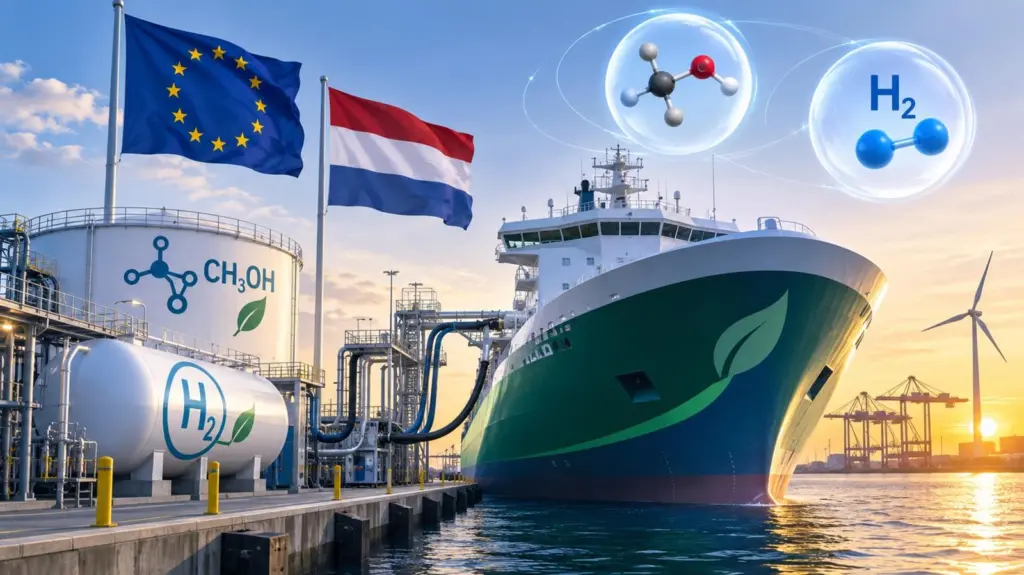
The approval allows the Netherlands to introduce a grant programme supporting both newbuilds and retrofits to operate on hydrogen or methanol.
It will concentrate on workboats, passenger ferries and cargo ships mainly operating in the short-sea segment.
“The scheme aims to help companies overcome high upfront investment costs and limited market incentives that currently slow the uptake of clean shipping technologies,” the EU statement said. “The aid will be granted between 2027 and 2031 and will help bridge the investment gap in line with the objectives of EU legislation such as the FuelEU Maritime and the EU Emission Trading System.”
Support will be provided through direct grants covering part of the higher costs of vessels using the two alternative fuels compared with conventional technologies.
The Commission said the measure contributes to the objectives of the European Green Deal and the Sustainable and Smart Mobility Strategy by encouraging the uptake of cleaner maritime technologies. It also found that public funding was necessary because shipowners would be unlikely to make the investments without financial support.
The approval is particularly significant because it moves beyond research and pilot projects, providing a framework for commercial deployment of alternative-fuel vessels within the Dutch fleet.
Dutch Maritime Master Plan
The scheme complements a broader programme of investment by the Dutch government through its Maritime Master Plan, which is intended to strengthen both the sustainability and competitiveness of the country’s maritime sector.
Under the Maritime Master Plan 2026 temporary subsidy scheme, administered by the Netherlands Enterprise Agency (RVO), €33.6 million has been allocated to collaborative research and demonstration projects involving newbuilds and retrofits.
This programme adds ammonia, bioethanol and onboard carbon capture systems linked to LNG or methanol.
The Maritime Master Plan is aimed at developing and demonstrating new technologies as opposed to deploying them. Projects must be carried out by collaborative consortia and cover the design, development, demonstration and monitoring of innovative onboard systems.
The Dutch government says the programme is designed to accelerate innovation while reinforcing the country’s position as a leading maritime technology hub.
The Maritime Master Plan is intended to reduce the technical risks associated with emerging propulsion technologies, while the newly approved State aid scheme is designed to help ship owners bridge the commercial gap between conventional propulsion and low-carbon alternatives.
For shipowners, equipment manufacturers and technology developers, the combination of innovation funding and commercial investment support could help accelerate market adoption of alternative fuels that have so far struggled to compete on cost.
The Commission’s approval also signals continuing support for member states using targeted State aid to step a transition to low-emission shipping, provided the measures are proportionate, transparent and aligned with EU climate policy.