![MaritimeJournal[Seawork]](https://www.maritimejournal.com/wp-content/uploads/2026/09/MaritimeJournalSeawork.svg)


GNSS resilience in the age of cyber crime
Vessel management ecosystems should incorporate navigation protection by creating a resilient position and timing source detection and mitigation plan, the senior maritime marketing manager at Orolia Maritime has said.
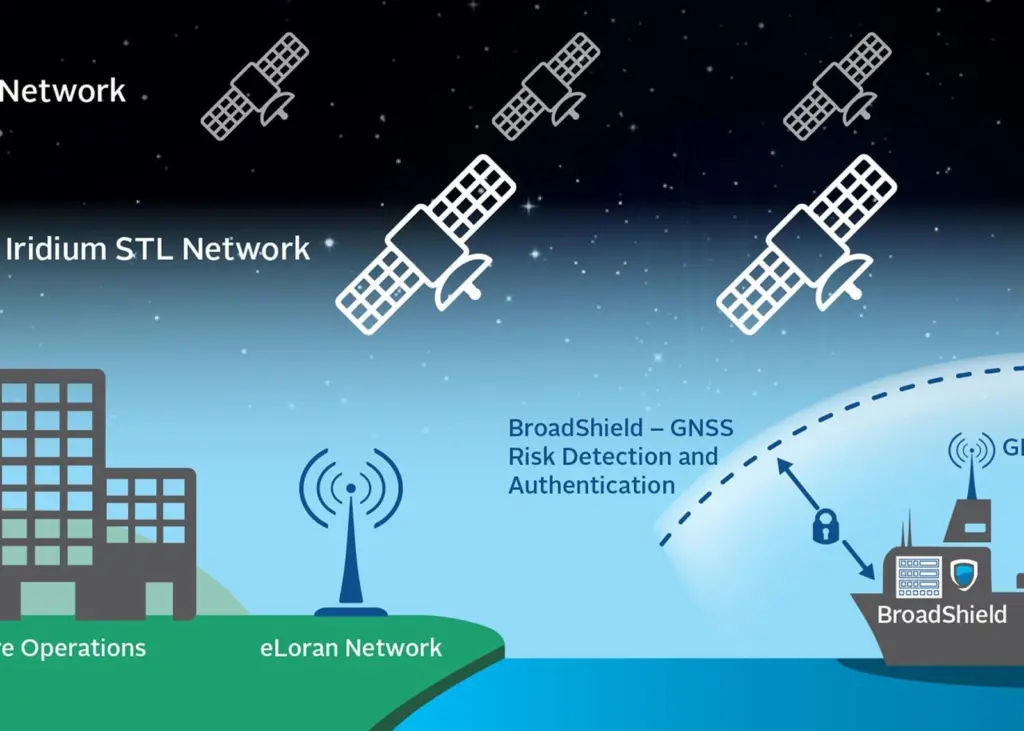
Sean McCrystal said there is a growing realisation that Global Navigation Satellite System (GNSS) as a source of position, navigation and timing (PNT) needs to be both protected and irrefutable, leading to the birth of Resilient PNT (RPNT). This is the convergence of traditional positioning, navigation and timing technology with non-traditional and emerging technology to improve the reliability, performance and safety of navigation signals.
“Poor cyber security could compromise commercial vessels’ safety through interference with navigation accuracy,” warned Mr McCrystal.
Augmented navigation signals such as Satellite Time and Location (STL), offer an encrypted signal, 1000 times stronger than GNSS, that resists jamming and spoofing. Though less accurate than GNSS, it can serve as a check to the GNSS indicated position or time and provide valuable range and Doppler updates to the inertial measurements, reducing drift and maintaining a proper navigation solution.
Navigation Protection Devices
A Navigation Protection Device (NPD) typically includes a monitoring component, which monitors GNSS receptions, analyses the signals and alerts the pilot on the bridge.
Detection scenarios include the NPD activating on the presence of additional signals in the GNSS band or anomalous behaviour of the signal; the navigation solution not matching the ship’s GNSS guidance solution due to equipment malfunction or malicious signals; or identification that the navigation solution differs from the GNSS constellations and its alternatives sources, such as STL.
Fleet owners are “under growing pressure to adopt these solutions or face losing their competitive edge,” stated Mr McCrystal.
Mr McCrystal will be speaking at Seawork at 1pm on Tuesday 11 June, on the theme of ‘Mass Rescue’.
By Rebecca Jeffrey
Related Articles
 ACCESSORIES & EQUIPMENT
 DESIGN
 SEAWORK NEWS