![MaritimeJournal[Seawork]](https://www.maritimejournal.com/wp-content/uploads/2026/09/MaritimeJournalSeawork.svg)






Seawork: The vessel life extension debate intensifies
Workboat operators and vessel designers are increasingly weighing the commercial realities of vessel decarbonisation against the cost of replacing existing fleets and whether to build new or convert.
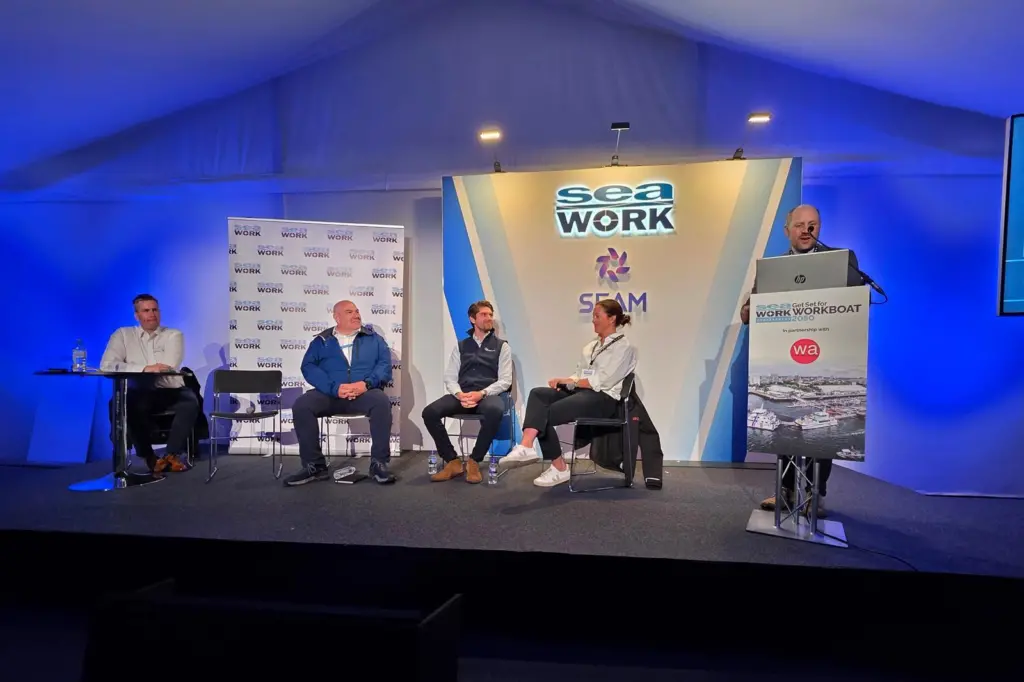
Speaking during the opening conference session of Seawork 2026 and as part of the “Get set for workboat 2050 series” conference programme, industry leaders from across the commercial marine sector examined whether vessel conversion and extended operational lifecycles can deliver meaningful emissions reductions without undermining commercial viability.
The discussion at the ”Extending vessel life and reducing emissions: Do the numbers stack up?” session brought together representatives from offshore wind support, vessel design and carbon consultancy to assess how operators should approach vessel propulsion, lifecycle emissions and future investment strategies.
“Ultimately, we need to get organised with our carbon planning,” said Zennor Pascoe, consultant at Seaotool. “We need to be thinking beyond just our fuel consumption.”
A complex situation
The panel highlighted how vessel decarbonisation is becoming increasingly complex as operators face pressure from emerging emissions reporting requirements, uncertain regulation and rapidly evolving vessel propulsion technologies.
While much of the maritime debate has focused on alternative fuels, Ms Pascoe argued that companies must adopt a broader lifecycle perspective when assessing vessel design and vessel conversion projects.
“We really need to start thinking about vessel lifecycle as a framework of how we measure emissions across the entire lifecycle,” she said.
The discussion reflected growing concern across the commercial marine sector that decarbonisation decisions cannot be based solely on operational fuel burn. Instead, operators are increasingly examining the embedded carbon associated with vessel construction, materials, maintenance and future upgrades.
Ms Pascoe explained that many workboat operators are entering a “planning phase” rather than rushing into major investment decisions. She advised companies to begin collecting operational and emissions data now to prepare for future reporting obligations and commercial requirements from larger contractors and charterers.
“This reporting requirement is not really going away,” she said. “Vessels already have a lot of monitoring and management systems in place already. You have that data there already.”
Evolving design
The offshore wind support vessel market provided several practical examples of how vessel design priorities are evolving. Kenneth Coughlan, CTO at North Star, outlined how the company’s service operation vessels (SOVs) and emergency response and rescue vessels (ERRVs) have become increasingly sophisticated operational platforms supporting offshore wind operations.
North Star’s SOV fleet operates in demanding offshore conditions, deploying technicians directly onto turbines using motion-compensated gangways and advanced positioning systems. According to Coughlan, vessel propulsion and operational efficiency are now closely linked to both safety and commercial performance.
“The ships are the foundation for offshore wind farms,” he said. “I do not see a reduction in the requirement for vessels, only a requirement for more vessels and more efficient in nature.”
However, Mr Coughlan warned that operators face a difficult balancing act between investing in future technologies and protecting current profitability. While regulatory pressure is increasing through measures such as emissions trading schemes, uncertainty remains over how quickly more aggressive decarbonisation rules will be implemented.
“If you take the passive approach, in 10 or 15 years’ time you may not have a value proposition and you might fall behind the competition,” he said.
At the same time, he pointed out that several early adopters of alternative vessel propulsion technologies have experienced significant financial challenges. Mr Coughlan noted that some companies invested heavily in hybrid or alternative-fuel systems only to encounter unforeseen technological and operational complications.
“You have this push-pull where you stay passive and risk your future competitiveness, or be proactive and risk your current competitiveness,” he said.
Conversion economics
The economics of vessel conversion were also examined closely during the session. Ben Colman, managing director at Diverse Marine, described how offshore wind crew transfer vessels (CTVs) have evolved dramatically over the past two decades.
Early-generation CTVs were typically 13m to 14m vessels carrying 12 passengers at relatively modest speeds. Today’s vessel design expectations are significantly different, with modern CTVs commonly reaching 25m to 35m in length while delivering higher speeds, improved comfort and greater operational capability.
“Technicians have got a very high level of expectation,” Mr Colman said. “They’ve become almost a hotel room with propellers underneath them.”
Despite growing pressure for vessel decarbonisation, he explained that commercial realities continue to dominate investment decisions.
Diverse Marine previously delivered hybrid offshore wind transfer vessels capable of operating electrically in port, but operators were often unwilling to absorb the additional capital costs.
“I think the challenge of the industry means that clients aren’t prepared to pay the extra,” he said.
According to Mr Colman, hybrid propulsion systems have added approximately GB£600,000 to the build cost of a crew transfer vessel, while fully electric propulsion solutions could add around GB£1 million to smaller fast craft vessel projects in his experience.
As a result, operators are increasingly prioritising efficiency improvements over wholesale propulsion replacement. Many are focusing on reducing fuel consumption through hull optimisation, hydrofoils and improved propulsion system design rather than committing immediately to fully electric or alternative-fuel solutions.
Decarbonisation question
The panel also debated whether extending vessel life through vessel conversion projects can genuinely support vessel decarbonisation targets. While repowering and refitting projects can provide lower-cost alternatives to newbuilds, commercial returns remain uncertain.
“We have had three successful projects,” Mr Colman explained. “But maybe those vessels only gained another two years of operational life.”
Battery technology also featured heavily in the discussion. While lithium-ion systems are increasingly common across maritime applications, several speakers questioned whether current battery solutions represent a permanent answer for commercial vessel propulsion.
“Electric motors are excellent,” said Mr Coughlan. “But I would say that lithium-ion batteries are a stepping stone towards something else.”
For many operators, the immediate focus remains on improving operational efficiency, collecting better emissions data and preparing for future regulation while avoiding premature investment in technologies that may quickly become obsolete.
”So it’s important to look at the bigger picture, not just vessel efficiency and the fuel burn, also look to your operations onshore and make your whole value chain operate more efficiently,” said Ms Pascoe.
“These requirements aren’t going away. Gather your data now and ready yourself for the future while we watch and wait on what will come next.”
As offshore wind operations expand further offshore and vessel requirements become more demanding, the debate around vessel decarbonisation, vessel life extension and future vessel design strategies looks only likely to intensify.
Related Articles
 SEAWORK
 SEAWORK NEWS
 SEAWORK