![MaritimeJournal[Seawork]](https://www.maritimejournal.com/wp-content/uploads/2026/09/MaritimeJournalSeawork.svg)



A close look at SMITs first big cat
A brief news item in Tugs & Towing in July of this year reported the completion of Smit Panther, the first of Damen Shipyards’ new ASD Tug 3213 terminal tugs and the first of a quartet of identical vessels for Smit International. At the time tug had completed exhaustive trials in Viet Nam and was en route to Rotterdam but the ink was barely dry on that report when the tug was diverted to Italy to serve the new Adriatic-LNG offshore gas facility.
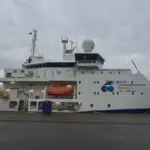
Smit Panther
is currently part of a new four tug fleet operating under a joint venture between Smit and Italian partners Adriatic Towage Srl and Rimorchiatori Riuniti Panfido Srl.
Maritime Journal
has been given a unique opportunity to visit
Smit Panther
at its operating base in the port of Chioggia, at the southern end of the Venice lagoon.
With the rapid growth in the number of new Liquid Natural Gas (LNG) terminals, the demand for powerful, highly sophisticated terminal tugs, capable of handling a new generation of LNG carriers and conventional tanker traffic, under a variety of arduous conditions, has also increased.
The Damen ASD Tug 3213 design was developed to address that particular sector of the towage market, and incorporates input from clients and the MARIN ‘Safe Tug’ joint industry project, to which Damen and Smit subscribe. ‘Safe Tug’ was undertaken by the Netherlands MARIN Research Institute to study the design and operation of tugs in exposed locations with the involvement of participants from the petrochemical industry, shipowners, tug owners, designers and specialist shipbuilders. In common with its three sister ships Smit Jaguar, Smit Cheetah and Smit Tiger, the tug was constructed at the Song Cam shipyard, in Hai Phong, Viet Nam to meet the class requirements for Lloyds 100A1 Escort Tug +LMC, UMS, Fire Fighting Ship 1 with waterspray.
At first sight Smit Panther embodies many features common to all of the Damen ASD product range but closer examination reveals a vessel of exceptional power, strength and stability. With an overall length of 32.14m the tug has a beam of 13.29m, a depth of 5.50m and draft (aft) of 6.00m. The hull form incorporates increased volume forward, a raised forecastle, deep box keel and a pronounced sheer aft, increasing freeboard at the open stern. This additional freeboard aft has enhanced the vessel’s performance running astern and reduces the ingress of water on deck.
Shiphandling in exposed locations demands fendering of a high standard to enable the tug to operate effectively in the ‘push-pull’ mode without fear of damage to ship or tug. Smit Panther’s massive bow fender, made up of moulded vertical ‘W’ sections, is designed to distribute the high pushing forces generated over the greatest possible area. Two horizontal strakes of heavy ‘D’ section moulding mounted on the forecastle protects the all important forward quarters. A single rubber moulding of the same ‘D’ section protects the hull sides. A large diameter tubular rubber moulding is mounted above the bow fender at bulwark height around the entire forecastle and the aft quarters. The bow fender can be lubricated to prevent friction damage while pushing in a heavy swell, by two water spray nozzles mounted on the forward towing fairlead.
From deck level the relatively low, compact design of the superstructure and the overhead clearance achieved by the angled exhaust stacks become obvious. The after deck provides a very large working area, protected by a hardwood covering, and the open stern incorporates a 3m wide stern roller with a 126 tons safe working load (SWL). All of the bulwarks are enclosed on the inside adding considerable strength and simplifying maintenance. The foredeck is dominated by the massive towing fairlead with a 300 tons SWL and the combined towing winch and anchor windlass. The winches installed aboard Smit Panther form an important part of the overall concept for shiphandling in exposed locations. Both were supplied by Rolls-Royce Marine, configured for the purpose and hydraulically driven.
A heavy duty, twin drum, two speed winch, incorporating the windlass mechanism and a warping head, is mounted on the foredeck for use during escort and shiphandling operations. The winch has a maximum brake holding capacity of 320 tons and full ‘render and recovery’ capability. When paying out, the winch can maintain a load of up to 120 tons (on the 1st layer) or 80 tons while recovering the towline. The tugmaster can control the winch from the wheelhouse, including pre-setting line length and towline tension. Both drums are equipped with 150m of high performance fibre towline of 104mm diameter. The fairlead apertures and the top surfaces of the forward bulwarks are lined with stainless steel to protect the towline.
Smit Panther has a single drum, twospeed winch situated on the after deck in a relatively sheltered location between the exhaust uptakes. The winch has a 320 tons brake holding capacity and can generate a line pull 80 tons at 80 m/min. A steel wire towline of 1,000m in length and 56mm diameter is installed for towing over the stern, in harbour or at sea. Other deck equipment includes a capstan, a Mampaey quick release 100 ton SWL towhook and a Heila HLM deck crane with a maximum lifting capacity of 3.6 tons at 2.74m outreach.
The external fire fighting system comprises two remotely operated Alco short barrel monitors, each capable of delivering 1,200 cu/m of water/foam per hour, self protection spray nozzles and hose connections on deck. Both monitors are mounted on the forward superstructure at bridge deck level.
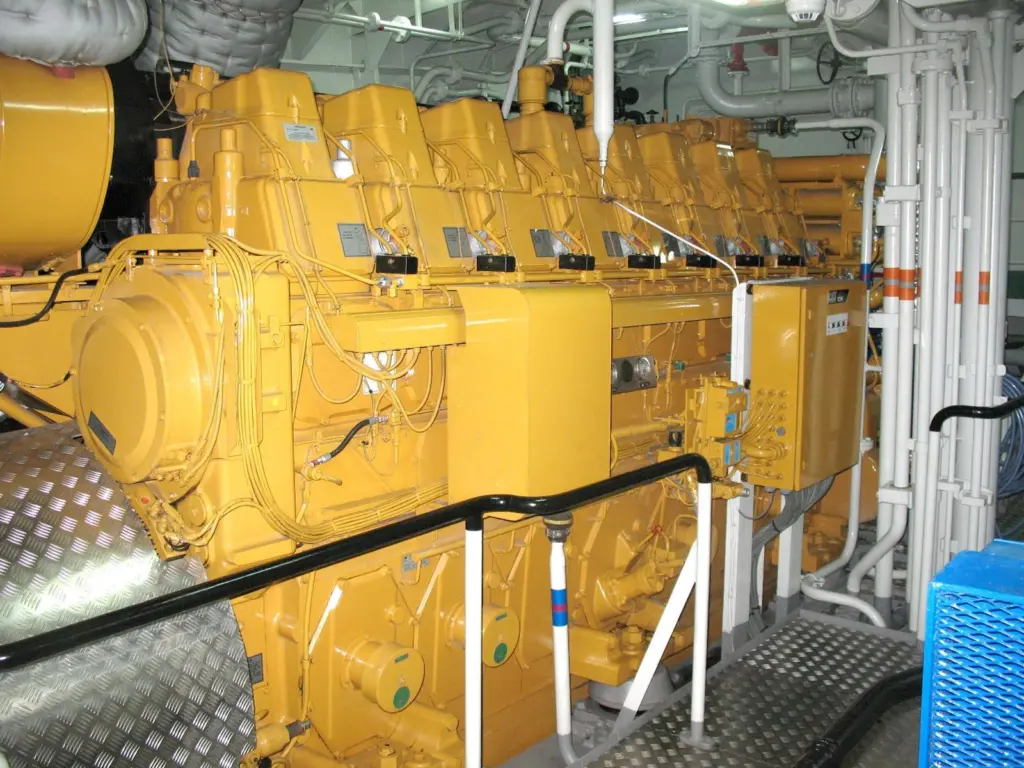
At the heart of the all important propulsion system is a pair of Caterpillar C280-8/MC main engines developing a total of 7,268 bhp (5,420 bkW) at 1,000 rpm. These modern engines already comply with the IMO Tier 2 emission regulations that come into force in 2011. The engines are air started and utilise NRF box coolers. Flexible engine mountings and couplings, and huge heavily insulated exhaust silencers minimise noise and vibration. A Kumera-Norgear ‘step-up’ gearbox is coupled to the front of each main engine, each driving a Kvaerna fire pump for the main fire fighting system and a hydraulic pump to power the deck machinery system. The engine room forced ventilation system delivers a massive 80,000 cu/m of air per hour.
The engine room is entered via a small sound proofed switchboard room, containing switchboards for the auxiliary generators and, when necessary, a shore power supply. Two display panels are mounted in the same location. A Praxis system controls the alarms and monitors the electrical systems and tank soundings and another by Allen-Bradley the main engines. Electrical power is supplied by two Caterpillar C9TA 188kVA alternator sets located in the engine room.
Power from the main engines is transmitted via ‘cardan’ shafts to Rolls-Royce US 285 fully azimuthing propulsion units incorporating 3,000mm diameter controllable pitch propellers. This arrangement offers rapid and precise control of thrust in any direction.
During trials at Hai Phong, Smit Panther achieved a bollard pull towing ahead of 94.7 tons and 88.9 tons pulling astern. Maximum free running speeds, an important matter for any escort tug, of 14.3 knots ahead and 14 knots astern were recorded. Accelerating from 0 to 14.3 knots takes just a few seconds and a crash stop can be completed in less than the tug’s own length. A complete 360 degree turn on its own axis can be made within 10 seconds.
A spacious, well equipped wheelhouse has two control stations, one forward and one aft, designed to give the tug master easy access to either from the captain’s chair mounted on its central track. The forward console is built to a standard design common to all Damen modern ASD tugs and simplifying familiarisation and training. The wheelhouse has large windows ensuring good all round vision. A comprehensive outfit of navigational and communications electronics meets the standards for GMDSS Area 3. Included in the package are two radars, a satellite compass, GPS, echo sounder, auto-pilot, speed log, two Inmarsat C terminals, Navtex, two VHF and one single sideband radio.
Fully air conditioned and heated accommodation is provided for up to nine persons in three single and three double berth cabins. There is also a large mess room, a well equipped galley, sanitary spaces, washing facilities and stores for dry and frozen supplies. The accommodation is constructed with floating floors and insulated linings and ceilings to reduce sound levels to 60-65 dBA throughout, including the wheelhouse. A horizontal watertight hatch is installed above the wheelhouse stairwell to isolate the wheelhouse in an emergency.
The Smit-Adriatic-Panfido joint venture has an exclusive 25 year contract for the provision of towage services at the new Adriatic LNG regasification plant. Smit Panther is now working alongside the tugs San Francisco AT and San Nichola AT from Adriatic Towage and the chartered Ciuciolo. All three are virtually brand new, the pair from Adriatic Towage are Turkish built vessels of 32.5m and 65 tons bollard pull delivered in 2008. The 32m and 65 tons bollard pull Ciuciolo is also Turkish built and was delivered in January 2009 to Globeco Spa.
The unique offshore liquid natural gas facility, located nine miles off the coast of Porto Levante, is the world’s first offshore gravity based structure to be used for unloading, storage and regasification of LNG. Operated by Qatar Terminal Limited, a subsidiary of Qatar Petroleum, ExxonMobil Italiana Gas, and Edison, the terminal is 47m high, 88m wide and 180m in length. The facility was built in Algeciras, Spain, towed to the site and completed in August 2008.
Operations started in mid-2009 and the terminal received its first cargo on 11 August 2009. When fully operational, it is expected to store and regasify 8bn cu/m of natural gas per year, enough to meet 10% of Italy’s natural gas needs. An LNG carrier is expected to arrive at the offshore terminal every three days from Qatar. The cargo will then be regasified and sent to the Italian gas network by a pipeline from the terminal to the coast.
In order to safely berth and unberth LNG carriers, Adriatic LNG has established an infrastructure to provide the services of pilots, tugs, and line handlers for visiting ships. Extensive studies and training have been conducted to ensure the arrival and departure of LNG carriers can be accomplished safely under a wide range of allowable weather conditions. This is just the environment that Smit Panther and the Safe Tug project were intended to address.
Damen’s Director of Tugs & Workboats, Coen Boudesteijn told Maritime Journal, ‘The new ASD Tug 3213 design is generating considerable interest and a further ten vessels are under construction. This includes four tugs for the Lamnalco Group with deliveries scheduled for late 2010.’
At the time of writing Smit Jaguar and Smit Cheetah had left China on their delivery voyage to Europe and work on the Smit Tiger is well advanced. No doubt the final destination of these vessels is still subject to change.
By Jack Gaston