![MaritimeJournal[Seawork]](https://www.maritimejournal.com/wp-content/uploads/2026/09/MaritimeJournalSeawork.svg)



A Cure for What AILs You
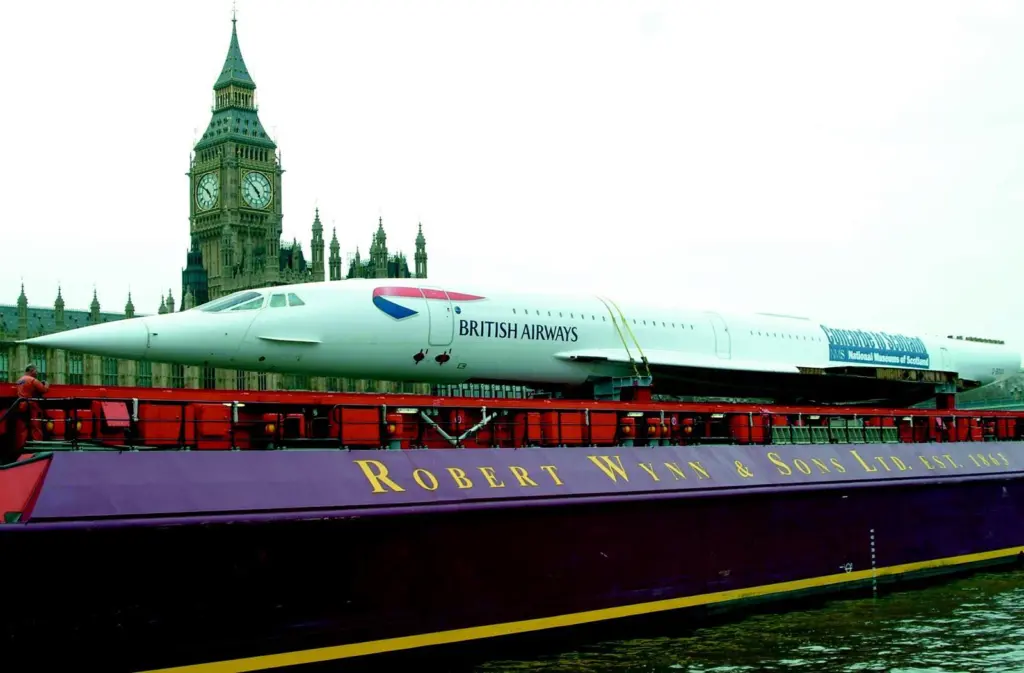
A new vessel which also embodies a new concept for taking Abnormal Indivisible Loads (AILs) off Europes crowded highways and onto commercial waterways and short sea routes could not wish for a more spectacular start to its working life than to transport the last British Airways Concorde from Londons River Thames to Scotland, stopping for a photo opportunity with its famous cargo lifted from the hold outside the Houses of Parliament.
The event in central London earlier this month, which drew large crowds of Concorde enthusiasts as well as the general public, was at an appropriate venue for it was the British Government’s award of an £8.5m Freight Facilities Grant to Robert Wynn & Sons Ltd that made the building of the Multi Purpose Pontoon (MPP) Terra Marique possible. The grant covered 99% of the cost of building Terra Marique and converting the former inland barge Inland Navigator (see MJ , February 2004).
Terra Marique will work in tandem with its smaller daughter vessel Inland Navigator , which it can carry inside to allow greater inland penetration. Working together as a system, the vessels will enable 400 tonne single piece loads to be carried to and from inland locations in both the UK and on the Continent while the mother ship working alone can carry loads up to 1,200 tonnes in weight into major estuaries and along tidal stretches of rivers such as the Thames as well as into numerous coastal ports.
Using various load/discharge scenarios, the MPP system can handle heavy loads on and off conventional berths, riverbanks or beaches. Accommodating varying tidal ranges and quay heights, loads are transferred using combined Ro-Ro and Lo-Lo loading techniques, with loads carried on in most cases by multi-wheeled trailers in Ro-Ro mode.
The 2,211dwt Terra Marique is also semi-submersible, able to load and unload floating structures into a 67m by 9m hold which can also be flooded to provide floating dockage for an inland barge such as Inland Navigator.
A 133 year old family business when re-established in 1996 as water-born transport specialists, Wynns moved over 1,000 tonnes of power generation equipment for Siemens in 1998. The largest load ever to be moved on British inland waterways, the project proved that AILs could be transported on inland canals and coincided with the then new Labour Government’s statement of intention to take freight off Britain’s congested roads. The moment gave birth to the concept for Terra Marique , which has now arrived with a Government policy in place to only issue AIL road permits in instances where water movements are not feasible.
Wynns provided a functional specification for naval architects Burness Corlett & Partners, which developed an outline but detailed specification for tendering. The defining design characteristic was a requirement to clear the Gainsborough Bridge so that AILs could be delivered up the River Trent. Four preferred bidders included three UK yards but the contract was awarded to the Damen Shipyards Group of the Netherlands on the basis of both price and volunteered design innovations to help realise the ambitious intentions of the project. These included the Hydrospex gripper jack system which elevates Terra Marique ‘sthree internal hold sections and 7.5m spuds at either end which can help stabilise the vessel during loading/unloading operations.
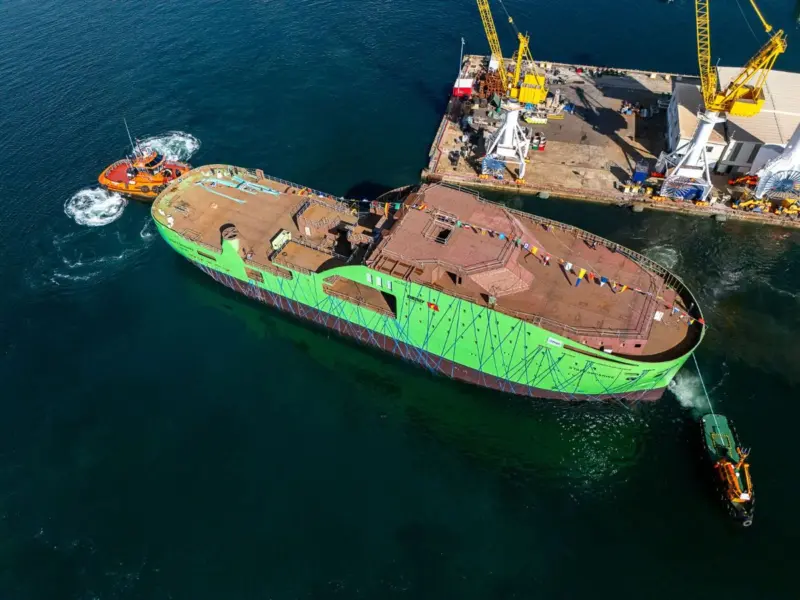
Terra Marique was built at Damen Shipyards Okean on the Black Sea and towed through heavy seas in the Mediterranean which proved her seaworthiness to Damen’s Gorinchem yard in the Netherlands for completion.
The vessel was built to a demanding specification requiring compliance with Lloyds Register of Shipping classification 100A1 Barge, UK coastal service, and occasional voyages at sea, LA bottom strengthened for loading and unloading aground, ES (20%), and LMC limited self manoeuvring capability.
Terra Marique also had to meet MCA requirements for safety and the limited transportation of hazardous cargoes. Lloyds code of lifting appliances was applicable for all elevating and lifting systems. To meet these requirements, special attention had to be given to the design, construction and fitting out of the vessel. Damen’s project manager Bert Jan ter Riet said, ‘Considering the measurement accuracies required of this newbuilding, it was one of the greatest achievements we have ever made.’
The longitudinally framed, welded hull of Terra Marique is80m LOA with a moulded beam of 16.5m and a design draft of 2.75m. The underwater profile is optimised for course stability and incorporates smooth lines in way of the four 200kW Jastram W40 azimuthing jet thrusters mounted at each corner.
Ballast tanks for the critical and sophisticated Lodic ballast water management system are fitted at the wings and underneath in the vessel’s double bottom.
The control cabin includes all facilities for the highly automated operation of the vessel and is fitted on a mechanical lifting device which can lower it below the air draft at bridges.
At the stern, two Heila HLRM 170-4S 10 tonne knuckle boom cranes lift the two watertight door panels and lay ramp extensions when required for loading/unloading. For mooring purposes at these occasions, the spuds are complemented by a 4-point mooring system with hydraulic winches with a pull of 5 tonnes at 14m/min and a holding force of 10 tonnes coupled by wire to high holding power anchors.
Although designed to be towed, Terra Marique has a diesel-electric propulsion system developed by Bakker Sliedrecht which can self-propel the vessel at 4.75 knots with a bollard pull of 5.5 tonnes. The vessel can self manoeuvre in MCA Category D waters and for beach landings.
Power for the propulsion system and the vessel’s main electrical supply is located in an engine room forward of the cargo hold and supplied by two Caterpillar 3508TA diesel engines coupled to generators, each providing 630KW at 440V. An emergency generator powered by a Caterpillar 3304 NA diesel is rated at 57kW. Hydraulic power is supplied by a central high pressure system serving equipment such as the deck cranes and winches.
The heart of the Terra Marique is the elevating deck, consisting of three roadway sections, each of which is capable of lifting 600 tonnes. These can work separately or together to receive cargo from quay heights varying from 200 mm to over 5m into the single unobstructed hold which has a maximum underdeck height of some 6.5m. The roadways have also been designed to give 2º of heel and 3º of trim, enabling the vessel to take the ground on unprepared surfaces.
The gripper jacks system delivered by Dutch firm Hydrospex derives from that company’s involvement in supplying similar technology to lift the Russian submarine Kursk from the floor of the Barents Sea. A gripper jack is a hydraulic ‘monkey’ which can climb up and down a square steel bar. Each deck section is fitted with eight gripper jacks and each of them has a lifting capacity of 125 tonnes. The system is totally computer controlled, with loadings, speed and other parameters recorded in the control cabin.
In conjunction with the elevating roadways, the vessel also has a 450 tonne capacity lifting gantry which can be erected at every gripper jack position to perform Lo-Lo lifts from or to the daughter vessel or to trailers, enabling the shipment of cargo in instances where modal change is required.
A 4×100 tonne skid system is also provided to move cargo horizontally on the roadway.
Terra Marique has two types of shore ramp, one permanent and the other a shore spreader, as well as ramp extensions of 14m unsupported span for working at unprepared sites.
For loading/unloading extremely heavy loads, the stability of the vessel is crucial.
A highly automated ballast system integrates with the elevating roadways to maintain optimal trim and draught, with a pre-calculated ballast sequence automatically executed in direct relation to the position of the cargo. The ballast system comprises four ballast pumps, each of 680m 3/hr capacity.
The cargo hold can be closed by means of an alloy weather-tight hatch cover system and for most of its voyage to near the Museum of Flight at East Fortune, Concorde (minus tail and wings) was snug and dry and out of view. But for one glorious hour and a half on the afternoon of 13 April, Terra Marique ‘s gripper jacks hoisted Concorde to deck level and the cheering crowds along the Thames witnessed a special moment when one breakthrough in transport innovation carried another to its final resting place.
MJInformation No: 19319