![MaritimeJournal[Seawork]](https://www.maritimejournal.com/wp-content/uploads/2026/09/MaritimeJournalSeawork.svg)



A new era for accessing offshore wind turbines
Siem Offshore Contractors recently took delivery of a new generation offshore wind installation support vessel that is set to introduce a new standard for accessing offshore turbines.
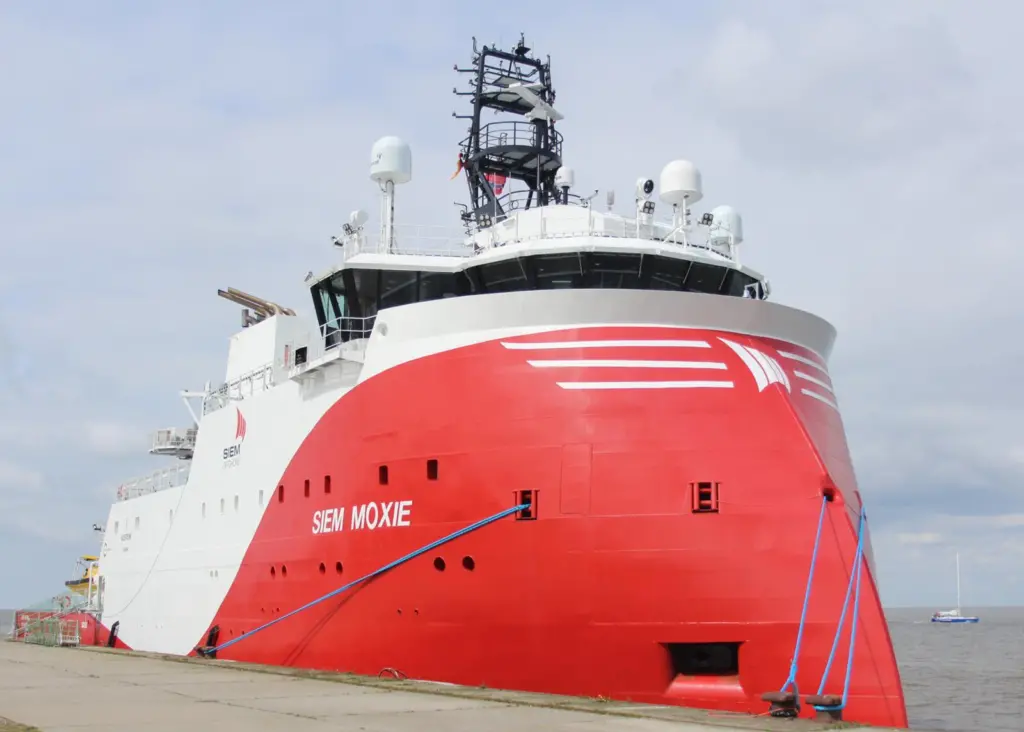
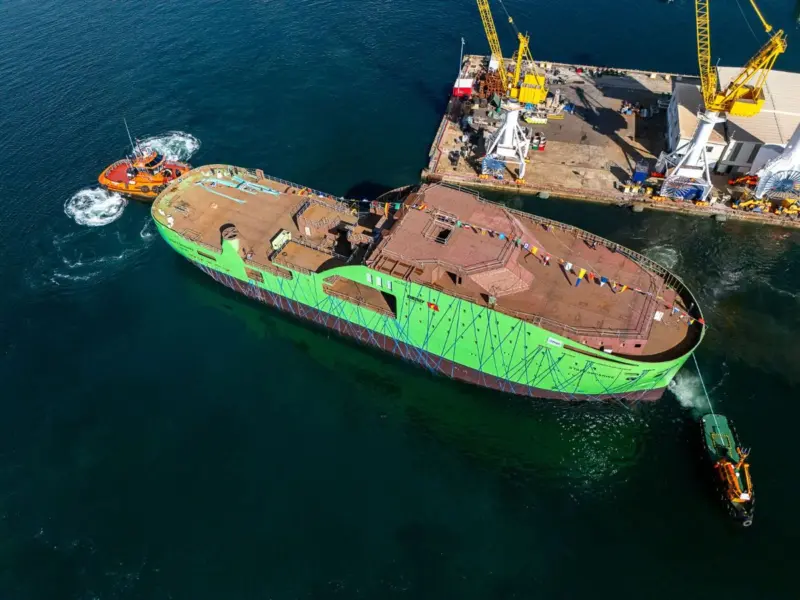
Earlier this year in Hamburg, the name-giving ceremony was held for the installation support vessel Siem Moxie. The vessel was built for Siem Offshore Contractors by shipbuilder Fjellstrand AS (based at Omastrand in the Hardangerfjord on the west coast of Norway). Following model testing at the Hamburg Ship Model Basin, the basic vessel was built at Ada Shipyard at Tuzla in Turkey before being towed to Fjellstrand’s facilities in Norway for completion.
The vessel has immediately been taken on charter by E.ON for duties at the Amrumbank West offshore windfarm north of Helgoland in the German sector of the North Sea. There are a number of notable features with the Siem Moxie, including: ULSTEIN’S patented X-BOW design, Voith Schneider propulsion (VSP) units (the first example of this combination in an offshore work vessel) and the first example of a three-axis motion compensated offshore crane. The combination of features in this innovative vessel have presented the industry with a visible example of how they may address the issue of providing access to turbines at a time when traditional methods are being overtaken by progressive developments.
FURTHER AND DEEPER
As the story of offshore wind unfolds, two developments in particular have led to operators now facing a choice of roads to venture down. An increasing number of windfarms are moving from the construction to operational phase, and secondly more developments are appearing in deeper, more hostile waters further offshore. Windfarms in the German sector of the North Sea in particular are mainly located further offshore than for example UK Round 1 and 2 sites. The situation in the UK itself will in time change once Round 3 developments, particularly in the North Sea start to materialise with projects moving from the planning and consent stages to the construction phase, in waters deeper and further offshore than so far experienced. An obvious requirement during the two relevant phases (construction and operational) is facilitating access to the turbines for both personnel and equipment. Whatever the foundation type, from an early stage there is the requirement to transfer personnel and equipment to continue the installation process including the hooking-up of inter-array cables.
A feature of the offshore wind industry is that despite the appearance on the skyline, no two windfarms are the same with many variables presenting individual challenges and in turn possible solutions. Developers are faced with a choice of foundation type, some windfarms comprising a combination of for example: monopile, jacket and gravity base designs. Providing access is a basic requirement whatever the type of foundation and it is the provision of such that has seen progressive evolution since the very start. The days of a local fishing boat lying alongside while technicians scramble up a boarding ladder before hoisting their tools up by hand are thankfully long gone.
The crew transfer market has developed and expanded to satisfy the increasing demand with impressive, sea-kindly craft providing airline style comfort and facilities for technicians, able to operate in increasingly higher sea states and for longer periods of time. There are a number of factors however, including the increasing distances offshore mentioned above that are now seeing developers explore different solutions. The small crew transfer vessel method of operation typically involves a day-work pattern including a journey of an hour or more each end of a full working day on the turbine. This, combined with the desire to remain within the twelve passenger regulatory model can place potential limitations on the efficiency and effectiveness of such working as the number of turbines installed at sites further offshore increases, stretching the ‘there and back in a day’ method of working. In short there is now an option for personnel to remain offshore for periods of for example one month, making the journey to work a much shorter one.
So what choices are windfarm developers faced with for keeping turbines fed with personnel and equipment to keep them turning, particularly with future projects? It is worth pausing here and taking a look at the offshore oil and gas industry which has faced similar requirements for decades. With this industry however, platforms are typically located on their own, and substantially larger than a single turbine. Permanent accommodation platforms may be sited adjacent to for example, a production platform allowing the workforce to take a short walk to and from work each shift.
A typical windfarm however may comprise a hundred or more individual installations requiring a comparatively small workforce in attendance at a certain number of locations on a rotating maintenance and repair schedule. In other words some form of intensive boat or ship transfer operation will be involved with vessels constantly manoeuvring close to one structure before moving on to the next. A new phrase is to be heard describing this type of operation, ‘walk to work’ access. Taking SMart Wind’s Hornsea Round 3 Zone off the UK east coast as an example, at its closest point the zone is 31km from the coastline, at its furthest 190km. This is perhaps an example of a project that could operate a mix of day boat working and more permanent infield support vessels with maintenance crews spending a month at a time offshore. In its Scoping Report for the Round 3 Dogger Bank Teesside projects, Forewind explores options for the O&M phase including the possibility of up to ten pre-installed permanent moorings per project allowing vessels to moor while work is ongoing. It is this sector of what will no doubt become an increasingly active area of the industry that the Siem Moxie is aimed at. It is also important to mention that other similar vessels are either now available or at the building or concept stage. It is the range of notable features with this particular example that makes the vessel worth a closer look.
PROVEN DESIGN
Siem Offshore Contractors have selected a new design from the stable of ULSTEIN, designated the SX163. Renewables is a new business segment for ULSTEIN and the Siem Moxie has been developed in close cooperation with Siem. It is also the first vessel of ULSTEIN design to be built by a Norwegian yard other than at its own shipyard at Ulsteinvik. The design includes ULSTEIN’s patented X-BOW, a concept featuring an “inverted bow” which reduces pitch and heave accelerations and speed loss in waves, delivering higher transit speeds or reduced power consumption with consequential improved fuel efficiency and reduced emissions. With maintenance teams being based offshore for a month at a time comfort is an essential requirement, particularly where the technicians may not originate from a maritime background. The X-BOW provides the solution here by eliminating slamming and bow impact with resultant reduced noise and vibration. As of early 2014, around 60 vessels are in operation featuring ULSTEIN’s X-BOW.
Siem Moxie was constructed in accordance with classification society DNV’s latest rules and regulations for international trade. Main class notations are: DNV *1A1, Offshore Service Vessel, SF, EO, BIS, DYNPOS-AUTR, CLEAN DESIGN, COMF-V(3), NAUT-OSV (A), SPS. Operating under the Norwegian (NIS) flag, the vessel also conforms to IMO MSC.266(84) code for special purpose ships, 2008. The main service duties for the vessel are stated as: support of installation, repair and maintenance services on fixed offshore structures and other offshore installed assets; and safe transfer of personnel from a fixed structure to the vessel and vice versa. The main particulars quoted here are all approximate: length overall is 74m (70.7m BP), moulded breadth 17m with a depth from main deck of 8m. Design draught is 6m and maximum draught 6.4m. The vessel’s freeboard at maximum and design draught are 1.6m and 2m respectively. Capacities are: fuel oil 955m3, fresh water 780m3, water ballast/TFW 1,877m3, lube and hydraulic oil 55m3. Deck cargo area is 190m2 with a deck load of approximately 500t. Deadweight at maximum draught is 2,798t and gross tonnage 4,349t.
PROPULSION CHOICE
A particularly notable feature of the Siem Moxie is the choice of propulsion system. Two Voith Schneider ECS Propellers and Cycloidal Rudders (VSP) together with associated transmissions are installed. The vessel becomes the first work vessel with the ULSTEIN X-BOW to be fitted with two VSPs. The two electronically controlled VSPs are of the size 28R5 ECS/234-2, each with a propulsive power of 1,850kW and arranged in the vessel’s stern. Each unit comprises five 2,340mm long blades operating in an orbit diameter of 2,800mm at a motor speed of up to 1,200 rpm. Vessel stability is an important requirement for the Siem Moxie, particularly considering the requirement for safe transfer of personnel and equipment to a small platform target area in open-sea conditions many miles offshore. This is achieved through provision of the vessel’s roll reduction system comprising two passive roll reduction tanks, along with active roll stabilisation from the VSP propulsion and control system. An anti-heeling tank system is included comprising two wing tanks and a single electrically powered pump with a capacity of 400m3/hr.
Manoeuvrability is further enhanced with an array of thrusters. Two electrically driven tunnel thrusters are located forward: propeller diameter is 2,250mm with a motor rating of approximately 1,200kW at 900 rpm for each. Additional benefits are gained with addition of a retractable, electrically driven azimuth thruster forward: the propeller diameter is 1,850mm with a motor rating of 850kW at 1,200 rpm. All three thrusters are of the variable speed, controllable pitch type, powered by fresh water cooled electric motors. Siem Moxie’s main power is derived from a quartet of generator sets, comprising two of 1,840ekW at 1,800 rpm and two smaller units of 1,380ekW. An air radiator-cooled 285ekW emergency generator set is also included. The vessel’s trial speed at 100% load on each of the propulsion units at 5m draught, clean hull and sea state 0-1 is 13.5 knots. The alternating current electrical system comprises 3 phase 60Hz for the general electrical system, complying with DIN and/or IEC norms. The system voltages are 690V AC, 440V AC, 230V AC and 24V DC.
Siem Moxie is equipped with a joystick arrangement which integrates control of the main propulsion unit’s rpm and forward thrusters in one single control lever. For vessels carrying out roles such as those envisaged for Siem Moxie, maintaining precise position close to fixed structures for prolonged periods usually demands a suitable dynamic positioning system and here the vessel meets the standards of DP 2 (Dynpos AUTR) comprising an array of reference systems and sensors including two wind sensors with heating, three motion reference systems, two differential GPS systems, one Cyscan laser reference system and a radar reflective position sensor.
INNOVATIVE CRANE
Arguably the most notable and significant feature of the Siem Moxie is provision of a new brand new design of offshore crane from MacGregor (part of Cargotec). Siem Offshore Contractors approached MacGregor’s Competence Centre for Advanced Load Handling in Kristiansand Norway to address the challenge of being able to transfer limited weight loads, in the form of tools and small containers, to the access platform at the base of the turbine (at the top of the foundation). The key to the efficiency of the operation, and the capability of operating in open sea condition, naturally requires minimum relative movement between the moving ship and fixed structure. Active heave compensation for the load on a crane’s hook is now well established in the offshore industry but of course a ship’s motion includes many movements, not just up and down. The requirement was for a crane to carry out transfers in a significant wave height of 3m to platforms 30m above the water and with an area of only 4m2. The crane can typically be used to place a 10ft container or suitable pallet and box loads on to the platform.
The result is what is described as: “… a first of its kind, not just for MacGregor, but for the industry” by Frode Grøvan Director, sales and Marketing, Advanced Load Handling. Technology was developed to compensate for the vessel’s movement in the horizontal plane: pitch and roll with the crane’s pedestal remaining vertical in relation to the seabed such that it is always parallel to the structure. MacGregor’s solution involves hydraulically tilting the crane’s foundation (the outer foundation remains welded to the deck). The fixed foundation is connected to the internal foundation system. Active heave compensation is also provided through the crane’s winch. Physical displacement of the crane, relative to the motion of the ship, is reduced by positioning it at the centre of the vessel.
Four high-speed hydraulic tilt cylinders, arranged in two pairs, provide full functionality and a good level of redundancy. Each cylinder is fitted with a positioning sensor to provide real-time feedback to the control system. A motion reference unit is the primary sensor for calculating heave motion. In addition, a secondary sensor placed in the tip of the crane’s boom will verify the motion reference unit’s accuracy, providing overall redundancy. Luffing and slewing control remains while three-axis compensation is activated allowing precise load positioning by the crane operator.
All the main operational functions are controlled from an operator’s cabin providing good views of the main deck and lifting zones. The crane complies with DNV lifting regulations and has a SWL of 5t at 25m outreach. It features a telescopic jib and is also capable of ship-to-ship transfers using a constant tension function. MacGregor states that although it will not be a standard feature, the crane can be specified for personnel lifting. The winch would need two independent brakes to be certified for such operation along with specific certificates for some of the crane’s other components. Earlier this year it was announced that MacGregor had won the Offshore Support Journal’s Innovation of the Year Award for Siem Moxie’s crane (the vessel also picked up the Offshore Renewables Award). The news was announced at the fifth Annual Offshore Support Journal Conference and Awards event, held in London. The award is given for a product, system or service which is judged to have made the most significant impact on the design, build and/or operational aspects of offshore support vessels. Tom Svennevig, Vice President, Advance Load Handling said: “It is an honour to receive such a prestigious prize from one of the most reputable forums in the international offshore sector” adding: “It is also an important recognition of our capabilities from peers across the offshore industry.”
Älesund Norway based Uptime International AS have provided another essential part of the Siem Moxie’s equipment list with one of their AMC 19.4m +/- 4m telescopic active motion-compensated personnel transfer system . Access to the system is arranged directly from the vessel’s C-deck on a permanent basis, allowing for easy and safe access of personnel. As to be expected with a vessel of this type, the electronics fit is comprehensive and includes an integrated bridge and a complete GMDSS A3 communication station. Deck machinery comprises a double electric windlass/mooring winch with cable lifters, drums and warping heads and two electric 10t mooring winches located aft.
The connection that Siem Offshore Contractors, ULSTEIN and Fjellstrand have with the offshore oil and gas industry is reflected in the quality of accommodation which, as in those industries, is to a high standard. Siem Moxie can accommodate a total of 60 persons in 18 single and 21 double cabins. In addition there are day rooms, mess rooms, offices, conference rooms, galley, provisions store and gymnasium. Each cabin has direct access to a private toilet (shower, WC and wash) and the accommodation is fully air-conditioned for world-wide operation based on a chilled water system. The vessel’s safety equipment complies with SOLAS and flag state requirements and includes: two aluminium hulled, approved type, fast rescue craft (FRC) featuring inboard diesel engine and waterjet propulsion; two single-point davits for the FRCs and six, 35 person liferafts, three on each side of the vessel.
As mentioned the Siem Moxie’s first task will be involvement in E.ON’s Amrumbank West windfarm north of Helgoland. The €1bn capital investment project has been under construction since January 2014 and extends over an area of 32km2. Eighty 3.6MW turbines will produce a total of 288MW of energy.
By Peter Barker