![MaritimeJournal[Seawork]](https://www.maritimejournal.com/wp-content/uploads/2026/09/MaritimeJournalSeawork.svg)



Blast of the past in historic restoration
Established in 1988 in the historic Gloucester Docks UK, T Nielsen & Company has grown to become a leading specialist in repairing, restoring and building traditional ships and rigging.
The company has two dry docks and large covered workshops, enabling it to work on vessels from small boats to multi-masted ocean going ships.
In order to carry out the wide variety of work involved, the workforce requires a wide range of skills and working practices have to be flexible, while respecting the individual characteristics of each vessel, many of which are of historic importance.
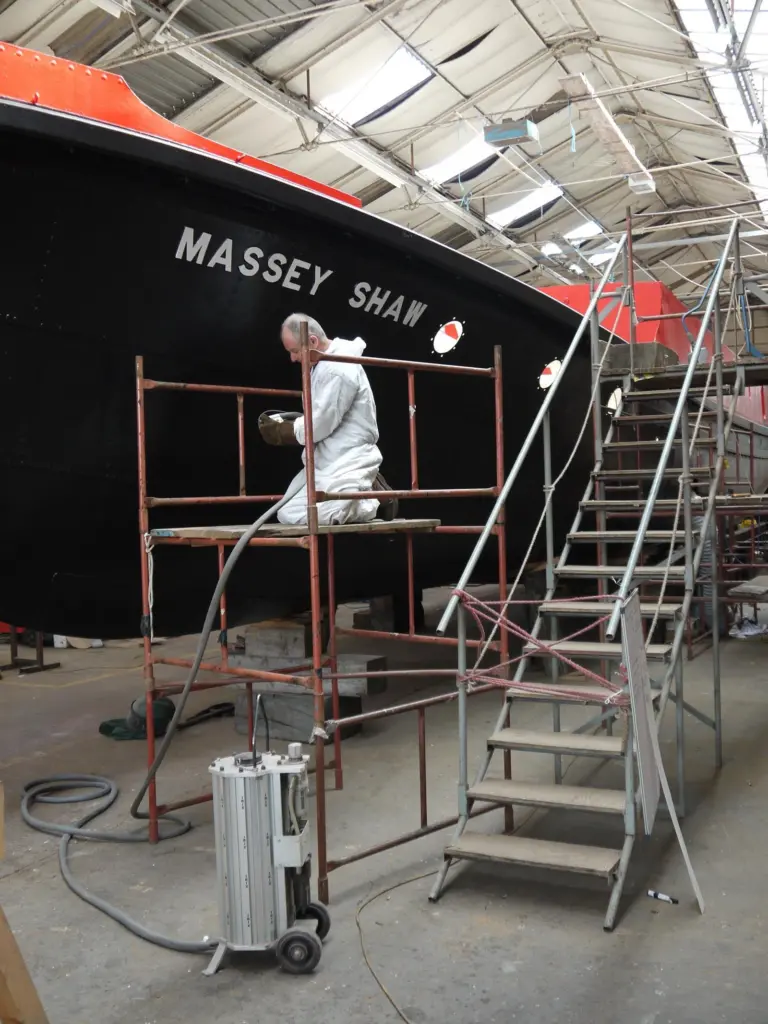
One of the major projects being undertaken by T Nielsen and Co is the restoration of the Massey Shaw, a former London Fire Brigade fireboat built in 1935 that also took part in the Dunkirk evacuation in 1940. The restoration is partly funded by the Heritage Lottery Fund, which applies strict rules to any project it supports.
The boat has required complete restoration, including replacing corroded sections of the steel hull and refurbishment of most other features. A significant part of the project has involved cleaning and preparing components and surfaces for painting. In order to achieve maximum flexibility for this work and avoid the need for external subcontractors, the company decided to invest in an IBIX 25 H2O dry or wet abrasive blast machine from Hodge Clemco, which is specifically designed for heritage restoration and other delicate surface treatment work.
Because of its compact size and light weight, the machine can be easily moved into confined spaces and onto work platforms by a single operator. Air pressure can also be adjusted easily by the operator from 0.2 to 7 bar to control abrasive output. The nozzle is a comfortable pistol style component with safety button.
For the Massey Shaw project the abrasives used are 80-mesh garnet and bi-carbonate of soda, but other abrasives are compatible. The IBIX H2O model used by T Nielsen and Co also allows low pressure wet blasting using atomised water mixed with abrasive directly at the nozzle, which is ideal for work on particularly delicate surfaces and also minimises dust.