![MaritimeJournal[Seawork]](https://www.maritimejournal.com/wp-content/uploads/2026/09/MaritimeJournalSeawork.svg)





Bullet proof boats make longlife friends
‘ These CSBs must be one of the most tough and versatile small workboat that has ever been built,’ Brian Clarke of Commercial Boat Services told MJ. ‘ They’ re not quite bullet proof, but they have been designed to be strafed by machine guns without sinking.’
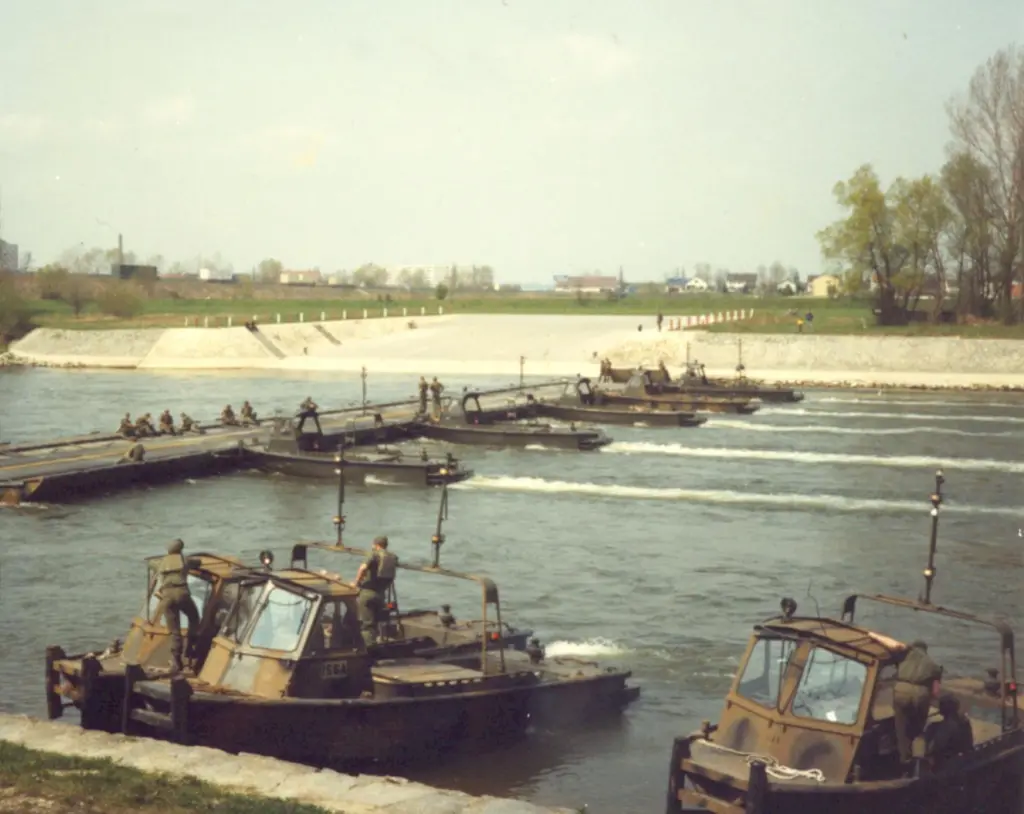
Not many design specs are that rugged and Commercial still finds a lively market for these aluminium Combat Service Boats. Originally built by Fairey Marine on the UK’s south coast for the British army around thirty years ago, the construction that made them the army’s choice for bridging manoeuvres and assault duties has also earned the craft considerable respect as tough, adaptable workboats. Denis Langridge, who still supports the CSBs through Premier Marine Spares, explained that the US and UK army knew it wanted a well tried design. FBM Marine on the Isle of Wight developed the craft based on the original Allday Aluminium 8m hull, featuring a pusher bow and an aft mounted capstan, tow hook and diving platform.
But obviously the CSBs, also known as BEBs in the US, had to be both adaptable to low profile operations and easy to transport on purpose made launching trailers across difficult terrain. So the boats were designed with a removable mast and cabin top.
The two self draining cockpits were each designed to accommodate a standard 1,000kg NATO pallet, with Dowty (now Ultra Dynamics) waterjets and twin 210hp turbocharged marine diesels providing the power. This is another plus in a commercial marine setting where the waters may be as challenging as for the craft which ended up on Nigerian cable-laying duties.
Brian Clarke explained that the vessels’ extremely shallow draft, a mere 0.7m, and waterjet propulsion means that the boats can be deployed in challenging environments such as shallow waters and those littered with flotsam.
‘What’s more, they can cope with fast moving water, and give the confidence of two engines rather than one, he added. ‘You can push and tow with them, and besides power, they have got a good turn of speed, doing 22 knots unladen and still manage to be reasonably economical.’
Other kinds of security have been built in. The boat features a number of redundant systems such as the battery and fuel lines. If something goes wrong away from shore, all the operator needs to do is flip a switch. Maintenance has been kept simple, and things like lifting the engine out putting another one in is only a four hour job.
The ex-military boats have been distributed far and wide. Rossaveel Harbour in County Galway.and Castletown Bere in County Cork, Ireland, are using them for general harbour duties and the craft’s stability, open design and lack of propellers make them very useful as diving support vessels.
The British Antarctic Survey still has a CSB on board the exploration vessel James Clark Ross. Denis Langridge keeps an eye on it, supplying parts for the boat once a year when the James Clark Ross comes in for servicing.