![MaritimeJournal[Seawork]](https://www.maritimejournal.com/wp-content/uploads/2026/09/MaritimeJournalSeawork.svg)

Clarissa fulfils dreams of both builder and owner
Following on from the success of Triton, Wey Chieftain 4 and Rapid Fisher, Portchester UK based BWSeaCat Ltd has made a bold move into the commercial fishing boat market with the first of its S.P.E.E.D. catamarans built to suit the under 10m fishing license.
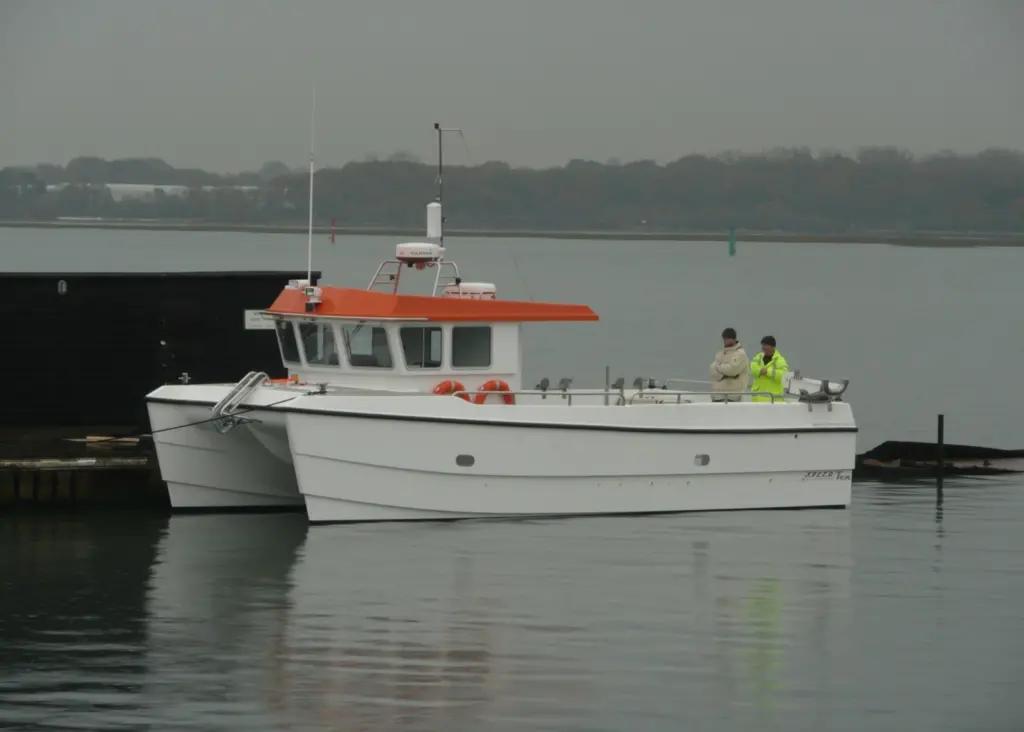
Clarissa has been built for Ken Turner of Plymouth, who has recently taken early retirement and was looking to open a new chapter in his life by venturing into commercial fishing for ‘line caught’ species.
Ken first found BWSeaCat by searching for potential vessel builders online and quickly arranged a sea trial onboard the company’s own demonstrator after seeing videos of the vessel on YouTube.
S.P.E.E.D. is an acronym for Small Power Extended Efficiency Displacement. The hull shape is, broadly speaking, that of a traditional displacement vessel but exhibits no ‘rocker’ or curve fore and aft along the keel line, which is therefore essentially straight. The round bilge forward sections of the hull give way at around midships to a very much squarer cross section, resulting in an almost flat bottom aft. The fine entry round bilge bows therefore slice through the waves rather than riding over them and the flat aft sections resist the hull’s urge to squat as traditional displacement speed (8 to 10 knots) is exceeded.
The effective lift in the forward sections created by a small chine acts in conjunction with the lift created by the flat aft sections to support a proportion of the vessel weight, although not to a fully planing state. This means that there is a small reduction in wetted surface area at speed which can allow the hull to run at 30 knots or more with correct powering.
Of more importance to most skippers however is the hulls ability to return exceptional fuel efficiency in the 12 to 20 knot speed range, where most boats are likely to spend most of their time. This is due to the hull being a displacement shape rather than planing one. There is therefore no need for any ‘resistance hump’ (the point at which a planing hull rises out of the water) to be overcome.
This results in far less power being needed to achieve and maintain sensible cruising speeds, with the resultant reduction in fuel throughput and therefore cost to the skipper.
On leaving Portsmouth Harbour entrance in the BWSeacat demonstrator, Ken Turner experienced the result of these design considerations for himself. Turning to head straight into a gusty force 6, he braced himself for the inevitable pitch and slam, which never happened.
He said, ‘I had no real idea what to expect from this new breed of power catamaran. I have many years experience aboard monohull boats of all kinds and have heard stories both good and bad about catamarans and their pitfalls. It was therefore with some trepidation that I watched the seas mount up near the harbour exit and I braced myself for the inevitable.
‘However, what happened next basically took my breath away. The skipper simply pointed us straight into what can only be described as a vicious, short, steep, breaking sea and nailed the throttles. We hit 29 knots in a matter of seconds and rather than pitching up and down and being thrown about, we just seemed to glide over the top of the sea. It took a while to get used to, but all I can say is that I have never experienced anything like that in any other vessel. When I took over the helm, I tried all speeds and all angles to the sea, but I just couldn’t fault her. Quite simply I was astonished.’
The demonstrator vessel was different from the vessel Ken Turner has had built in that it was powered by a pair of 175hp four stroke Suzuki outboards. This vessel was built by the company purely to demonstrate the hull’s ability at sea, in the full knowledge that most customers would prefer diesel inboards. BWSeaCat is keen to point out that its hull is one of the only catamaran hulls produced in the UK that can run just as effectively with outboards as inboards, meaning that skippers with lower budgets can still get to sea.
Clarissa has been built at 10m in length and features twin 115hp Nanni diesel inboard engines supplied by A.R. Peachments and driving three bladed propellers through 2:1 ratio Tuff Torq gearboxes. Coupled with a full Clements Engineering stern gear package, the vessel achieves sprint speeds of around 20 knots, with frugal cruising at 15 knots.
The on-deck layout is uncluttered and features a 2.5m by 2.5m forward wheelhouse within which is squeezed seating for two, a large dash area and a galley with microwave, sink and ample storage. There is also a heads compartment accessed from on deck. Toughened laminated windows supplied by Technautic Marine Windows along with their aluminium framed doors complete the sturdy purposeful look, with a high visibility orange roof making the vessel unmistakeable. Access to the forepeak area is gained from within the wheelhouse to provide extra storage.
The working gear is supplied by Fairwater Fishing and comprises six ‘jigging machines’ which are gunwale mounted and act like mechanical fishing rods. The fish when caught can then be wound in and stripped from the hooks by fish strippers provided by AFW Fabrications before finding their way into the custom made under-deck insulated fish rooms.
These machines require a fair amount of power so high capacity Rolls batteries of 230Ah each, supplied by Bardens, are fitted alongside the vessel starting batteries to cope with the demand. Ken Turner has also chosen to use the innovative intercalated generator supplied by A.R. Peachments, which simply fits in line between the main port engine and its gearbox. This device, rated at 4.5kW, provides 300 amps at 12 Volt for a weight of only 30kg, and with a thickness of only 125mm is easy to accommodate in even the tightest machinery space.
Clarissa represents a move into a brand new market for BWSeaCat. MD Iain Worrallo explained, ‘Fishing boats are where it all started for me ten years ago and where I got the initial inspiration to build power catamarans.
‘I used to work in a commercial repair yard in Cornwall and the boats we maintained were often quite old and the majority of them had been converted many times over the years for different uses. Cluttered decks, raised engine hatches and old engines and gear made for quite an unsafe working environment for these guys, especially when you consider the sea conditions they can be working in.
‘The problem was one of deck space, or rather lack of it, and the only way to gain more was to buy a bigger boat. Unfortunately this required a bigger, more expensive license which most skippers could not afford.
‘It became obvious to me, having looked at the way the fishing licensing works, that the answer was to go wider, not longer, and that idea lent itself perfectly to the catamaran hull form, which was where I started from. With Kens boat, I feel we are now at the point where I wanted to be all those years ago.’
Upon completion of Clarissa, the BWSeaCat team is turning its efforts towards a new vessel for Dave Gibson of Weymouth. Dave Gibson is a director of the Professional Boatmen’s Association and will use his 11m cat for charter work and also photography during the forthcoming 2012 Olympics.