![MaritimeJournal[Seawork]](https://www.maritimejournal.com/wp-content/uploads/2026/09/MaritimeJournalSeawork.svg)


Clever Sea Weasel burrows into wind farm world
Exeter UK based Lyme Boats has come a long way over the last two years, delivering a series of GRP pilot boats whilst also developing its aluminium workboat range.
The latter came to full fruition again last month with an open day at Dartmouth to celebrate the handing over of
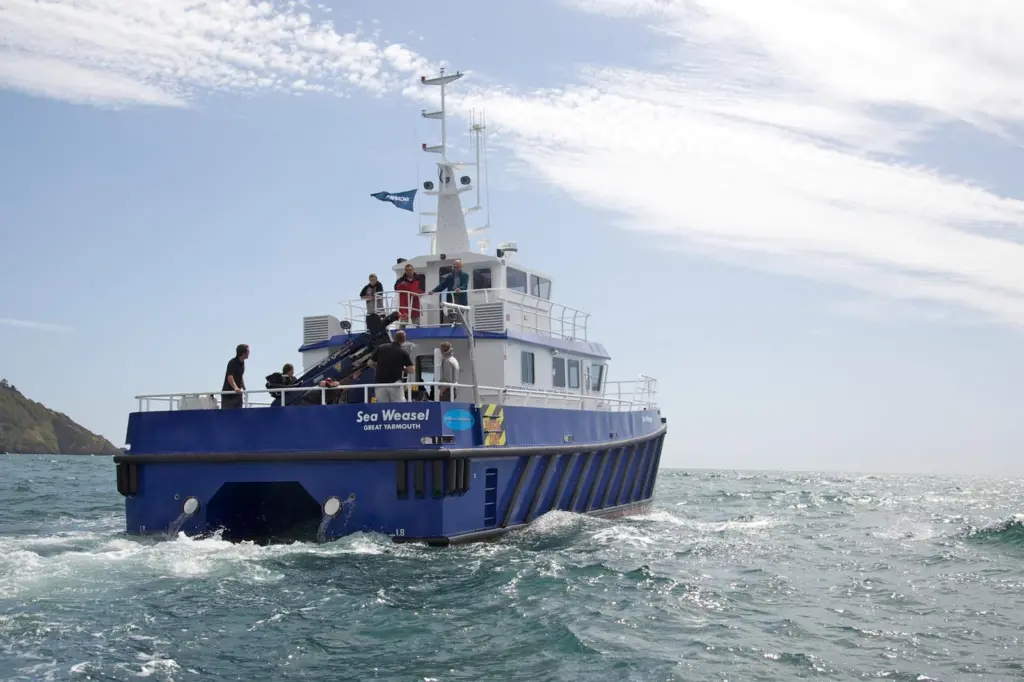
Sea Weasel
, a 16m aluminium wind farm support catamaran for Great Yarmouth based Enviroserve, which provides specialist services for marine scientists and engineers, with an emphasis on offshore wind farm projects.
Sea Weasel is the third vessel to be built in aluminium to Lyme Boat’s 16m Vigilante Workboats design. The high speed catamaran features a deep ‘V’ hull with spray chines and tunnels designed to increase vessel efficiency in terms of performance, manoeuvrability, stability and fuel consumption. The Vigilante Catamaran provides a stable platform for a variety of offshore activities, including wind farm crew transfer and support, surveying, diving support or serving as a passenger ferry.
Lyme Boats is in fact currently building a first of class 22.5m aluminium monohull ferry crew boat for Inchscape Shipping Services which will be deployed to Dubai. Due in November, it will be built to full Lloyds Register Special Service Craft Classification. Welding staff are all coded to Lloyds Register Approval.
Sea Weasel is powered by twin DI16 42M Scania marine diesels rated at 750hp each, which will take the vessel to speeds in the 24-25 knot range driving fixed pitch five blade propellers in a ‘V’ drive configuration. Also available in an 18m version, the vessel has a beam of 6.4m, a draft aft of 1.6m, and is equipped to carry two crew and 12 passengers.
Each hull is sub-divided into three watertight compartments; engine room, accommodation and forepeak, plus a forward collision bulkhead. High density foam insulation is applied to aluminium walls and ceilings in all main accommodation and cabin areas for both thermal and acoustic benefit.
The vessel is built under survey by the Sea Fish Industry Authority (SFIA) to SCV2 and MCA Code of Practice Category 2, allowing 60 miles from safe haven.
The raised bridgedeck is accessed by an internal staircase from the main passenger wheelhouse and features a central helm position, with bench seating for the crew. A comprehensive navigation and communications package is supplied by SMG. The wheelhouse itself provides seating for the 12 passengers in individual sprung seats with seat belts, head rests and arm rests. The seats are mounted on GRP boxes with stainless steel foot rests and storage for equipment. There are two standard berths and a forward storage area in each cabin, as Sea Weasel’s crew can be at sea for up to 12 days, working 24/7 in wind farm support operations.
On the aft deck is a Palfinger PK4501 M deck crane with an SO.9S hydraulic winch. The crane will be used to transfer a variety of stores to larger craft, which can range from split cast iron bend restrictors to control undersea cabling to pallets of bottled water. The bow is designed to optimise the safe transfer of engineers onto wind turbines.
Sea Weasel’s operator, Paul Lines of Enviroserve, started a transition from commercial fisherman to wind farm support services with a 29’Napier he converted into a vessel for transferring technicians and equipment to offshore structures, starting off in support of a DP cable laying ship at Great Gabbard and moving on to the Thanet wind farm. Other related works undertaken include guarding the Thanet wind farm from errant vessels and serving as a hydro survey craft at prospective wind farm sites.
Enviroserve has grown quickly, with Sea Weasel becoming the fourth vessel in the company’s fleet. It is the first bespoke wind farm support vessel as the others are all converted monohulls formerly engaged in fisheries and diving works.
Paul Lines will add more catamarans to his fleet and has a second 16m Vigilante Workboat currently under build and due in January. He believes the catamaran design provides a more stable platform and thus greater comfort for the engineers being transferred, who are not necessarily natural seafarers.
His company now employs 20 staff, mostly former fishermen. Paul Lines told MJ, ‘Fishermen are very well adapted to keeping things running and looking after boats’. As his former industry declines, he is finding no shortage of qualified personnel to follow him into the emerging wind farm support industry. He is also keeping an eye on developments in what are the relatively early days of the wave and tidal energy industries.
‘We are in the right place at the right time, Lines continued. ‘It is brilliant to be in an industry that is just developing.’