![MaritimeJournal[Seawork]](https://www.maritimejournal.com/wp-content/uploads/2026/09/MaritimeJournalSeawork.svg)



Flexible Meercat can move its own wheelhouse
The latest and largest Meercat was launched last month at Portchester UK before being transported to its new workplace in Dammam, Saudi Arabia, where it will be used for servicing offshore navigation aids and for dredging support.
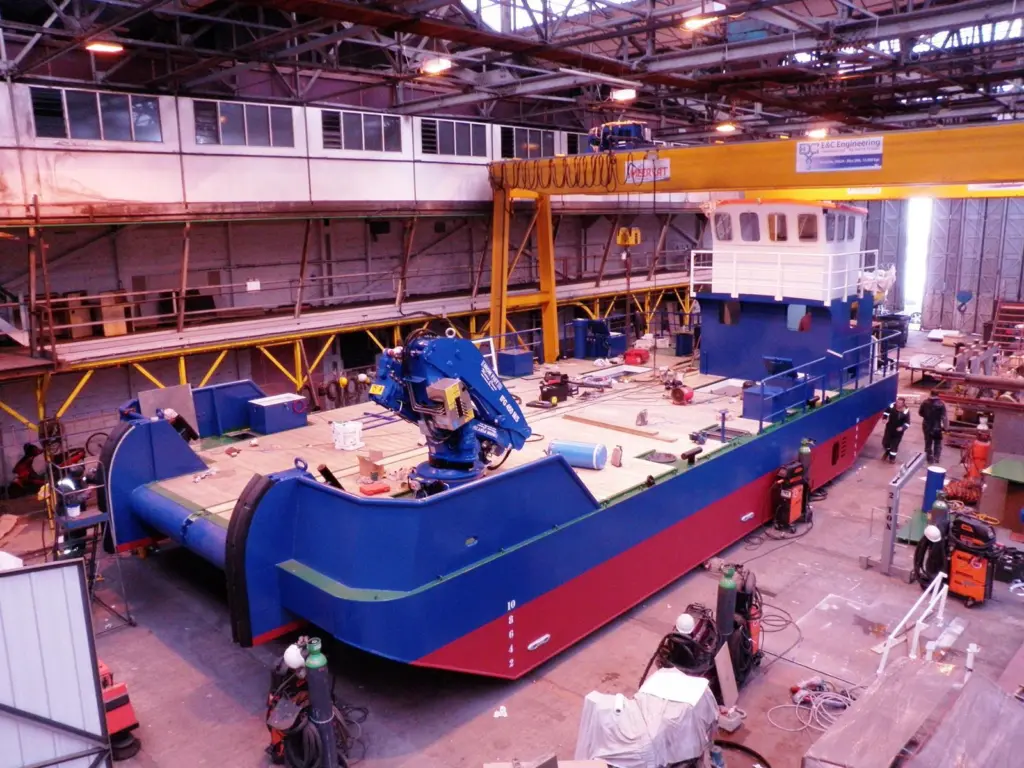
Murjan Al-Sharq Marine Services was looking for a “very sturdy multipurpose workboat” after being awarded a major offshore buoy servicing contract, and became interested in the Meercat’s flexibility. Peter Smith of Meercat Workboats explains: “This Meercat is the largest we’ve built at 18m by 8m and there have been considerable design developments giving a bigger payload and dryer decks, and of course, Murjan’s requirements meant the design had to evolve still further.”
One notable feature that has been retained, despite its size, is that like other Meercats, it can be transported by road.
This characteristic has resulted in a rather unusual capability, it can remove and replace its own wheelhouse. Peter Smith explained that the Meercat’s sturdy onboard crane, provided by Italian manufacturer Iron Fist, is a 450-5, 40t/m marine model that along with its many other jobs can also be used to lift the wheelhouse and place it on its own deck, after which it is easily lashed down. “The effect can be disconcerting as it’s rather like someone being able to take off their own head,” he says.
However unusual it sounds, this gives the vessel the low air draught needed to get under bridges while on the back of a trailer.
The Meercat is of a very rugged construction, based on a 8mm steel plate hull with wood sheathing on a deck which has a capability of carrying 60 tonnes with a loading of 6.5 tonnes per square metre. The 18m length overall gives a clear deck with an end to end measurement of 17.5m. The vessel also has a 13.6 tonne capacity of potable water, 20,000 litres of fuel cargo with transfer capability and it also has room for around 110 sq m of containerised cargo, all of which makes it a welcome addition to the new owner’s fleet.
“However, despite all this it really retains a very shallow draught. The vessel has a moulded depth of 1.75m but even with a full load it will only draw 1.1m of water,” says Mr Smith.
He goes on to say that under light ship conditions it has a draught of just 800mm. “This is very useful not just because of the low air-draft when going by road, but, also because a lot of the client’s work is in shallow water, and this particular model can be used to get in very close to the shore for activities such as repairs on the beached end of windfarm cabling and oil pipelines”.
Powering the new vessel are twin Doosan L086 TIH engines. These are six cylinder inline four-stroke models with a rating output of 210kW (285 hp) and a displacement of 8,071cc. The engines (marine rated to ISO 3046) also benefit from direct-injection via a governor, mechanical RSV system and wet turbo charging with an inter-cooler.
Blokland Bottom Coolers were added in order that the vessel would be able to operate in the sea temperatures of 32°C often experienced around its home port of Ras Tanura. This type of cooler is mounted on the inside of the ship’s skin, making sure the unit remains flush to the bottom and sides of the vessel and so reducing the chances of any damage being done.
The pair of Doosan engines were ordered from WaterMota at the beginning of the year at the Southampton Boat Show. Mr Smith says that the order for these engines represents a total of 28 Doosan engines for Meercats thus far, with WaterMota being the preferred supplier. “It’s a very robust, very simple engine which is exactly what our commercial contractors are after.”
There is also an onboard 21kVa, 400V three phase Beta Kubota Marine BV2203 generator which has a proprietary vortex combustion system and obtains an optimum air/fuel mixture by generating three swirling air flows within the spherical combustion chamber.
Along with the crane, there is a winch from another Italian company, Dinamic Oil. This is a hydraulic S60 model which has a capacity of some 25m of 18mm rope with a line pull of 7.750 tonnes on the first layer and with a speed of 40.5m per minute. It is supplemented by a bow roller and the winch wire can also be led aft for towing purposes.
Both the crane and winch controls are from Sweden’s Scanreco Remote Controls which are robust, simple to use and can be operated from anywhere on the vessel.
Mr Smith explains that during construction, it became increasingly clear that a vessel of this size required some overnight accommodation. Accordingly, the wheelhouse was lifted up a deck and a mess room/accommodation block constructed beneath it on the main deck. This had a small galley unit, two bunks, dinette and table and a WC/shower compartment. Both the mess room and wheelhouse are served with air conditioning.
The wheelhouse is large with good all round visibility and is equipped with a comprehensive electronics package. The steering system is hydraulic and supplied by Sleipner.
The vessel will have a dual role providing dredging support as well as servicing offshore navigation aids.
Technical Specification:
Length overall: 18m
Beam: 8m
Depth (moulded) 1.75m
Power: 2 Doosan L096 TIH rated 285 hp
Deck capacity: 60 tonnes